
Taxing the Invisible Transaction — TPTRP Foreign Entity Sales Tax Framework
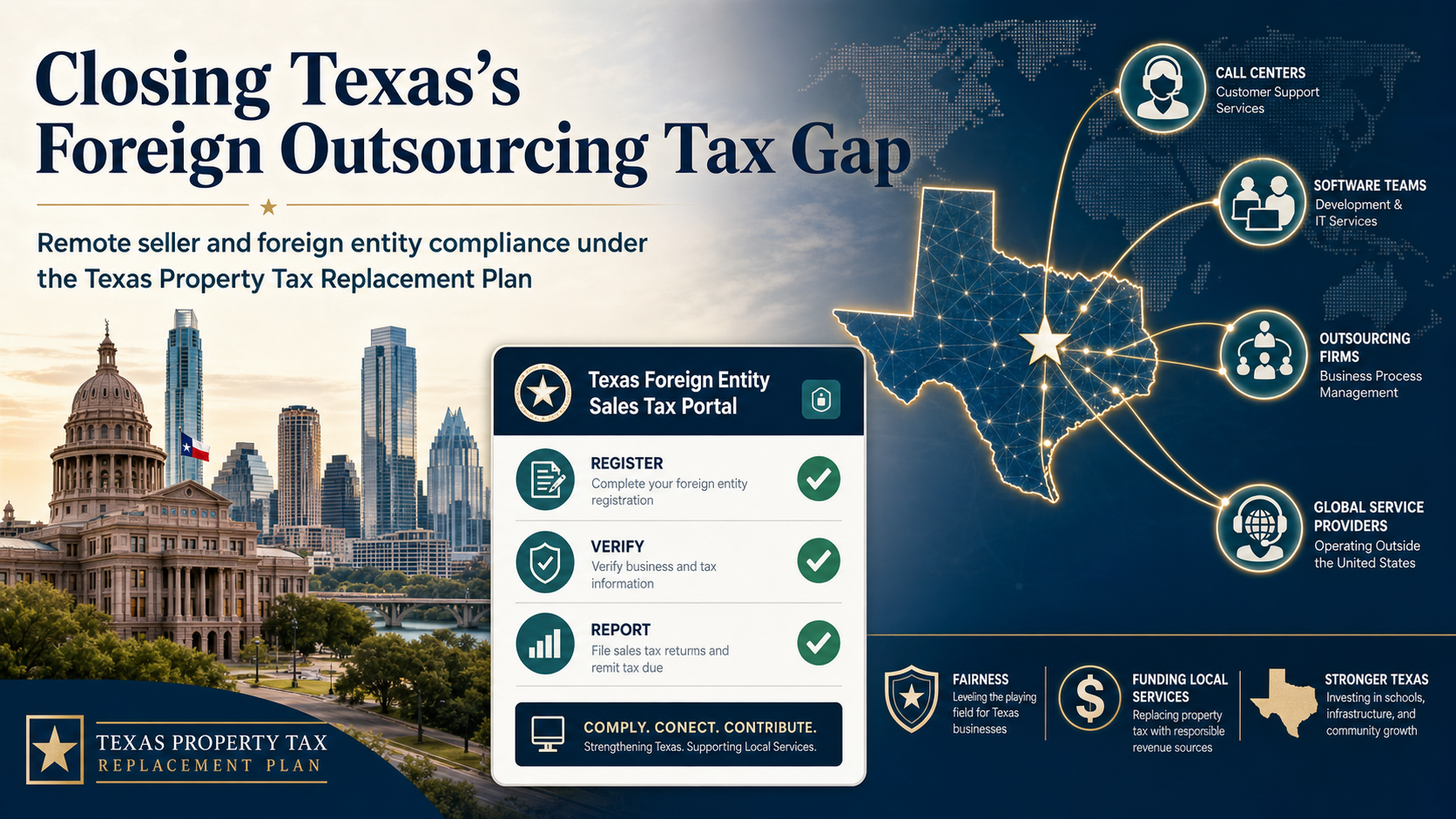
Rep. Will Campbell · House District 109 · June 23, 2026 · Texas Property Tax Replacement Plan — Working Paper
Taxing the Invisible Transaction — TPTRP Foreign Entity Sales Tax Framework
How the Texas Property Tax Replacement Plan will capture sales tax from foreign and out-of-state businesses — and why it is constitutionally sound, legally proven, and essential to a fair and complete Texas tax base.
The Invisible Gap in Texas’s Tax Base
Why foreign and out-of-state service providers represent the largest uncaptured commercial transaction category in Texas today — and why fixing it matters
Every day, Texas businesses write checks and wire payments to companies that will never set foot in this state. The call center in the Philippines handling your company’s customer support. The software development team in Bangalore building your enterprise application. The accounting firm in New York processing your accounts payable. The HR outsourcing company in Dublin managing your benefits enrollment. These are real commercial transactions — real money flowing from Texas businesses to service providers — and under the current system, not a dollar of Texas sales tax is collected on any of them.
The Texas Property Tax Replacement Plan (TPTRP) is built on a foundational principle: every commercial transaction that occurs in Texas should be part of the tax base. When a Texas business purchases a service, whether from a company down the street in Cedar Hill or from a vendor in Chennai, that transaction is occurring in Texas. The service is being consumed here, it benefits an operation here, and it is part of the economic activity that Texas’s infrastructure, legal system, and commercial environment makes possible. The current system taxes the Cedar Hill vendor and ignores the Chennai vendor. That is not a level playing field, and it is not a complete tax base.
The Core Inequity
Texas-based service providers collect and remit sales tax on every taxable transaction they deliver to Texas customers. Foreign competitors delivering identical services to the same Texas customers pay nothing — creating both a revenue gap and a structural competitive disadvantage for Texas businesses relative to foreign providers who bear no equivalent tax burden.
This article explains how the TPTRP will close that gap: the legal authority Texas already has, the constitutional framework that governs how this can be done, the international models that have proven it works at scale, and the specific legislation we will draft to implement it here. We also address the most immediate concern legislators and businesses raise: does requiring foreign companies to collect a Texas sales tax conflict with the federal government’s exclusive authority over import tariffs? The answer — grounded in settled Supreme Court precedent and the fundamental distinction between goods and services — is no.
This is not a new idea or an untested legal strategy. More than 110 countries around the world already require foreign service providers to register and collect a consumption tax when they sell services to customers within their borders. The European Union perfected the administrative mechanism for doing this more than a decade ago. The U.S. Supreme Court cleared the legal path for states in 2018 with South Dakota v. Wayfair, Inc. The only question remaining is whether Texas will act.
The Three Groups This Covers
The TPTRP foreign entity framework applies equally to three overlapping groups, all subject to the same rules:
- Foreign businesses (non-U.S. companies) providing services to Texas customers from locations outside the United States — IT outsourcing firms, BPO providers, call centers, software developers, data processors, and professional service firms domiciled in any foreign country.
- Out-of-state U.S. companies in other states providing taxable services to Texas customers remotely — the same economic nexus standard that already applies to remote goods sellers applies equally to remote service sellers.
- Digital platform intermediaries that facilitate connections between Texas businesses and foreign or out-of-state service providers — these platforms will be treated as marketplace facilitators and required to collect and remit on behalf of their vendors, capturing the long tail of providers who fall individually below the $100,000 TPTRP threshold.
Why Current Enforcement Is Inadequate
Texas already has a theoretical mechanism for addressing this gap: the use tax. When a seller fails to collect Texas sales tax, the Texas buyer is legally obligated to self-assess and remit use tax to the Comptroller. In practice, this mechanism is chronically undercollected for B2B transactions involving foreign service providers. Most Texas businesses are unaware of the obligation, and the Comptroller has no systematic way to identify and audit payments to foreign vendors who have not registered. The TPTRP replaces this passive backstop with a three-wall enforcement structure. The first wall requires the foreign or out-of-state seller to register and collect — or be legally barred from operating in the Texas market. The second wall prohibits any Texas business from transacting with an unregistered foreign or out-of-state seller when tax should be collected, attaching civil and criminal liability directly to the Texas buyer who knowingly circumvents that requirement. The third wall makes registration status publicly visible through a searchable Comptroller registry so any Texas buyer can verify compliance before transacting. Together these three mechanisms close the gap that the use tax alone cannot close.
For Foreign Businesses Reading This
If your company provides services to Texas businesses or consumers and your annual Texas revenue exceeds $500,000 under current Texas law (or will exceed the $100,000/200-transaction economic nexus threshold under the completed Act once enacted), you are required to obtain both a Secretary of State registration (SOS Authorization) and a Comptroller Texas Tax Registration Certificate through the coordinated Portal filing process, and to collect Texas sales tax on taxable services. The completed Act expands the taxable service categories and operates a Foreign Entity module inside the unified Texas Sales and Use Tax Portal, designed specifically for entities operating outside the U.S. Early voluntary compliance protects you from historical back-tax liability — and note that the statute of limitations does not begin to run for an entity that has never registered, so delay does not reduce your exposure; it runs from the missed filing period only for an entity that registered but failed to file. A Voluntary Disclosure Program is available to make this transition orderly and cost-effective. Under the completed Act, self-assessed use tax is not a substitute for verifying your registration status, and a Texas business that knowingly continues to transact with an unregistered foreign vendor faces civil and criminal consequences, which means your Texas customers will have their own legal incentive to require your compliance before continuing to work with you.
The Legal Authority Texas Already Has
South Dakota v. Wayfair, economic nexus, and why foreign entities are not exempt from Texas sales tax
Before discussing what new legislation the TPTRP needs to enact, it is important to understand what Texas law already says — because the foundation for taxing foreign and out-of-state service providers is far more solid than most people realize. The Supreme Court settled the core legal question in 2018, and Texas has been operating under the resulting framework since 2019.
The Old Rule and Why It Failed
For decades, states were prohibited from requiring companies to collect sales tax unless those companies had a physical presence in the state — an office, a warehouse, employees on the ground. That rule originated in the 1967 Supreme Court case National Bellas Hess v. Dep’t of Revenue of Illinois and was reaffirmed in 1992’s Quill Corp. v. North Dakota. As the internet economy grew, this rule created a massive loophole: online retailers and service providers with no physical presence in a state could sell billions of dollars of goods and services to that state’s residents and businesses and collect no sales tax. The physical presence rule was designed for a brick-and-mortar world, and by 2018, it had become indefensible.
South Dakota v. Wayfair, Inc. (2018)
On June 21, 2018, the Supreme Court reversed course in a 5-4 decision in South Dakota v. Wayfair, Inc. The Court held that states can require remote sellers to collect and remit sales tax based solely on economic presence — the volume of sales into the state — regardless of whether the seller has any physical presence there. The Court found that the old physical presence rule was “unsound and incorrect” in the modern digital economy and overruled both Quill and National Bellas Hess.
“The physical presence rule is not a necessary interpretation of the requirement that a state tax must be applied to an activity with a substantial nexus with the taxing State. Quill’s physical presence rule is unsound and incorrect.”Justice Kennedy, South Dakota v. Wayfair, Inc., 585 U.S. ___ (2018)
The Wayfair decision did not create a new legal right for states to tax out-of-state sellers. It removed an artificial judge-made barrier that had prevented states from enforcing a tax obligation that had existed on paper for decades. The fundamental principle — that commercial activity occurring in Texas generates a Texas tax obligation — was always correct. Wayfair simply restored the ability to enforce it against remote sellers.
Texas’s Economic Nexus Standard
Under current Texas law, economic nexus took effect in 2019 and uses a $500,000 receipts-only threshold with no separate transaction-count trigger. That is the current baseline remote-seller rule. Under the completed TPTRP constitutional amendment (Article VIII, Section 1-q) and the completed Act, that standard is changed to a $100,000 Texas-receipts or 200 separate-transaction economic nexus floor — either threshold is independently sufficient to establish substantial nexus — so that out-of-state and foreign sellers with meaningful Texas market activity are brought into the collection obligation earlier and more consistently with the post-Wayfair approach used in many states. The constitutional amendment fixes both thresholds as a floor: the Legislature may lower either by general law but may not raise either above $100,000 or 200 transactions without a further constitutional amendment approved by Texas voters.
Texas Economic Nexus vs. Selected States
Dollar and transaction thresholds that trigger mandatory sales tax collection for remote sellers — domestic or foreign
| State | Dollar Threshold | Transaction Threshold | Effective Date |
|---|---|---|---|
| Texas | $500,000 | None (dollar-only) | Oct. 1, 2019 |
| South Dakota (Wayfair plaintiff) | $100,000 | 200 transactions | Jan. 1, 2019 |
| California | $500,000 | None | Apr. 1, 2019 |
| New York | $500,000 | 100 transactions | Jun. 21, 2018 |
| Florida | $100,000 | None | Jul. 1, 2021 |
| Washington | $100,000 | None | Oct. 1, 2018 |
| TPTRP (all commercial services) | $100,000 | 200 transactions (either threshold triggers nexus) | Upon enactment |
Foreign Entities Are Not Exempt
The point that surprises many people — and that is important to establish clearly for foreign businesses reading this — is that the Wayfair economic nexus framework applies equally to foreign (non-U.S.) companies. The Texas Comptroller’s economic nexus rules contain no foreign company exemption. Non-resident suppliers of services are required to collect and remit sales tax in the same manner as U.S.-based counterparts once they exceed the applicable threshold — $500,000 under current Texas law, or $100,000 in Texas receipts or 200 separate transactions under the completed TPTRP framework.
And for foreign entities that believe they are shielded by international tax agreements: federal income tax treaties between the United States and foreign countries do not apply to state sales taxes. States are not parties to these treaties. Even if a foreign company is completely exempt from U.S. federal income tax under a treaty because it lacks a “permanent establishment” in the United States, it is still fully subject to Texas sales and use tax — under current Texas law once it meets the $500,000 threshold, and under the completed TPTRP framework once it exceeds $100,000 in Texas receipts or engages in 200 or more separate Texas transactions. These are two entirely separate legal regimes, and treaty protections from one do not carry over to the other. Multiple national accounting firms specializing in U.S. state tax compliance have confirmed this point explicitly.
For Legislators: The Key Point on Legal Authority
Texas does not need new constitutional authority or novel legal theory to tax foreign entities doing business here. That authority already exists under Wayfair and Texas’s implemented economic nexus rules. What the TPTRP needs is: (1) legislative expansion of the taxable services base to cover all commercial service transactions; and (2) a simplified registration and remittance mechanism that makes compliance practical for entities operating outside the United States. The legislation we draft in this article accomplishes both.
The Constitutional Framework
Complete Auto Transit, the Foreign Commerce Clause, the Import-Export Clause, and the Due Process Clause — what the Constitution actually requires for the TPTRP to be legally sound
Any state tax on commerce must satisfy constitutional requirements. For the TPTRP’s foreign entity collection mechanism, three constitutional provisions are relevant: the Commerce Clause (including its foreign commerce dimensions), the Import-Export Clause, and the Due Process Clause. All three have been extensively litigated, and the law is settled and favorable to what the TPTRP proposes — provided the legislation is designed correctly. This section explains the specific requirements and how the TPTRP satisfies each.
The Complete Auto Transit Four-Prong Test
Since 1977, the Supreme Court has applied a four-part test from Complete Auto Transit, Inc. v. Brady (430 U.S. 274) to evaluate whether a state tax on commerce is constitutional under the Commerce Clause. Every state tax on interstate or international commerce must satisfy all four prongs:
The Complete Auto Transit Test — Applied to the TPTRP Foreign Entity Mechanism
All state taxes on interstate or international commerce must satisfy each prong; foreign commerce adds two additional requirements
| Prong | Constitutional Requirement | How the TPTRP Satisfies It |
|---|---|---|
| 1 — Substantial Nexus | Tax must apply to activity with a substantial connection to the taxing state | $500,000 in Texas revenue establishes clear economic nexus under current law as confirmed by Wayfair (2018); the completed constitutional amendment (Art. VIII, Sec. 1-q) sets the TPTRP nexus floor at $100,000 in Texas receipts or 200 separate transactions |
| 2 — Fair Apportionment | Tax must be fairly apportioned to prevent double taxation across jurisdictions | Only the portion of a service used in Texas is taxable; multi-state allocation rules codified in legislation |
| 3 — Non-Discrimination | Tax must not discriminate against interstate or foreign commerce | Identical rate and rules apply to all sellers regardless of state or country of origin; no discriminatory surcharge |
| 4 — Fair Relation to State Services | Tax must fairly relate to services the state provides to the taxpayer | Texas market access, legal system, infrastructure, and commercial ecosystem directly benefit all sellers doing business here |
| 5 — No Enhanced Multiple Taxation Risk* | Must not create greater double taxation risk for foreign entities than for domestic ones | Apportionment rules and inter-jurisdictional credit provisions prevent unconstitutional double taxation |
| 6 — Federal “One Voice” Doctrine* | Must not prevent the federal government from speaking with one voice in regulating foreign commercial relations | Universal, non-discriminatory application; no country-specific targeting; treaty monitoring provision in legislation |
The Import-Export Clause: Why It Does Not Apply to Services
The single most common objection raised to requiring foreign service providers to collect a Texas sales tax is the Import-Export Clause of the U.S. Constitution (Article I, Section 10, Clause 2). The Clause prohibits states from imposing taxes on imports and exports — a power reserved exclusively to the federal government and exercised through the customs and tariff system. This is a legitimate constitutional provision to take seriously. And it has a clear, legally settled answer.
The Critical Distinction: Goods vs. Services
The Import-Export Clause has been consistently interpreted by the Supreme Court — beginning with Woodruff v. Parham (1869) and followed through modern case law — to apply only to goods (tangible personal property) imported from or exported to foreign countries. It does not extend to services. Since the outsourcing transactions at issue in the TPTRP — IT services, data processing, call center operations, BPO, consulting, staffing, professional services — are all services, not imported goods, the Import-Export Clause creates no constitutional barrier whatsoever. Cornell Law School’s constitutional analysis and the Library of Congress’s Congressional Research Service both confirm this interpretation.
When Texas requires a software development firm in India to collect and remit Texas sales tax on development services delivered to a Texas client, Texas is not imposing an import tariff on imported goods. It is applying a consumption tax to a commercial service transaction that was consumed in Texas. The federal government’s exclusive customs and tariff authority — which applies to goods crossing the U.S. border — is completely untouched. These are different types of transactions subject to different constitutional frameworks, and the distinction is clear and settled in the law.
The “Speaks With One Voice” Doctrine
The second Foreign Commerce Clause consideration — and the most legally nuanced — is the principle that state actions must not interfere with the federal government’s capacity to manage foreign commercial relations. This “speaks with one voice” doctrine could theoretically be invoked against a Texas law that targeted foreign service providers specifically or treated them differently from domestic providers.
The Supreme Court’s 1994 decision in Barclays Bank PLC v. Franchise Tax Board of California is directly controlling here. The Court held that a state tax does not violate the “speaks with one voice” doctrine absent an actual congressional directive prohibiting the state action. Executive branch objections, foreign government complaints, and diplomatic discomfort are not enough — Congress must act affirmatively to preempt the state. A non-discriminatory, generally applicable sales tax on services delivered to Texas consumers — applied at the same rate as services from domestic Texas providers — does not impede federal foreign policy and is constitutionally sound under Barclays.
Constitutional Design Rule: Non-Discrimination Is Everything
The single most important design principle for the TPTRP foreign entity tax is that it must apply the same rate and the same rules to all remote sellers regardless of national origin. No country-specific treatment. No foreign surcharges. No different compliance requirements for entities from particular countries. Identical application of Texas’s universal sales tax to all commercial transactions in Texas, regardless of where the seller is located. This is the key to satisfying all six constitutional prongs. Any departure from this principle — even if politically motivated by concerns about specific countries — would create serious constitutional risk.
Due Process: Minimum Contacts
The Due Process Clause requires that a seller have “minimum contacts” with a state before that state can impose tax obligations. Post-Wayfair, $100,000 in annual Texas revenue or 200 separate Texas transactions under the TPTRP framework — representing a sustained, deliberate, and substantial commercial relationship with Texas customers — far exceeds any reasonable minimum contacts threshold. The due process consideration does not create a meaningful barrier for the TPTRP.
Texas Taxable Services: What’s In, What’s Missing
The current 17-category framework under Tax Code § 151.0101, the gaps in coverage for outsourcing transactions, and the legislative expansion the TPTRP requires
Texas Tax Code Section 151.0101 defines 17 broad categories of “taxable services” subject to the 6.25% state sales and use tax. Some of these categories already capture certain outsourcing transactions. Others leave the highest-volume outsourcing categories entirely outside the tax base. Understanding the current framework and its gaps is essential to drafting the TPTRP legislation correctly, because the foreign entity collection mechanism is only as effective as the taxable service base it operates on.
Texas Taxable Services — Outsourcing Relevance Assessment
Current taxability status of major outsourcing service categories under Texas Tax Code § 151.0101 (2025)
| Service Category | Outsourcing Relevance | Current TX Status | Common Foreign Outsourcing Examples |
|---|---|---|---|
| Data Processing Services | Very High | Taxable (80% of charge) | Payroll processing, data entry, cloud hosting, SaaS applications, accounts payable/receivable automation |
| Information Services | High | Taxable (80% of charge) | Database subscriptions, financial data services, research services, market intelligence, mailing lists |
| Telecommunications Services | High | Taxable (100%) | VoIP platforms, data transmission, business communications infrastructure |
| Credit Reporting Services | Moderate | Taxable (if debtor in TX) | Third-party credit bureau services, background checks |
| Debt Collection Services | Moderate | Taxable (if debtor in TX) | Offshore debt collection centers operating for Texas creditors |
| Security Services | Moderate | Taxable | Cybersecurity monitoring, digital forensic services |
| Insurance Services | Moderate | Taxable | Claims processing, actuarial analysis, underwriting support |
| Professional Services (legal, accounting, consulting, engineering) | Very High | NOT taxable | Law firms, CPA firms, management consulting, engineering, financial advisory — largest single outsourcing gap |
| IT Consulting & Staffing | Very High | NOT taxable | Technology consulting, IT staff augmentation, offshore development teams, application development services |
| Human Resources Outsourcing | High | NOT taxable | HR administration, recruiting, benefits management, PEO services, employee training |
| General Business Process Outsourcing (BPO) | Very High | NOT taxable | Call centers, back-office operations, supply chain management, customer service operations — the largest global outsourcing category |
The most significant pattern in this analysis is that the categories with the highest foreign outsourcing relevance — professional services, IT consulting, HR outsourcing, and general BPO — are precisely the ones not currently taxable under Texas law. This is not a coincidence. These exemptions are largely the product of decades of lobbying by professional associations and industry groups. The TPTRP’s fundamental commitment to no exemptions means all of these high-value, high-volume outsourcing categories will be brought into the tax base for the first time. That is where the foreign entity framework becomes most important, because these are also the service categories most heavily supplied by foreign providers.
Multi-State Apportionment: Services Used Both In and Outside Texas
A practical question for any multi-state or cross-border business: what happens when a service is consumed by a Texas business that operates in multiple states? The answer is already established in Texas law — only the portion of the service used in Texas is subject to Texas sales tax. For data processing services, if the service cannot be assigned to an identifiable segment of the client’s business, it is sourced to the client’s principal place of business.
The 2025 amendments to Texas Administrative Code Section 3.330 updated and clarified multi-state allocation rules for data processing services and added new definitions for bundled transactions. The TPTRP legislation will extend these apportionment principles to all newly taxable service categories, ensuring that foreign entities providing services consumed in multiple states are taxed only on the Texas-use portion — satisfying the fair apportionment prong of the Complete Auto Transit test and preventing unconstitutional double taxation.
Legislative Action Required: Services Base Expansion
Before the foreign entity collection mechanism has anything meaningful to collect, the TPTRP must first expand the taxable services base in Texas Tax Code § 151.0101 to include professional services, IT consulting and staffing, HR outsourcing, and general BPO. The foreign entity portal and registration system apply the tax; the services base expansion defines what is taxable. Both are essential, and both must be enacted together.
Global Precedents: How Other Jurisdictions Do This
The EU One Stop Shop, OECD international standards, the federal HIRE Act, and more than 110 countries that already collect tax from foreign service providers — the proof of concept is global
Texas does not need to invent a system from scratch. The challenge of collecting consumption taxes from foreign service providers has been solved — elegantly and at scale — by jurisdictions around the world. The leading model is the European Union’s One Stop Shop (OSS), which since 2021 has handled VAT collection from non-EU businesses across 27 member states through a single registration and filing portal. Understanding how these systems work is essential to designing the Texas Foreign Entity Sales Tax Portal correctly.
The EU One Stop Shop Non-Union Scheme: The Gold Standard
The EU’s Non-Union OSS Scheme is specifically designed for businesses established outside the EU that supply services to EU consumers. A foreign business registers once with a single EU member state — its “Member State of Identification” — collects VAT at the rate applicable in each customer’s country, files one consolidated quarterly return, and makes one payment. The Member State of Identification then distributes the revenue to the appropriate countries. The entire system is online, multi-lingual, and does not require the foreign business to establish a legal entity in any EU country.
This is exactly the model the TPTRP should adopt for Texas: a single Comptroller portal, destination-based collection at the Texas rate applicable to the customer’s location, quarterly consolidated filing, and single remittance. The EU OSS went live on July 1, 2021, and replaced the prior Mini One Stop Shop (MOSS) system that had operated for digital services since 2015. The EU’s experience demonstrates that this model works at scale, can be built and operated by a government tax authority, and is accepted by the international business community as a legitimate compliance obligation.
Global Models for Foreign Service Provider Tax Collection
Selected jurisdictions requiring foreign entities to register, collect, and remit consumption tax on services — with design features directly applicable to the TPTRP portal
| Jurisdiction | Rate | Mechanism | Filing | TX-Applicable Design Features |
|---|---|---|---|---|
| EU (27 states) | 15–27% (by country) | OSS Non-Union Scheme | Quarterly | Single registration in one country; automatic distribution to all customer states; covers all services; no local entity required |
| United Kingdom | 20% | Non-Union VAT Registration | Quarterly | Separate from EU post-Brexit; streamlined for non-UK businesses; online-only portal |
| Australia | 10% GST | Simplified GST Registration | Quarterly | Low compliance burden; streamlined online portal; no local entity required; covers digital services and some goods |
| Canada (fed.) | 5% GST | Simplified GST/HST | Annual | Federal simplified regime for non-residents; provincial rules vary |
| Singapore | 9% GST | Overseas Vendor Registration (OVR) | Quarterly | Covers B2B and B2C; platform operators required to collect on behalf of foreign sellers; robust enforcement |
| South Korea | 10% VAT | Foreign Simplified Registration | Quarterly | Electronic services focus; major platform operators register on behalf of foreign sellers; no threshold |
| New Zealand | 15% GST | Non-Resident Registration | Two-monthly | Covers remote services and low-value imported goods; streamlined online portal |
| Texas (TPTRP) | TPTRP Rate | TX Foreign Entity Sales Tax Portal | Quarterly | Single registration, destination-based by customer ZIP, online remittance, multilingual, no U.S. entity required, VDA program |
The OECD’s International Standards
The Organisation for Economic Co-operation and Development has published internationally recognized standards for how countries should impose consumption taxes on digital services provided by non-resident suppliers. The OECD’s VAT Digital Toolkit establishes the destination-based approach — tax is owed where the consumer is located — as the global standard. This aligns precisely with Texas’s existing destination-based sourcing rules for remote sellers.
The OECD specifically recommends: simplified registration regimes requiring no local entity registration; threshold-based collection obligations (parallel to Texas’s $500,000 standard under current law, and to the completed TPTRP’s $100,000/200-transaction floor); online portals with multilingual support and rate calculation tools; marketplace facilitator rules shifting collection responsibility to digital platforms; and reverse-charge mechanisms for B2B transactions. All of these design elements are directly incorporated into the TPTRP foreign entity portal specification in Section 6 below. Texas is not departing from international norms — it is aligning with them.
The Federal HIRE Act: Related But Not Competing
In September 2025, the U.S. Senate introduced the Halting International Relocation of Employment (HIRE) Act, proposing a 25% federal excise tax on outsourcing payments made by U.S. companies to foreign persons for labor or services benefiting U.S. consumers. The bill would also deny income tax deductions for such payments and would direct revenues to a domestic worker retraining fund.
For TPTRP purposes, the HIRE Act is important to understand precisely because it is not in conflict with the TPTRP’s foreign entity sales tax. The HIRE Act is a federal excise tax imposed on the U.S. buyer for the act of making outsourcing payments to foreign entities — it is a transaction tax on the buyer. The TPTRP sales tax is a state consumption tax collected by the seller on the value of the service transaction. They operate at different levels of government (federal vs. state), on different parties (buyer vs. seller), with different purposes and different legal authority. Both can exist simultaneously without conflict, and the HIRE Act’s pending legislative status does not affect the TPTRP’s design or constitutional soundness.
The Current Texas Secretary of State Registration Framework
Texas already requires certain foreign entities “transacting business” in Texas to register with the Secretary of State under Chapter 9 of the Texas Business Organizations Code. However, this standard is built around physical presence activities and does not cleanly map to economic nexus for sales tax purposes. Many foreign entities providing remote outsourcing services to Texas clients would not be required to register with the SOS — even though they may have economic nexus for sales tax purposes. The TPTRP Foreign Entity Sales Tax Portal is a separate registration system administered by the Comptroller, distinct from the SOS corporate registration requirement. Registering on the tax portal does not, by itself, constitute “transacting business” under the Business Organizations Code or create corporate law obligations.
The Texas Foreign Entity Sales Tax Portal
Complete operational design: registration, rate calculation, filing, remittance, marketplace facilitator rules, and a six-layer enforcement strategy
Establishing legal authority is necessary but not sufficient. The practical question is how to make it work for an entity in Manila, Mumbai, or Manchester: how do they know what they owe, how to register, what rate to charge, and how to pay? The answer is a purpose-built, online-first compliance portal modeled on the EU’s proven One Stop Shop system and designed specifically for entities that have no physical presence in Texas or the United States. The TPTRP legislation will authorize and fund this portal as a Comptroller-operated system.
Who Must Register and When
The registration trigger is the TPTRP constitutional economic nexus threshold established by Article VIII, Section 1-q of the completed constitutional amendment: any entity — domestic, out-of-state, or foreign — whose total Texas revenue from taxable goods or services exceeds $100,000, or that engages in 200 or more separate taxable transactions with Texas buyers, in the preceding or current calendar year, must register under the TPTRP framework. Either threshold independently triggers the registration obligation. Registration must be completed before making the first taxable sale after a threshold is crossed. There is no grace period. However, the Voluntary Disclosure Program (described below) provides historical relief for entities that come forward proactively before being contacted by the Comptroller.
Registration: What Foreign Entities Need
Registration under the completed Act is a two-part, coordinated process, not a single permit. A foreign or out-of-state entity must obtain both a SOS Authorization from the Secretary of State and a Texas Tax Registration Certificate from the Comptroller — issued together through a single coordinated filing inside the Foreign Entity module of the Texas Sales and Use Tax Portal. Registration will not require a U.S. Social Security Number or Individual Taxpayer Identification Number, or a U.S. bank account. Foreign entities will use their home-country tax identification number, or where none exists, will receive a Texas Comptroller-assigned Foreign Entity Tax Identification Number. Unlike registration under the current SOS framework, SOS Authorization under the completed Act is not a separate, optional corporate-law step — it is a mandatory condition of market access, and an entity that transacts business without it cannot enforce its Texas contracts in Texas courts.
Required registration information: entity legal name, country of domicile and principal business address, primary contact name and information, description of services provided to Texas customers, estimated annual Texas revenue, home-country tax identification number, and payment account information for remittances. The portal will be available in English and Spanish at minimum, with Mandarin, Hindi, Portuguese, and Filipino added for the primary outsourcing source countries.
Rate Determination: Destination-Based by Customer ZIP Code
Texas uses destination-based sourcing for remote sellers: tax is calculated based on the customer’s location, not the seller’s. For a foreign entity serving a Texas customer in Cedar Hill, the applicable rate is the combined state and local rate for Cedar Hill, which varies by the customer’s precise location within the taxing jurisdiction. The TPTRP portal will include a built-in rate lookup tool by customer ZIP code and service category, eliminating the need for foreign entities to independently research applicable local tax rates. This is identical to the rate lookup tools that the EU member states provide within the OSS portal and that Avalara and similar services offer commercially.
Filing and Remittance: Quarterly, Consolidated, Online
Filing will be quarterly, consistent with the international standard. Foreign entities will submit a single consolidated return covering all Texas taxable sales for the period, report total tax collected by local rate jurisdiction, and make a single payment covering all obligations. The portal will accept: ACH electronic funds transfer (for entities with U.S. bank accounts), international wire transfer, and major international electronic payment platforms designated by the Comptroller. No paper filing will be accepted. The completed Act also directs the Comptroller to establish a currency-conversion methodology for payments denominated in foreign currency, using a designated published exchange rate source, with a safe harbor for entities that remit at the Comptroller-designated rate.
Marketplace Facilitator Rules Extended to Services
Texas already applies marketplace facilitator rules to tangible goods: platforms that facilitate third-party vendor sales are responsible for collecting and remitting tax on those vendors’ behalf. The TPTRP will explicitly extend these rules to services. Digital platforms that connect Texas businesses with foreign or out-of-state service providers — freelance marketplaces, BPO matching platforms, cloud service brokers, staffing platforms — will be designated as marketplace facilitators and required to collect and remit on behalf of their foreign sellers. This single mechanism will capture the long tail of smaller foreign service providers who individually fall below the $100,000/200-transaction TPTRP nexus floor, because the marketplace facilitator consolidates their Texas revenues into a single taxable relationship with the Comptroller.
Rate Integration with the TPTRP Rate Structure
The foreign entity sales tax will be integrated into the TPTRP’s tiered rate structure. B2B outsourcing transactions — services purchased by Texas businesses from foreign entities for use in their business operations — will be subject to the standard TPTRP commercial transaction rate, consistent with the TPTRP’s elimination of B2B exemptions. The completed Act repeals the resale certificate system entirely (Tax Code §151.302) — no resale certificate will be issued or accepted. In its place, the constitutional Agent Transaction Anti-Pyramiding Rule governs: goods or services acquired for resale are taxed once at acquisition, and the resale itself is a separate taxable transaction taxed once at the point of resale, so each dollar of economic value is taxed once at each actual transaction with no exemption at any stage of the supply chain. The completed Act also repeals the intercorporate services exemption, the manufacturing-input exemption, the data processing 80/20 partial exemption, and both data center exemptions, consistent with the constitutional prohibition on business-input and industry-specific carve-outs.
The Six-Layer Enforcement Strategy
Enforcement against non-compliant foreign entities is the primary practical challenge. Entities physically outside U.S. borders cannot be directly compelled through Texas courts in the same way as domestic entities. The TPTRP addresses this through a layered enforcement strategy that does not depend solely on direct action against the foreign entity:
- Texas Buyer-Side Verification Duty: Before transacting with any out-of-state or foreign entity, a Texas business must affirmatively verify that the entity appears as currently registered in the Comptroller’s Public Foreign Entity Registry. Under the completed Act, there is no use-tax self-assessment alternative to this duty — a Texas business that pays an unregistered vendor is in violation regardless of any attempt to self-assess or remit use tax afterward, and lack of knowledge of the vendor’s non-compliance is not a defense. This converts the Texas buyer into an enforcement partner with a direct, non-waivable incentive to confirm their vendors are registered before paying them.
- Elimination of the Passive Use Tax Backstop: Under prior law, a buyer who failed to collect could fall back on self-assessed use tax as an after-the-fact cure. The completed Act eliminates that fallback for transactions with unregistered out-of-state or foreign entities, replacing a passive, rarely-enforced obligation with an upfront registration-verification requirement that must be satisfied before the transaction occurs.
- IRS Data Sharing: The Comptroller will enter a data-sharing agreement with the Internal Revenue Service to access Forms 1099 and 1042-S identifying payments by Texas-domiciled payers to foreign service providers. These federal information returns, filed by U.S. businesses making payments to foreign vendors, create a readily available database for identifying non-compliant foreign entities who are receiving significant Texas-source income without a Texas permit on file.
- Marketplace Facilitator Coverage: By extending marketplace facilitator rules to services platforms, the TPTRP captures the majority of foreign service transactions through U.S.-based platform operators who are fully within Texas enforcement jurisdiction. The platform operator faces direct Texas liability for collection failures, creating a commercial incentive for platforms to require their foreign vendors to comply or be removed from the platform.
- Banking Reporting: Authorize the Comptroller to receive reports from Texas-chartered banks and branches of foreign banks operating in Texas identifying international wire transfers to foreign service providers above a reporting threshold where the transferor does not have a Texas Remote Sales Tax Permit on file. This closes the gap for large, direct transactions outside any platform.
- Voluntary Disclosure Program: A structured Voluntary Disclosure Agreement (VDA) program for foreign entities not currently compliant, offering: a look-back period limited to not more than four years; penalty waivers for periods covered by the voluntary disclosure; and streamlined registration and filing. The VDA program will remain open on a continuing basis. This is statistically the most cost-effective enforcement tool — it brings the largest number of non-compliant entities into compliance at the lowest administrative cost, and the international precedent shows that well-designed VDA programs capture the majority of voluntary compliance.
The Three Walls: Locking Out Non-Compliant Foreign Sellers
The TPTRP foreign entity framework is built on three interlocking enforcement walls, not a single registration requirement. Understanding all three is essential to understanding why this framework is meaningfully different from the weak use-tax system it replaces.
Wall One — The Seller Registration Gate (SOS + Comptroller Permit)
Under the completed Act (Section 6), the Secretary of State registration prerequisite is written into the Texas Business Organizations Code as a condition of market access. A foreign or out-of-state entity cannot lawfully do business in Texas without a current SOS Authorization tied to a current Texas Tax Registration Certificate. An unregistered foreign entity therefore cannot enforce contracts in Texas courts, cannot sue Texas customers for non-payment, and cannot legally sustain Texas business relationships. This makes non-registration legally expensive for the seller — not merely inconvenient.
Section 11 of the completed Act adds direct financial and criminal exposure on the seller side as well: an unregistered or non-remitting seller owes all uncollected tax plus interest, plus a civil penalty of not less than $500 and not more than $10,000 per violation. A person who knowingly or intentionally operates without a current SOS Authorization or Texas Tax Registration Certificate commits a Class A misdemeanor if the total tax liability does not exceed $10,000, and a state jail felony if it exceeds $10,000 — a materially higher criminal exposure than the buyer side carries.
Wall Two — The Texas Buyer Prohibition (Civil and Criminal Liability)
Section 10 of the completed Act creates a hard statutory prohibition: a Texas business is legally barred from transacting with an out-of-state or foreign entity unless that entity holds both a current SOS Authorization and a current Texas Tax Registration Certificate. The Texas buyer has an affirmative verification duty — before transacting, it must confirm the vendor appears as currently registered in the Public Foreign Entity Registry, and lack of knowledge of the vendor’s non-compliance is not a defense. There is no use-tax self-assessment alternative: a buyer that transacts with an unregistered vendor is in violation regardless of any subsequent attempt to self-assess or remit use tax. If it transacts anyway, it owes the uncollected tax plus interest, and faces escalating civil penalties: 25% of tax liability for a first violation, 50% for a second, and 100% for a third or subsequent violation. Its own Comptroller permit can be suspended for up to 12 months for first violations. A foreign national operating a Texas business under an E-1 or E-2 treaty visa with a physical Texas place of business is classified as Texas-domiciled, not as a remote seller, and is not subject to this prohibition.
Section 12 adds criminal exposure for any officer or director who knowingly directs a Texas business to transact with an unregistered foreign entity: a Class B misdemeanor if total tax liability does not exceed $5,000, and a Class A misdemeanor if it does. This reaches the decision-makers personally — not just the corporate entity — which gives the prohibition real deterrent force.
Wall Three — The Public Registry
Section 7 of the implementing bill requires the Texas Foreign Entity Transaction Tax Portal to maintain a searchable Public Registry of all registered remote and foreign sellers. Any Texas buyer can look up any vendor before transacting and confirm permit status. This makes compliance visible, verification easy, and willful non-verification legally indefensible. The registry also gives Comptroller auditors a ready tool for identifying unregistered sellers operating in the Texas market who should be registered.
Statute of Limitations Tolling
Section 11(d) of the completed Act tolls the four-year statute of limitations for any out-of-state or foreign entity that never registered, until the earlier of the date the Comptroller discovers the entity’s Texas taxable transactions (through audit, Portal cross-reference, or IRS data sharing) or the date the entity registers, including through the Voluntary Disclosure Program. A foreign business cannot simply hide for years, wait for the limitations period to expire, and then claim it is too late for the Comptroller to collect. This tolling rule applies only to entities that never registered at all — an entity that registered but simply failed to file or remit for a specific period is subject to the standard four-year clock running from the close of that period.
Marketplace Facilitator Coverage
Foreign entities that deliver services through a platform — outsourcing marketplaces, staffing platforms, software service brokers — are caught by marketplace facilitator rules extended to services (Section 8). The platform becomes the collecting entity, responsible for remitting on behalf of its foreign vendors. A foreign seller cannot route around the collection obligation by operating through a digital intermediary.
What This Means for Texas Businesses
The compliance obligation does not sit solely on the foreign vendor. Every Texas business that purchases taxable services from a foreign or out-of-state vendor has a verification duty and faces real legal consequences for knowingly circumventing it. The framework is designed so that the Texas market itself becomes inhospitable to unregistered foreign sellers — because every Texas customer they have is legally motivated to require their compliance.
Legal Risk Analysis and Mitigations
An honest assessment of every meaningful constitutional and legal challenge the TPTRP’s foreign entity framework may face — with specific design mitigations for each
A proposal of this significance will face legal challenges — from foreign companies, from advocacy groups, and potentially from foreign governments through diplomatic channels. The TPTRP must be designed from the outset to withstand those challenges. The following analysis addresses every meaningful legal risk, assesses its severity based on settled precedent, and identifies the specific legislative design features that mitigate each risk. Legislators, legal counsel, and constituents deserve full transparency on what the risks are and how they are being addressed.
Constitutional and Legal Risk Assessment — TPTRP Foreign Entity Framework
All significant legal challenges, risk levels based on settled precedent, and specific legislative mitigations
| Legal Risk | Risk Level | Controlling Authority | Specific Mitigation in Legislation |
|---|---|---|---|
| Import-Export Clause challenge | LOW | Clause applies only to goods; services excluded per settled case law since Woodruff v. Parham (1869) through modern Cornell LII and LOC analysis | Legislation expressly applies only to services and non-goods transactions; statutory language carves out goods subject to federal customs duties |
| Commerce Clause (interstate) | LOW | Wayfair (2018) settles economic nexus; Complete Auto 4-prong test satisfied by non-discriminatory flat rate applied uniformly | Identical rates and rules for all remote sellers regardless of state of domicile; $100,000 TPTRP threshold consistent with the Wayfair safe-harbor pattern; more protective than current Texas $500K baseline |
| Foreign Commerce Clause — Discrimination | MODERATE | Japan Line (1979) and Barclays (1994) require non-discriminatory treatment of foreign entities | Identical rate and rules for all foreign sellers; zero country-specific treatment; zero discriminatory foreign surcharges; facially neutral legislation |
| Foreign Commerce Clause — Multiple Taxation | MODERATE | Risk if other jurisdictions tax the same transaction on similar basis; Japan Line prong 5 | Clear apportionment rules in legislation; the completed Act makes the inter-jurisdictional credit against double taxation mandatory, not discretionary, as required by Japan Line, removing any Comptroller discretion to withhold the credit |
| Federal Tax Treaty Preemption | NONE / LOW | Federal income tax treaties expressly govern federal income tax only; states not parties; confirmed by BNN CPA, PKF O’Connor Davies, and Anchin Advisory analysis | Statutory findings section documents that federal tax treaties do not apply to state sales taxes; Comptroller guidance will clarify for foreign entities |
| Due Process / Minimum Contacts | LOW | $100,000 in Texas revenue or 200 separate transactions under the completed TPTRP framework far exceeds any reasonable minimum contacts threshold post-Wayfair | The $100,000/200-transaction threshold ensures robust commercial connection before obligation attaches; threshold represents deliberately sought Texas market access |
| HIRE Act Conflict | NONE | Federal excise on the buyer; state sales tax on the seller; entirely different parties, governments, and legal bases | No legislative action needed to avoid conflict; HIRE Act status to be monitored as a data point on federal legislative direction |
| “Speaks With One Voice” Doctrine | MODERATE | Barclays (1994): requires actual congressional preemption, not merely executive or diplomatic objection; non-discriminatory tax generally survives | Universal non-discriminatory application; treaty monitoring provision in legislation; Comptroller authorized to yield to any future congressional directive governing state taxation of foreign commerce |
| Practical Enforcement Against Non-Compliant Foreign Entities | HIGH (practical) | No federal precedent for compelling foreign entities outside U.S. jurisdiction through Texas courts directly; primary practical risk is collection deficiency, not legal invalidity of the tax | Six-layer enforcement strategy: buyer-side reporting, use tax backstop, IRS 1042-S data sharing, marketplace facilitator rules, banking reporting, and Voluntary Disclosure Program |
The Bottom Line on Constitutional Soundness
The TPTRP foreign entity framework is constitutionally sound when designed as specified in this article and the accompanying draft legislation. The legal risks are real and must be respected in the legislative drafting, but none of them represents a fundamental barrier to the framework. The two most important design rules — which must be treated as absolute requirements, not suggestions — are: (1) identical rates and rules for all sellers regardless of national origin; and (2) fair apportionment for services consumed in multiple states or countries. Get those two things right, and the constitutional framework holds.
What the TPTRP Constitutional Amendment Must Address
The constitutional amendment eliminating property taxes and authorizing the TPTRP sales tax must include express language on four points: (1) universal application of the sales tax to all commercial transactions consumed in Texas regardless of seller location; (2) explicit abrogation of the physical presence requirement at the state constitutional level; (3) authorization for the Legislature to define “engaged in business in Texas” based on economic activity; and (4) a non-discrimination mandate preventing future Legislatures from creating discriminatory foreign surcharges. The completed constitutional amendment (H.J.R. No. _____, 90th Legislature) covers all four requirements plus two additional protections: the Definition Filter establishing which transactions are outside Texas jurisdiction, and a constitutional floor on the non-discrimination and anti-exemption requirements that prevents a future Legislature from restoring special-interest carve-outs for foreign or out-of-state sellers. The implementing bill (H.B. No. _____) then operationalizes all of these constitutional mandates through registration, portal, enforcement, and penalty mechanisms.
Annotated Bibliography
All sources are organized by the article sections they principally inform. Sources are primary authorities, official government publications, or analysis from nationally recognized tax compliance organizations with demonstrated expertise in state and federal tax law. Sources are cited in APA 7th Edition format.
U.S. Supreme Court Decisions — Sections 2, 3, and 7
United States Supreme Court. (2018). South Dakota v. Wayfair, Inc., 585 U.S. ___ (138 S. Ct. 2080). https://supreme.justia.com/cases/federal/us/585/17-494/
The foundational authority for the entire foreign entity tax framework. The Court’s 5-4 decision overturned Quill Corp. v. North Dakota (1992) and National Bellas Hess (1967), establishing that physical presence is not required for sales tax collection obligations. Justice Kennedy’s majority opinion confirmed economic nexus — the volume of sales into a state — as a constitutionally sufficient basis. This decision applies to foreign entities equally; it contains no foreign entity exemption. The TPTRP’s $100,000/200-transaction threshold is drawn directly from and identical to the South Dakota statute the Court approved in this case.
United States Supreme Court. (1977). Complete Auto Transit, Inc. v. Brady, 430 U.S. 274. https://supreme.justia.com/cases/federal/us/430/274/
Establishes the four-prong test controlling constitutionality of all state taxes on interstate and international commerce: (1) substantial nexus; (2) fair apportionment; (3) non-discrimination; (4) fair relation to state services. Every TPTRP foreign entity tax design decision is evaluated against this framework. The four-prong table in Section 3 is directly sourced from this opinion.
United States Supreme Court. (1979). Japan Line, Ltd. v. County of Los Angeles, 441 U.S. 434. https://supreme.justia.com/cases/federal/us/441/434/
Adds two additional constitutional requirements specifically for taxes affecting international commerce beyond the four Complete Auto Transit prongs: no enhanced risk of multiple taxation for foreign entities, and no interference with the federal government’s capacity to speak with one voice in foreign commercial relations. These are the two prongs most critical to the TPTRP’s foreign entity design. The non-discrimination requirement and apportionment rules in the draft legislation directly respond to these prongs.
United States Supreme Court. (1994). Barclays Bank PLC v. Franchise Tax Board of California, 512 U.S. 298. https://www.law.cornell.edu/supct/html/92-1384.ZS.html
The most important authority for the TPTRP’s “speaks with one voice” analysis. The Court held that California’s worldwide combined reporting method for corporate taxes did not violate the Foreign Commerce Clause, establishing that absent an affirmative congressional preemption, a non-discriminatory, fairly apportioned state tax on foreign entities generally satisfies both Japan Line prongs. This decision directly supports the TPTRP’s constitutional soundness and defines the limits of executive-branch diplomatic objections to state tax law.
United States Supreme Court. (1869). Woodruff v. Parham, 75 U.S. (8 Wall.) 123. Historical citation.
Established that the Import-Export Clause applies only to goods imported from or exported to foreign countries and does not extend to services. This foundational distinction is the basis for the analysis in Section 3 concluding that the Import-Export Clause creates no barrier to the TPTRP’s foreign entity sales tax on services.
Texas Statutes and Comptroller Guidance — Sections 2, 4, and 6
Texas Legislature. (2025). Texas Tax Code § 151.0101 — Taxable Services. https://law.justia.com/codes/texas/tax-code/title-2/subtitle-e/chapter-151/
The governing statutory text defining the 17 current categories of taxable services in Texas. The source of the current-law taxable service base analyzed in Section 4. The TPTRP legislation in Bill 1 Section 3 directly amends this section to add newly taxable service categories including professional services, IT consulting and staffing, HR outsourcing, and general BPO.
Texas Comptroller of Public Accounts. (2024). Taxable Services — Publication 96-259. https://comptroller.texas.gov/taxes/publications/96-259.php
Official Comptroller guidance on all current taxable service categories, with practical examples and edge cases for each. Primary source for the current-law analysis in Section 4’s taxable services assessment table. Used to identify which common outsourcing service types are and are not currently taxable under Texas law.
Texas Comptroller of Public Accounts. (2024). Data Processing Services are Taxable — Publication 94-127. https://comptroller.texas.gov/taxes/publications/94-127.php
Detailed Comptroller guidance on the data processing services category, including multi-state allocation rules and the 20% partial exemption. Grounds the apportionment discussion in Sections 4 and 6 and directly informs the multi-state apportionment provision in Bill 1 Section 7. The allocation methodology described here is the model for the TPTRP’s expanded service apportionment rules.
Texas Comptroller of Public Accounts. (2019). Remote Sellers. https://comptroller.texas.gov/taxes/sales/remote-sellers.php
Official Comptroller page establishing Texas’s economic nexus standard for remote sellers, including the $500,000 threshold and October 1, 2019 effective enforcement date. Primary source for the Texas-specific nexus details in Sections 2 and 6 and the metrics strip figures.
Texas Comptroller of Public Accounts. (2025). Use Tax. https://comptroller.texas.gov/taxes/sales/use-tax.php
Official guidance on the Texas use tax mechanism: when a seller fails to collect Texas sales tax, the buyer owes use tax directly to the Comptroller. The buyer-side reporting and enforcement discussion in Section 6 and Bill 1 Section 6 are built on this existing legal framework. The TPTRP strengthens this backstop by converting it from a passive obligation to an active reporting requirement.
Texas Comptroller of Public Accounts. (2025). Remote Sellers and Marketplace Frequently Asked Questions. https://comptroller.texas.gov/taxes/sales/remote-sellers-marketplace-faq.php
Official FAQ on Texas marketplace facilitator rules for remote sellers, confirming that marketplace facilitators are responsible for collecting and remitting on behalf of their vendors. Section 5 and Bill 1 Section 5 extend this existing framework from goods to services.
Texas Office of the Secretary of State. (2025). Foreign or Out-of-State Entities. https://www.sos.state.tx.us/corp/foreign_outofstate.shtml
SOS corporate registration requirements for foreign entities “transacting business” in Texas under Chapter 9 of the Texas Business Organizations Code. Relevant to Section 5’s discussion of the distinction between the SOS corporate registration requirement and the Comptroller tax registration requirement. Bill 1 Section 4(c) expressly provides that Portal registration does not constitute SOS registration.
Grant Thornton. (2025, April 11). Texas updates data processing services tax rule. https://www.grantthornton.com/insights/alerts/tax/2025/salt/p-t/tx-updates-data-processing-services-tax-rule-04-11
Analysis of the 2025 amendments to Texas Administrative Code Section 3.330 updating data processing services tax rules and adding new definitions for bundled transactions. These amendments provide the most current statement of Texas’s multi-state allocation methodology for data processing services, which serves as the model for the TPTRP’s expanded service apportionment rules in Bill 1 Section 7.
Constitutional Law Analysis — Sections 3 and 7; Bill 2
Cornell Law School Legal Information Institute. (2024). Whether a Good Qualifies as an Import or Export — Import-Export Clause Analysis. https://www.law.cornell.edu/constitution-conan/article-1/section-1/clause-2/
Primary legal analysis confirming that the Import-Export Clause applies only to goods and does not extend to services. This is the key authority supporting the conclusion in Section 3 that the Import-Export Clause creates no constitutional barrier to the TPTRP’s foreign entity service tax. Cornell LII is widely recognized as a primary legal research resource for constitutional analysis.
National Constitution Center. Jensen, E. (2024). Export and Port Preference Clauses. https://constitutioncenter.org/the-constitution/articles/article-i/clauses/758
Academic constitutional analysis of the Import-Export Clause confirming its application to interstate and foreign trade in goods and prohibition on state tariffs. Corroborates the Cornell LII analysis. Authored by a recognized constitutional law scholar and published by the National Constitution Center.
Library of Congress / Constitution Annotated. (2024). Foreign Commerce and State Powers. https://constitution.congress.gov/browse/essay/artI-S8-C3-7-10/
The official Library of Congress analysis of the Foreign Commerce Clause and state taxing power, confirming that the Import-Export Clause does not extend to services. Used to corroborate the Import-Export Clause analysis in Section 3.
Vanderbilt Journal of Transnational Law. (Various). The Foreign Commerce Clause and the Market Participant Exception. https://scholarship.law.vanderbilt.edu/vjtl
Peer-reviewed academic analysis of the “speaks with one voice” doctrine under the Foreign Commerce Clause, including the Barclays decision’s implications for state taxation of foreign entities. Informed the nuanced constitutional analysis of the “speaks with one voice” doctrine in Section 3 and the constitutional design rules for non-discrimination.
Foreign Entity Compliance Analysis — Sections 2 and 5
BNN CPA. (2024). State Tax Issues Facing Foreign Businesses. https://www.bnncpa.com/resources/state-tax-issues-facing-foreign-businesses/
Practitioner analysis confirming that federal income tax treaty protections do not extend to state sales taxes. The direct source for the treaty non-application analysis in Section 2. States explicitly: “Federal income tax treaty exemptions do not apply to state sales taxes. Therefore, if a foreign company is making sales in the U.S., it must be aware of the states’ sales tax laws and filing requirements.” Published by a CPA firm specializing in international and state tax compliance.
Anchin Advisory. (2026, February). U.S. Business Expansion: Understanding State Nexus — Sales and Income Tax Obligations for Foreign Businesses. https://www.anchin.com/articles/
February 2026 analysis from a national accounting firm confirming that foreign entities are subject to state sales tax obligations under economic nexus standards, with the same rules applying to non-U.S. companies as to domestic remote sellers. Corroborates the Section 2 foreign entity analysis with current (2026) practitioner guidance.
PKF O’Connor Davies. (2019). International Tax Considerations in Light of South Dakota v. Wayfair. https://www.pkfod.com/wp-content/uploads/2019/01/International-Tax-Considerations-in-Light-of-South-Dakota-FINAL2.pdf
White paper analyzing the Wayfair decision’s implications for foreign (non-U.S.) vendors, confirming that economic nexus applies equally to foreign entities and that U.S.-foreign double taxation agreements do not protect foreign entities from state sales tax obligations. Published immediately after the Wayfair decision by a national accounting firm. Primary source for the treaty non-application analysis.
Economic Nexus State Law — Section 2
CPA Journal. (2025, September 2). How Wayfair’s Economic Nexus Has Redefined Business Tax Obligations. https://www.cpajournal.com/2025/09/02/how-wayfairs-economic-nexus-has-redefined-business-tax-obligations/
Peer-reviewed practitioner analysis of Wayfair’s seven-year impact on state sales tax collection, confirming that economic nexus now governs uniformly across all states and that remote sellers of all types have well-established compliance obligations. Provides post-Wayfair context and the historical development of the physical-presence rule that Wayfair overturned.
Sales Tax Institute. (2020, June 16). Texas Amends Rules for Remote Sellers to Establish Economic Nexus. https://www.salestaxinstitute.com/resources/texas-amends-rules-for-remote-sellers-to-establish-economic-nexus
Documents the specific Texas administrative action implementing economic nexus under Wayfair, including the $500,000 threshold, October 1, 2019 effective date, and the absence of a transaction-count trigger. Primary source for Texas-specific nexus details in Sections 2 and 6 and the economic nexus comparison table.
Numeral. (2026, April 6). Texas Economic Nexus: Threshold & Sales Tax Rules. https://www.numeral.com/nexus/texas
Current (April 2026) practitioner summary of Texas economic nexus rules confirming the $500,000 dollar-only threshold and clarifying that physical-nexus sellers cannot use the economic nexus threshold to avoid registration. Corroborates the Sales Tax Institute analysis with current-year data.
Avalara. (2026, June 16). Texas Sales & Use Tax Guide. https://www.avalara.com/us/en/taxrates/state-rates/texas/
Current (June 2026) comprehensive guide to Texas sales and use tax rules from a leading automated tax compliance platform. Used to corroborate technical Texas tax rules in Sections 2 and 6, including destination-based sourcing for remote sellers.
Global Models and International Standards — Section 5
European Union. (2021). VAT One Stop Shop (OSS). Europa.eu. https://europa.eu/youreurope/business/taxation/vat/one-stop-shop/index_en.htm
Official EU guidance on the One Stop Shop system, including the Non-Union Scheme for non-EU businesses. The gold standard model for the Texas Foreign Entity Sales Tax Portal design in Section 6. The EU OSS has operated at full scale since July 2021, replaced the MOSS system that operated since 2015, and serves as the world’s most proven mechanism for collecting consumption tax from foreign service providers. Every major design element of the TPTRP portal is derived from the OSS model.
OECD. (2021). VAT Digital Toolkit for Asia-Pacific. OECD Publishing. https://www.oecd.org/tax/vat/vat-digital-toolkit-for-asia-pacific.pdf
OECD-published toolkit establishing internationally agreed standards for VAT/GST on digital and electronic services by non-resident suppliers. The destination-based approach, simplified registration recommendations, marketplace facilitator rules, and apportionment standards in Section 6 are consistent with these international standards. The OECD framework confirms that the TPTRP design aligns with global best practice rather than departing from it.
Fonoa. (2026, March). Global VAT & GST on Digital Services: Complete Guide. https://www.fonoa.com/resources/blog/global-vat-and-gst-on-digital-services
Updated March 2026 guide confirming that over 110 countries require foreign digital service providers to register for VAT/GST and remit tax where the customer is located. Source for the “110+ countries” figure in the metrics strip and Section 5. Fonoa is a recognized global tax compliance technology company with direct experience operating in these jurisdictions.
Avalara. (2021, July). IOSS, MOSS, OSS: What Does It All Mean? https://www.avalara.com/blog/en/europe/2021/07/ioss-moss-oss-what-does-it-all-mean.html
Practitioner explanation of the EU OSS and its predecessor MOSS systems, including the Non-Union Scheme for non-EU businesses. Provides practical context for the Section 5 discussion of the EU OSS model and the TPTRP portal design principles derived from it.
Federal HIRE Act — Section 5
RSM US LLP. (2025, October 12). HIRE Act Would Impose Excise Tax on Outsourcing Abroad. https://rsmus.com/insights/services/business-tax/hire-act-proposes-reshape-outsourcing-excise-tax.html
Analysis of the proposed HIRE Act from one of the largest U.S. accounting and advisory firms. Confirms the 25% excise tax structure, its application to the U.S. buyer (not the foreign seller), and its scope covering payments to foreign persons for services benefiting U.S. consumers. Used in Section 5 to establish that the HIRE Act and the TPTRP sales tax operate on different parties through different legal mechanisms, with no structural conflict.
Grant Thornton. (2025, October 6). Proposed Excise Tax Targets U.S. Firms Outsourcing Abroad. https://www.grantthornton.com/insights/newsletters/tax/2025/hot-topics/oct-07/proposed-excise-tax-targets-us-firms
Grant Thornton analysis of the HIRE Act structure confirming its characterization as a non-deductible federal excise on outsourcing payments made by U.S. buyers. Corroborates the RSM analysis used in Section 5 on the HIRE Act’s distinct structure from the TPTRP mechanism.
Cullen LLP. (2025, October 6). HIRE Act Proposes 25 Percent Excise Tax on Outsourcing Payments. https://www.cullenllp.com/blog/hire-act-proposes-25-percent-excise-tax-on-outsourcing-payments/
Legal analysis of the HIRE Act from a law firm, including discussion of the income tax deduction denial for covered outsourcing payments. Provides the third independent confirmation of the HIRE Act’s buyer-side, federal-level structure distinguishing it from the TPTRP’s seller-side, state-level mechanism.