
The Texas Education Freedom Accounts (Vouchers): Setting the Record Straight
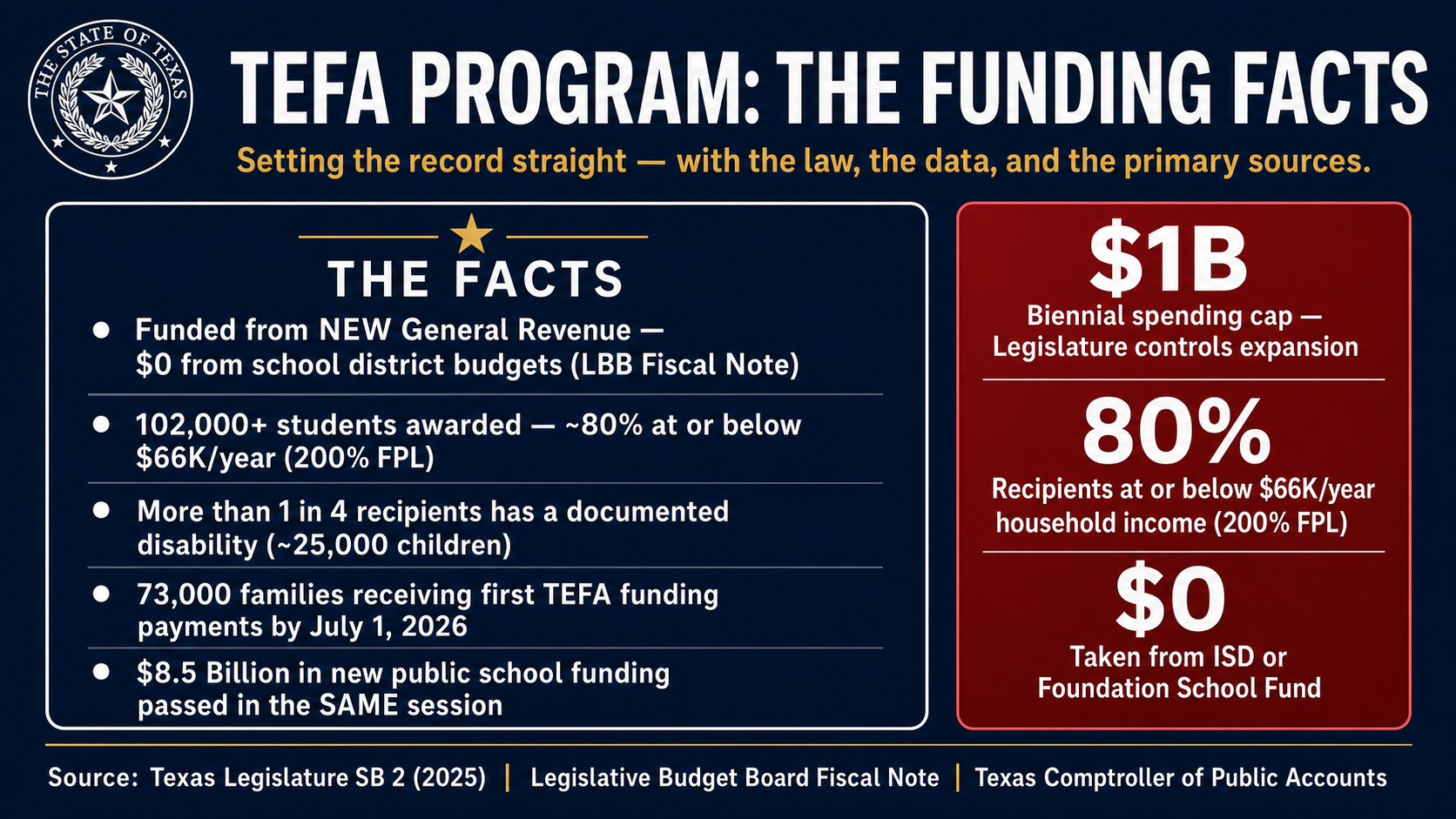
The Texas Education Freedom Accounts Program: Setting the Record Straight on How It Is Funded
Senate Bill 2 established a new Education Savings Account program funded entirely from the state's General Revenue Fund — not from ISD property taxes, not from ADA-based public school allotments, and not from the Foundation School Program. Here is what the law actually says, what the data actually shows, and what critics are actually getting wrong.
- The Law — What Senate Bill 2 Actually Established
- Funding Structure — General Revenue, Not ISD Money
- Program Data — Who Is Actually Getting the Accounts
- Race and Ethnicity — What the Official Demographic Data Shows
- Public Schools — HB 2 and the $8.5 Billion Investment
- Students with Disabilities — TEFA, the Law, and the Reality for Families
- ADA and Property Taxes — Understanding the Mechanics
- Responding to Critics — The Democrat Talking Points, Examined
- References
- Inspect the Data
Introduction: What This Article Is and Why It Was Written
A note from the author on the purpose of this analysis and where it fits within a broader vision for education in Texas
This article is a factual analysis of the Texas Education Freedom Accounts (TEFA) program — how it is structured, how it is funded, who it is actually serving, and whether the most common criticisms leveled against it are grounded in fact. It is written for Texans who want to read the law, examine the data, and reach their own conclusions. Every claim made in this article is cited to a primary source: the enrolled text of Senate Bill 2, official fiscal analyses from the Legislative Budget Board, published demographic data from the Texas Comptroller of Public Accounts, official TEA enrollment reports, and — where criticism is addressed — the direct words of the critics themselves, quoted in full and in context.
The core finding is straightforward: a significant portion of the public debate over TEFA is being conducted with factual claims that do not hold up against the actual law and the actual data. The TEFA program is funded from a new, separate appropriation within the state’s General Revenue Fund. It is not funded from ISD property tax collections. It is not funded from the Foundation School Program. The Legislature used $0 from Foundation School Fund 193 for TEFA in FY 2026 or FY 2027, as confirmed by the Legislative Budget Board’s own fiscal note. The families receiving TEFA funds are, by an overwhelming majority, low-to-moderate income families — approximately four in five earn under $66,000 per year. More than one in four recipients has a documented disability. The program is not a coupon for wealthy families. The people of Texas deserve to know these facts, and this article exists to put them on the record clearly and comprehensively.
This article addresses the TEFA program specifically — what the current law does, what the data shows, and what critics are getting wrong. It does not argue that TEFA is the ideal long-term solution to education funding in Texas. That is a separate and important conversation, addressed briefly below and in full in the companion policy articles in this series.
My Position as a Candidate: TEFA Is a Step in the Right Direction — Not the Final Destination
I support the Texas Education Freedom Accounts program. The TEFA program moves in the right direction: it gives families, particularly lower-income families and families with children who have disabilities, a measure of real choice in education that they did not have before. It is funded responsibly, with a legislative spending cap and a re-appropriation requirement that prevents the kind of unchecked expansion that caused fiscal problems in other states. And the data from its inaugural year demonstrates that it is reaching the families it was designed to serve. For all of those reasons, I am glad it was passed and I support its continued, responsible operation. However, I do not believe that the voucher program, as structured, is the long-term answer to education freedom in Texas. It still leaves families paying property taxes to a school district whose school their child may not attend. It still routes state funds through a government-administered account. And it still leaves the state in control of education policy, curriculum standards, and school accountability in ways that I believe should belong to parents and local school districts — not to Austin.
My long-term position is more fundamental: end property taxes. End the voucher program. Replace both with a system that gives every Texas family genuine financial freedom and genuine educational choice. The Texas Property Tax Replacement Plan (TPTRP) — detailed in a companion article in this series — proposes to replace every property tax in Texas with a unified, tiered, starting 3.35% sales-and-use tax on all non cost of living transactions (taxing the full $7.1 Trillion sales tax base not currently taxed, constituionally capped at 6.00%) that fully funds all 1,016 ISDs at their current combined property tax and Foundation School Program funding level, plus an additional 10%, while eliminating the property tax bills that families pay today.
When property taxes are eliminated, every Texas family keeps the money they were paying to their ISD — and they are free to use it to send their children to whatever school they choose, public or private, without needing a government program to intermediate that decision. ISDs continue to be funded without interruption, without a reduction in per-student dollars, and without dependence on enrollment counts that fluctuate as families exercise their freedom. The difference is that under the TPTRP, a family in Cedar Hill that chooses a private school for their child does not need a voucher — they simply keep the $7,000 to $10,000 a year in property taxes they were paying and direct it however they see fit, while Cedar Hill ISD continues to receive its full funding allocation regardless. Power over curriculum, class offerings, and educational standards returns to parents and local school boards — not the Texas Education Agency, not the Legislature, and not Austin. That is what genuine freedom of education looks like, and it is what I am fighting to achieve.
That said, it is important to set the record straight so that real conversations can be had with the people of Texas on the topic of education funding and freedom of choice in education for our children.
Even if you share my view that the TPTRP is the better long-term framework, the misinformation being spread about TEFA today causes real harm. When political leaders tell families that “vouchers take money from public schools,” those families make decisions based on a falsehood. When advocates claim that TEFA is a “coupon for wealthy families,” the low-income and disabled families who make up the overwhelming majority of its recipients are being erased from the public conversation. Getting the facts right is not optional. The people of Texas deserve the truth, regardless of where one stands on the long-term policy question. That is what the sections that follow are here to provide.
The Law: What Senate Bill 2 Actually Established
The statutory text, the program structure, and the legislative history of TEFA
On May 3, 2025, Governor Greg Abbott signed Senate Bill 2 (89th Legislature, Regular Session) into law, establishing the Texas Education Freedom Accounts (TEFA) program — the largest first-year school choice initiative in the nation. (Governor Greg Abbott, 2025) The bill, authored by Senator Brandon Creighton and Representative Brad Buckley, adds Subchapter J to Chapter 29 of the Texas Education Code, creating a new Education Savings Account (ESA) program to be administered by the Texas Comptroller of Public Accounts. (Texas Legislature, 2025a)
Senate Bill 2 passed the Texas House on an 86–61 vote on April 17, 2025, and was confirmed by the Texas Senate 19–12 on April 24, 2025 — the first time since 1957 that the Texas House approved legislation making state money available for private schooling. (Texas Tribune, 2025a; Texas Association of School Administrators, 2025)
The program officially launched in the 2026–27 school year, with the application window open from February 4 through March 31, 2026. (Texas Education Freedom Accounts, 2026a) The stated purpose of the Act is to provide additional educational options to assist families in exercising the right to direct the educational needs of their children, and to achieve a general diffusion of knowledge. (Texas Legislature, 2025a, Sec. 1)
Texas Education Code Sec. 29.353(a): “The program fund is an account in the general revenue fund to be administered by the comptroller.” (Texas Legislature, 2025a) This language is unambiguous: the TEFA program operates from a dedicated sub-account within the State's General Revenue Fund, not from ISD allotments, Foundation School Program funds, or property tax collections.
What Families Can Use TEFA Funds For
Under Texas Education Code Sec. 29.359, approved education-related expenses include: (Texas Legislature, 2025a, Sec. 29.359)
- Tuition and fees for accredited private schools, higher education providers, online educational courses, or industry-based credential programs
- Textbooks, instructional materials, and required uniforms
- Fees for classes at public schools that do not qualify the child for ADA funding
- Academic assessments; private tutoring and educational therapies
- Transportation to and from preapproved providers
- Computer hardware or software required by a provider (capped at 10% of account)
Critically, Section 29.361(g) states explicitly: “A transfer under Subsection (a) may not be funded using federal money or money from the available school fund or the state instructional materials and technology fund.” (Texas Legislature, 2025a, Sec. 29.361(g)) This means the TEFA program is statutorily prohibited from using the very funds that flow to public schools.
Any child eligible to attend a Texas public school is eligible to participate in TEFA. Participants are prioritized by need through four tiers: (1) children with disabilities from households at or below 500% FPL; (2) households at or below 200% FPL (~$66,000/yr family of four); (3) households between 200–500% FPL; and (4) all other households, capped at no more than 20% of program funding. (Texas Legislature, 2025a, Sec. 29.356(b)) Children of statewide elected officials are not eligible.
Funding Structure: General Revenue, Not ISD Money
What the law says about the program fund, where the money comes from, and what it cannot touch
The most critical — and most frequently misrepresented — aspect of the TEFA program is its funding structure. Under Texas Education Code Sec. 29.353, the TEFA Program Fund is a dedicated account within the General Revenue Fund, administered by the Comptroller. (Texas Legislature, 2025a, Sec. 29.353) Per Sec. 29.353(b), the fund is composed of: general revenue transferred to the fund; money appropriated to the fund; interest and earnings; gifts, grants, and donations; and any other money available for purposes of the program. (Texas Legislature, 2025a, Sec. 29.353(b)) It is funded by a new, separate appropriation from the Legislature — not from any existing ISD allotment, not from the Foundation School Fund (Fund 193), and not from the Available School Fund.
The Legislative Budget Board's fiscal note for SB 2 confirms: “The Introduced versions of the 2026–27 General Appropriations Bill include $1,000,000,000 for fiscal year 2027 from the General Revenue Fund for an ESA program.” (Legislative Budget Board, 2025a) The LBB five-year impact table shows the entire program cost flowing from General Revenue Fund 1, while the Foundation School Fund (Fund 193) shows $0 in costs for FY 2026 and FY 2027. (Legislative Budget Board, 2025b) The Foundation School Program — which funds ISDs — is a completely separate appropriation stream.
Foundation School Program (FSP) → Property Tax Collections + State Aid (Fund 193) → ISD General Fund → Per-ADA Allotments. ISDs continue to receive property tax revenue and FSP funding based on enrolled ADA count. SB 2 does not redirect any existing ISD revenue.
| Fiscal Year | Cost from GR Fund 1 | Foundation School Fund 193 | Net GR Impact |
|---|---|---|---|
| FY 2026 | ($10,610,728) | $0 | ($10,610,728) |
| FY 2027 | ($989,389,272) | $0 | ($989,389,272) |
| FY 2028 * | ($3,329,679,780) | +$257,546,337 | ($3,072,133,443) |
| FY 2029 * | ($3,693,816,701) | +$522,404,297 | ($3,171,412,404) |
| FY 2030 * | ($4,786,415,581) | +$805,532,528 | ($3,980,883,053) |
Starting in FY 2028, the LBB projects positive figures in the Foundation School Fund column. This does not mean ISD money is transferred to TEFA. It means the state would owe less under the FSP formula because fewer public school students would be generating per-ADA entitlements. That is a state-level accounting adjustment. An ISD's per-student funding rate does not decrease when a student departs; the district simply stops receiving the allotment for that individual student, as it would if that student moved out of the district. (Legislative Budget Board, 2025a)
The $1 Billion Cap — A Legislative Guardrail
Senate Bill 2 includes an explicit spending cap: “for the state fiscal biennium beginning September 1, 2025, the amount spent for purposes of the program may not exceed $1 billion.” (Sec. 29.3521(c-1)) (Texas Legislature, 2025a) This cap applies to the two-year budget period ending August 31, 2027. Future funding levels will be set by subsequent legislatures through the normal appropriations process, meaning the program cannot expand automatically without affirmative legislative action.
Program Data: Who Is Actually Getting the Accounts
Official statistics from the Texas Comptroller on TEFA recipients, income levels, and prior enrollment
The Texas Education Freedom Accounts application window opened on February 4, 2026, and closed on March 31, 2026. (Texas Education Freedom Accounts, 2026a) More than 274,000 applications were received during the six-week window — well above the 100,000 initially projected. (Texas Education Freedom Accounts, 2026b) As of June 10, 2026, Acting Texas Comptroller Kelly Hancock announced that more than 102,000 students had been awarded accounts for the 2026–27 school year, with 144,744 eligible students remaining on a waitlist. (Texas Comptroller of Public Accounts, 2026b) By July 1, 2026, nearly 73,000 families were scheduled to receive their first funding payments, reflecting the subset of award recipients who had completed enrollment and accepted the award by the Comptroller’s deadline. (KSAT, 2026; Texas Comptroller of Public Accounts, 2026c)
“More than one in four awarded students has a documented disability. Approximately four in five awarded students has a household income below 200% of the federal poverty level ($66,000 per year for a family of four).”— Texas Education Freedom Accounts Program, Updated Demographic Information, June 18, 2026 (Texas Education Freedom Accounts, 2026c)
These demographics directly contradict the claim that TEFA is designed to benefit wealthy families already in private schools. As of mid-May 2026, data reported by The Texan showed that 57 percent of TEFA recipients had attended private school or were homeschooled in 2024–25, while 43 percent were previously public school students. (The Texan, 2026) Early application data from OSOD (collected March 4, 2026) reported that 76% of applications came from families not currently in public schools and that fewer than 0.7% of the 5.5 million public school families had applied at all. (Texas Organization for Scholastic Diversity, 2026)
| Metric | Figure | Source |
|---|---|---|
| Total applications received (Feb 4 – Mar 31, 2026) | 274,000+ | TX Comptroller, Apr 2026 |
| Total students awarded accounts (as of June 10, 2026) | 102,000+ | TX Comptroller, Jun 2026 |
| Tier 1 awards (disability + income ≤500% FPL) | 42,600+ | WFAA, May 2026 |
| Tier 2 awards (income ≤200% FPL, ≤$66K/yr family of 4) | 53,000+ | TX Comptroller, May 2026 |
| Students remaining on waitlist (as of June 10, 2026) | 144,744 | TX Comptroller, Jun 2026 |
| Tier 2 students on waitlist (low-income) | 12,860 | TX Comptroller, Jun 2026 |
| Recipients with documented disability | ~25%+ (1 in 4) | TEFA Demographic Update, Jun 2026 |
| Recipients with household income ≤200% FPL | ~80% (4 in 5) | TEFA Demographic Update, Jun 2026 |
| Recipients previously in private school or homeschool (2024–25) | 57% | The Texan, May 2026 |
| Recipients previously in public school (2024–25) | 43% | The Texan, May 2026 |
| Public school families who applied (of ~5.5M students) | <0.7% | OSOD, Mar 2026 |
| Per-student award (private school, 2026–27) | $10,474 | TEA / TX Comptroller, Dec 2025 |
| Maximum award for students with disabilities (full services) | Up to $30,000 | SB 2, Sec. 29.361(a)(2) |
| Homeschool award | $2,000 | SB 2, Sec. 29.361(b-1) |
Approximately four in five TEFA recipients have a household income at or below $66,000 per year for a family of four (200% of the federal poverty level), and more than one in four has a documented disability. (Texas Education Freedom Accounts, 2026c) Fifty-seven percent were already outside of public schools before TEFA, while 43 percent were previously public school students. (The Texan, 2026) The data does not support the narrative that TEFA is a wealthy-family handout.
Race and Ethnicity: What the Official Demographic Data Shows
Official applicant and awardee demographic data on race and ethnicity from the Texas Comptroller and TEFA fact sheets
The Texas Comptroller’s official application-insights release reported 274,183 total TEFA applications and provided the clearest statewide racial and ethnic breakdown available for the full applicant pool. White students made up 45 percent of applicants, Hispanic students 23 percent, Black students 12 percent, multiracial students 11 percent, Asian or Pacific Islander students 8 percent, and American Indian or Alaskan Native students 1 percent. (Texas Education Freedom Accounts, 2026b)
The award-side data is more fragmented. The Comptroller’s June 10 fact sheet for 102,037 active awards confirms overall award totals and grade distribution, but the public race-and-ethnicity breakout has been released most clearly through earlier official tier-based updates and official summaries reported from those releases. Those figures show the demographic mix of awardees narrowed somewhat from the original applicant pool, but white students still remained overrepresented relative to statewide public-school enrollment while Hispanic students remained underrepresented. (Texas Comptroller of Public Accounts, 2026b; Texas Comptroller of Public Accounts, 2026d; Texas Education Freedom Accounts, 2026b)
These figures do not show that minority families were absent from TEFA. They show that the applicant pool and early award rounds were racially mixed, but not proportionate to Texas public-school enrollment, where Hispanic students make up the majority statewide. (Texas Education Freedom Accounts, 2026b; Texas Education Agency, 2025)
| Group | Full Applicant Pool | Tier 1 Awards | Tier 2 Awards | Texas Public School Enrollment |
|---|---|---|---|---|
| White | 45% | 42% | 36% | 24% |
| Hispanic | 23% | 25% | 28% | 54% |
| Black | 12% | 16% | 17% | 13% |
| Multiracial | 11% | 12% | 12% | 3% |
| Asian / Pacific Islander | 8% | 4% | 7% | 6% |
| American Indian / Alaska Native | 1% | 1% | <1% | <1% |
The official tier-based award data suggests the demographic mix became somewhat more diverse as priority rounds progressed. White students accounted for 42 percent of Tier 1 awards and 36 percent of Tier 2 awards, while Hispanic students rose from 25 percent in Tier 1 to 28 percent in Tier 2, and Black students rose from 16 percent to 17 percent. (Texas Comptroller of Public Accounts, 2026d)
Even so, the broad statewide pattern remained the same: compared with Texas public-school enrollment, TEFA participation has so far drawn a disproportionately white applicant pool and a disproportionately low Hispanic share. That is not an argument by itself for or against the program, but it is an observable fact from the official demographic releases and should be stated plainly. (Texas Education Freedom Accounts, 2026b; Texas Education Agency, 2025)
Public Schools: The $8.5 Billion the Legislature Also Passed
House Bill 2 — the largest public education funding investment in the same session that produced TEFA
The 89th Legislature did not simply pass a voucher program and walk away from public schools. In the same session, the Legislature approved House Bill 2 (HB 2), which Governor Abbott signed on June 3, 2025, authorizing approximately $8.5 billion in new funding for Texas public schools. (KERANEWS, 2025; Texas Tribune, 2025b) This is the largest public education investment in a single legislative session in recent Texas history.
HB 2 provided: $4.2 billion for teacher and school staff pay raises; nearly $2 billion for special education overhaul and full-day pre-K; $430 million for school safety upgrades; $500 million for non-administrative support staff; $677 million for early learning; $153 million for CTE; and a $55 increase to the per-student basic allotment — the first increase since 2019. (Texas Association of School Administrators, 2025; Texas Tribune, 2025b; KERANEWS, 2025)
The Raise Your Hand Texas organization characterized the 89th Session result as “$8.5 billion in new school funding, which is greatly appreciated support but still short of inflation-adjusted needs.” (Raise Your Hand Texas, 2026) Even from an organization that advocates for greater public school investment, this statement acknowledges the scale of public school investment made alongside SB 2. The Legislature invested in both simultaneously.
| Category | Allocation |
|---|---|
| Teacher and staff pay raises (Teacher Retention Allotment, SSRA, TIA expansion) | $4.2 billion |
| Special education overhaul + full-day pre-K + early learning interventions | ~$2 billion |
| Fixed cost allotment (transportation, insurance, utilities, retired educators) | $1.3 billion |
| Non-administrative support staff raises (counselors, nurses, librarians) | $500 million |
| Early learning and pre-K expansion | $677 million |
| School safety upgrades | $430 million |
| Small and midsized school district allotment | $300 million |
| Charter school facilities | $200 million |
| Career and technical education (CTE) | $153 million |
| Teacher preparation programs | $135 million |
| Basic allotment increase (+$55/student) | ~$600 million est. |
| Total New Public School Funding | ~$8.5 billion |
Students with Disabilities: TEFA, the Law, and the Reality for Families
Why families with children who have disabilities are among the most powerful beneficiaries of TEFA — and why the program exists to solve a problem many have struggled with for years
More than one in four students awarded a Texas Education Freedom Account in the program’s inaugural year has a documented disability — representing more than 25,000 individual children. (Texas Education Freedom Accounts, 2026c) That is not an accident. Senate Bill 2 placed students with disabilities first in line for TEFA awards, in the program’s highest-priority Tier 1, and authorizes award amounts up to $30,000 per year — compared to the $10,474 baseline for other recipients — in recognition of the higher cost of educating children with significant needs. (Texas Legislature, 2025a, Sec. 29.356(b), 29.361(a)(2)) The entire first round of TEFA awards, totaling more than 42,600 students, consisted exclusively of Tier 1 recipients: children with qualifying disabilities in households at or below 500% of the federal poverty level, and their siblings. (Texas Comptroller of Public Accounts, 2026a)
SB 2 establishes four tiers of award priority. Tier 1 is explicitly reserved for students with disabilities whose household income falls at or below 500% of the federal poverty level (approximately $160,750 for a family of four). These students receive the first awards from available funding, before any other applicants. The maximum Tier 1 award is $30,000 per year, reflecting the actual cost of specialized private schooling for children with significant needs. (Texas Legislature, 2025a, Sec. 29.356(b); Texas Comptroller of Public Accounts, 2026a)
Why Many Families with Disabled Children Leave Public Schools
To understand why TEFA matters so much to families with children who have disabilities, it is important to understand what they faced before the program existed. For decades, many Texas families whose children had disabilities found that their local public school could not adequately meet their child’s needs. Some families pursued lengthy administrative disputes with their district through the ARD/IEP process. Others sought private placements at their own expense after reaching an impasse with their district. (Swanson Special Education Law, 2025; Parent Resources for Navigating Texas, 2020) When a family makes that choice — pulling their child from public school and enrolling them in a private school or beginning homeschool — they historically received no state financial support whatsoever. They continued paying property taxes to the local school district. They paid private school tuition or home education costs out of pocket. And the public school district simply stopped receiving state ADA funding for that child, without any corresponding relief to the family. (Raise Your Hand Texas, 2024)
Before TEFA, a family whose child had a disability and who chose a private school after exhausting options in the public system received nothing from the state to help cover that cost. They still owed property taxes to the ISD. The ISD stopped receiving ADA funding for the student — but the ISD also incurred no further cost for that child. The family bore the full financial burden alone. TEFA changes that equation: the state now provides up to $30,000 to offset the private placement cost, using a new, separate General Revenue appropriation that did not previously exist. (Texas Legislature, 2025a, Sec. 29.353, 29.361(a)(2); Raise Your Hand Texas, 2024)
Texas’ History of Special Education Undercoverage
Texas’ public school system carries a documented history with special education that gives additional context to why families seek private alternatives. For over a decade, the Texas Education Agency (TEA) enforced an informal performance benchmark that effectively capped special education enrollment at 8.5% of students in each district — well below the national average of approximately 14–15%. (Disability Rights Texas, 2019; National Center for Education Statistics, 2023) Disability Rights Texas discovered this benchmark in 2014 and spent three years fighting it before the U.S. Department of Education formally found Texas in violation of federal special education law (IDEA) in 2018, requiring a five-year corrective action plan. (Disability Rights Texas, 2019) By the time the cap was eliminated, an estimated 250,000 children had been denied special education services they were entitled to under federal law. (Texas School Alliance, 2018)
Even after the cap was lifted, Texas’ special education funding has remained under strain. As of the 2024–25 school year, TEA data shows 856,651 students — 15.5% of all public school enrollment — were receiving special education services, up from 14.0% the prior year and representing a 72% increase from 498,320 students just seven years earlier. (Texas Education Agency, 2025b; Yahoo News, 2026) Disability advocates estimate a structural special education funding gap of approximately $2 billion statewide, with districts spending more to serve students with disabilities than the state reimburses under the FSP formula. (Texas Standard / KERA News, 2024) Even after the 89th Legislature allocated roughly $2 billion for special education through HB 2, advocates noted the systemic underfunding has not been fully resolved. (The 74 Million, 2025)
856,651 students enrolled in special education in Texas public schools in 2024–25, representing 15.5% of total public school enrollment — up from 14.0% the year prior and a 72% increase from 2017–18. (Texas Education Agency, 2025b) The national average for students served under IDEA is approximately 15%, a benchmark Texas finally reached only after the TEA’s illegal 8.5% cap was lifted in 2018 following a federal finding of violation. (National Center for Education Statistics, 2023; Disability Rights Texas, 2019) An estimated structural funding gap of $2 billion remains between what Texas districts spend on special education and what the state reimburses. (Texas Standard / KERA News, 2024)
What TEFA Provides That Was Never Available Before
For a family whose child has a disability and who determines that a private school is better suited to meet that child’s specific needs — whether a specialized learning environment, a lower teacher-to-student ratio, therapies not available at the local public school, or simply an educational approach that works for their child — TEFA provides something unprecedented: a state-funded account of up to $30,000 per year to help cover those costs. The funds can be used for private school tuition, educational therapies (occupational, speech, physical therapy), specialized curriculum, assistive technology, and transportation. (Texas Legislature, 2025a, Sec. 29.359; Texas Council for Developmental Disabilities, 2025)
| Provision | Statutory Reference | What It Means for Families |
|---|---|---|
| Tier 1 priority in program lottery | Sec. 29.356(b)(1) | Children with disabilities (household ≤500% FPL) receive awards before all other applicants |
| Maximum award up to $30,000/year | Sec. 29.361(a)(2) | Reflects actual cost of specialized private schooling; baseline is $10,474 |
| Approved uses: educational therapies | Sec. 29.359 | Occupational, speech, and physical therapy are eligible TEFA expenditures |
| District evaluation obligation retained | Sec. 29.3615 | School districts must still conduct special education evaluations for TEFA participants upon request |
| $1,000 district payment per FIIE | HB 2, TEC §48.159 | Districts receive $1,000 for each full individual initial evaluation of a non-enrolled child, incentivizing cooperation |
| Participation is voluntary | Sec. 29.352(b) | No family is required to use TEFA; public school options remain fully available |
| Return-to-public-school protection | Sec. 29.3611 | If a child re-enrolls in public school, the district receives a transition allotment (basic allotment × 0.1) |
An Honest Acknowledgment: The Trade-Off Families Should Understand
It is factually accurate, and worth stating plainly, that when a family enrolls their child in a private school using TEFA, they are giving up certain procedural rights that IDEA guarantees in the public school context. A private school is not required to develop a full Individualized Education Program (IEP) or provide the same legally mandated continuum of services that a public school must offer. (Texas Council for Developmental Disabilities, 2025; Texas School for the Blind and Visually Impaired, 2026) Families should review their child’s needs carefully and consult with educational advocates before making this choice. The key point is this: TEFA participation is entirely voluntary. No family is pushed out of the public system. Every TEFA recipient retains the right to return to their public school at any time. (Texas Legislature, 2025a, Sec. 29.352(b))
Furthermore, under federal law, public school districts retain a Child Find obligation — they are still required to locate and evaluate children who may have disabilities, including those enrolled in private schools or homeschools. If a family requests a special education evaluation, the district in which the private school is located must respond. (Parent Resources for Navigating Texas, 2020; Texas School for the Blind and Visually Impaired, 2026) And under SB 2’s Sec. 29.3615, school districts are explicitly required to conduct evaluations for TEFA-participating students with potential disabilities upon request. SB 2 retains this protection by statute. (Texas Legislature, 2025a, Sec. 29.3615; Texas Education Agency, 2025a)
Families with children who have disabilities did not need TEFA to tell them that public schools sometimes failed their children — they already knew it from lived experience. What TEFA provides is a financial tool that for the first time gives those families a real choice: stay in the public system and fight for services, or access up to $30,000 per year in state funds to pursue a private educational environment that better meets their child’s needs. That is not a loss of rights. That is an expansion of them. The 25%+ of TEFA recipients with documented disabilities — more than 25,000 children — are families who made that choice with full knowledge of the trade-offs involved. (Texas Education Freedom Accounts, 2026c; Texas Legislature, 2025a)
ADA and Property Taxes: Understanding the Mechanics
How the Texas school funding formula works, what happens when a student leaves, and why property taxes still flow to ISDs
To understand why the “vouchers take money from public schools” argument is factually inaccurate, it is necessary to understand how Texas public school funding works. Texas public schools are funded through the Foundation School Program (FSP), which draws from two primary sources: local property tax collections and state aid from the General Revenue Fund. The amount of state aid a district receives is directly affected by how much local property tax it collects — higher local revenue means less state aid, in an equalization formula. (Raise Your Hand Texas, 2024; China Spring ISD, 2022)
The Texas Legislature sets a per-student funding entitlement. ISDs collect property taxes first; the state fills the gap. The key metric for state funding is Average Daily Attendance (ADA) — a calculation of how many students are in seats each school day, not total enrollment. When enrollment drops, state aid drops. (Arlington ISD, 2025; China Spring ISD, 2022)
What Happens When a Student Leaves a District?
When a student leaves a public school district to participate in TEFA, the district's ADA count decreases for that student. Because state Foundation School Program funding is based on ADA, the district's state aid entitlement decreases by the per-student allotment for that child. This is not a transfer of that district's funds to the TEFA program. The TEFA program is funded by a separate, newly appropriated General Revenue Fund account (Sec. 29.353). The district loses a student's ADA-based state aid because it is no longer educating that student — which is precisely how the funding formula is designed to work: funding follows the student being educated. (Texas Legislature, 2025a; Arlington ISD, 2025)
If a family moves from Cedar Hill to DeSoto, Cedar Hill ISD loses that student's ADA-based funding. No one argues DeSoto is “taking money from Cedar Hill.” The same principle applies when a student exits the public system for TEFA. The state simply stops paying an allotment it was paying on behalf of a student it is no longer asked to educate. The funds that flow to TEFA come from a new, separate appropriation — not from Cedar Hill ISD's budget.
Property Taxes: Families Still Pay; Districts Still Receive
A Texas family that sends its child to a private school using TEFA still pays property taxes to the ISD in which they reside. Those revenues continue to flow to the local school district regardless of where the child is educated. The only adjustment is to the state's share of the per-student allotment under the FSP formula, because the district's ADA count reflects one fewer student. The district retains all its locally collected property tax revenue. (Raise Your Hand Texas, 2024)
A family in Cedar Hill that pays property taxes to Cedar Hill ISD but sends their child to a private school is essentially paying twice for education — once through local taxes that fund a school their child does not attend, and again through private school tuition. TEFA provides a partial offset for that burden. The $10,474 award represents approximately 85% of the statewide average per-student cost, recognizing the family's continued property tax contribution while providing meaningful educational flexibility. (Texas Education Freedom Accounts, 2026a; Texas Legislature, 2025a, Sec. 29.361(a)(1))
Statutory Protection for Districts When Students Return
Senate Bill 2 also includes a provision protecting ISDs when TEFA students return to public school. Under Sec. 29.3611, if a child ceases TEFA participation and re-enrolls in a school district during a school year, the district is entitled to receive an additional allotment equal to the basic allotment multiplied by 0.1 for that student's ADA for that school year. (Texas Legislature, 2025a, Sec. 29.3611) This provision acknowledges the transition cost for ISDs and provides a statutory remedy.
Responding to Critics: The Democrat Talking Points, Examined
A factual, point-by-point review of the primary Democratic opposition arguments, in their own words
Representative Aicha Davis’s public statements on vouchers and education savings accounts echo the same claims examined in this section. In a WFAA Inside Texas Politics interview, Davis said she is “ready to fight against private school vouchers that would draw funding away from local public schools in order to subsidize private school tuition,” and defined “true choice” as having “strong public schools as a choice.” (Teach the Vote, 2025) As a member of the State Board of Education, she also stated that the implementation of education savings accounts “would take away money from the school districts and charter schools,” a characterization that assumes voucher-style programs must reduce ISD funding rather than operate from separate appropriations as TEFA does. (KUT, 2023)
| Claim | Source | TEFA Funding Fact |
|---|---|---|
| Private school vouchers “would draw funding away from local public schools in order to subsidize private school tuition.” | Teach the Vote summary of WFAA Inside Texas Politics interview with Rep. Aicha Davis (Teach the Vote, 2025) | TEFA is funded from a new, separate $1 billion appropriation in General Revenue Fund 1 for FY 2027. The Legislative Budget Board fiscal note shows $0 in costs from Foundation School Fund 193 (ISD funding) for FY 2026 and FY 2027. (Legislative Budget Board, 2025a, 2025b) |
| The implementation of education savings accounts “would take away money from the school districts and charter schools.” | KUT reporting on SBOE debate quoting board member Aicha Davis (KUT, 2023) | Texas Education Code Sec. 29.353 establishes the TEFA Program Fund as a dedicated account within the General Revenue Fund composed of general revenue transfers and appropriations. Sec. 29.361(g) expressly prohibits TEFA transfers from using the Foundation School Fund, the Available School Fund, or the state instructional materials and technology fund. (Texas Legislature, 2025a) |
Texas Democratic leaders and the Texas Democratic Party have organized their opposition to TEFA around a set of recurring claims. The following addresses each claim directly, using the Democrats' own words and providing a fact-based response grounded in primary sources.
Claim 1: “Vouchers divert billions of taxpayer dollars from Texas public schools.”
“The Texas Senate Democratic Caucus stands united in strong opposition to Senate Bill 2, a deeply flawed voucher scheme that diverts billions of taxpayer dollars from Texas public schools and channels them into private hands—with no guarantee of better outcomes, no public accountability and no protections for the children who need the most support.” (Texas Senate Democratic Caucus, 2025)
The Facts: The TEFA program fund is a dedicated account within the General Revenue Fund (Sec. 29.353). It is appropriated separately from the Foundation School Program. The LBB's fiscal note confirms $1 billion in costs to General Revenue Fund 1, with $0 coming from Foundation School Fund 193 in FY 2026 and FY 2027. (Legislative Budget Board, 2025a; 2025b) No ISD budget line is reduced on account of TEFA appropriations. To “divert” funds from public schools would require those funds to have been designated for public schools in the first place. The $1 billion TEFA appropriation is a new allocation, not a reallocation of FSP funds. Furthermore, in the same session, the Legislature also passed $8.5 billion in new public school funding through HB 2. (Texas Legislature, 2025a; Texas Tribune, 2025b)
TEFA is funded by a new, separate General Revenue Fund appropriation. The statutory language (Sec. 29.353 and Sec. 29.361(g)) explicitly prohibits TEFA from using available school funds or state instructional materials funds. The program is an addition to the educational funding landscape, not a subtraction from existing ISD revenues.
Claim 2: “Public school districts will lose hundreds of millions from vouchers.”
“Under the LBB's analysis… Texas public schools would lose about $250 million in the first year that vouchers would hit their budgets… roughly 0.4 percent of the $57 billion in funding that school districts received in 2022–23.” (Houston Landing, 2025)
The Facts: This claim requires important context. The LBB's methodology note states: “This analysis assumes public school students that would leave to enroll in private schools would generate a savings under the Foundation School Program (FSP), estimated at $10,512 per student in fiscal year 2027.” (Legislative Budget Board, 2025a) The FSP adjustment is not a transfer of an ISD's existing funds to TEFA — it is the state reducing its own outlay for a child it is no longer being asked to educate. The district's local property tax revenue is unaffected. The LBB projected only approximately 24,500 students would leave public schools for private schools in FY 2027 — less than 0.5% of the 5.5 million public school student population. Actual first-year TEFA data shows 43% of recipients were previously in public school — approximately 43,860 of 102,000 awarded students — still less than 1% of total public school enrollment. (Legislative Budget Board, 2025a; The Texan, 2026)
ISDs do not “lose money to vouchers.” When a student leaves a district, the district stops receiving the per-ADA state allotment for that child because it is no longer educating that child. This is how ADA-based funding has always worked. The district retains all local property tax revenue. In the inaugural year, fewer than 1% of public school students received TEFA accounts. Meanwhile, the Legislature added $8.5 billion in new public school funding in the same session.
Claim 3: “Vouchers are designed for wealthy families already in private school.”
“These corporate private school vouchers will only provide a coupon for wealthy families to keep sending their children to the private and religious schools they're already attending — at the expense of the 96% of Texas children who rely on our public schools.” (Texas Democratic Party, n.d.)
The Facts: The official demographic data published by the Texas Comptroller directly contradicts this claim. As of June 18, 2026: approximately four in five (80%) of awarded students have household income below $66,000/year for a family of four (200% of FPL). More than one in four (25%+) have a documented disability. The statute caps wealthier families (500%+ of FPL, ~$160K+/year) at no more than 20% of program funding. (Texas Education Freedom Accounts, 2026c; Texas Legislature, 2025a, Sec. 29.3521(d)) Furthermore, the claim that 96% of Texas children “rely on public schools” does not follow from any reduction in ISD funding, since as established above, no ISD funding is redirected to TEFA.
The data shows the opposite of what critics claimed. Eighty percent of TEFA recipients are from families earning under $66,000 per year. The program's statutory priority framework is working as designed. The 20% cap on high-income recipients is written directly into law. The first year's data is unambiguous: TEFA is predominantly serving lower-income families and families with children who have disabilities.
Claim 4: “Students with disabilities lose federal rights and protections under a voucher.”
“Students with disabilities… will be hurt most by a voucher scam: Private schools can reject students because of their religion, test scores, disabilities… students with disabilities lose their federal rights and protections with a voucher.” (Texas Democratic Party, n.d.)
The Facts: It is accurate that private schools are not bound by IDEA (Individuals with Disabilities Education Act) in the same way public schools are, and that parents who choose a private placement give up certain procedural IDEA rights. This is a legitimate trade-off for families to consider carefully, and it is addressed in full in Section 6 of this article. However, three key statutory facts provide critical context for this claim. First, TEFA participation is entirely voluntary — no family is required to use it, and students are always welcome to return to their public school. Second, SB 2 gives the highest priority in the program lottery to students with disabilities, with awards up to $30,000 per year — triple the baseline — recognizing the genuine higher cost of serving this population. Third, the law requires school districts to conduct evaluations for TEFA-participating students with potential disabilities (Sec. 29.3615), and districts receive $1,000 per initial special education evaluation for non-enrolled children under HB 2. (Texas Legislature, 2025a, Sec. 29.356(b), 29.3615; Texas Education Agency, 2025a)
The data demolishes the claim that the program “hurts” children with disabilities. As of June 18, 2026, more than one in four (25%+) of all TEFA recipients has a documented disability. (Texas Education Freedom Accounts, 2026c) The entire first round of TEFA awards — 42,600 students — consisted exclusively of Tier 1 recipients: children with qualifying disabilities. (Texas Comptroller of Public Accounts, 2026a) These are families who chose to participate with full knowledge of the trade-offs involved, and who apparently weighed those trade-offs against years of experience navigating an underfunded and historically under-serving public special education system. (Disability Rights Texas, 2019; Texas Standard / KERA News, 2024)
Moreover, the claim that these families “lose” rights fundamentally mischaracterizes the pre-TEFA status quo. Before TEFA, families who pulled their children from public schools for private special education placements already had no IDEA rights in that private setting — and they also had no financial support from the state. They paid property taxes. They paid tuition. They received nothing. TEFA does not eliminate rights these families possessed; it provides financial support they never had. (Raise Your Hand Texas, 2024; Texas Legislature, 2025a, Sec. 29.353)
More than 25,000 children with documented disabilities — representing over one in four TEFA recipients — are enrolled in the program in its inaugural year. The entire first round of awards went exclusively to students with disabilities and their siblings. The program offers up to $30,000 per year for disability-related educational expenses — tuition, therapies, technology, and transportation. TEFA participation is voluntary. Public school options and the right to return remain fully intact. And the Child Find obligation under federal law, along with Sec. 29.3615 of SB 2, ensures school districts retain evaluation responsibilities for these children. The families choosing TEFA are not being misled about trade-offs; they are making an informed choice to access support that never existed before for families who chose private special education placements — a choice already denied to them by a system that historically capped special education enrollment at 8.5%, below the national average, for over a decade. (Texas Education Freedom Accounts, 2026c; Texas Comptroller of Public Accounts, 2026a; Texas Legislature, 2025a; Disability Rights Texas, 2019)
Claim 5: “Voucher programs are bankrupting other states. Costs will skyrocket.”
“Other states' voucher programs provide cautionary tales. Costs skyrocket, fraud occurs and public education is slashed, inevitably leading to higher taxes. Vouchers are bankrupting Arizona, and conservative voters in Nebraska recently repealed vouchers.” (Texas Senate Democratic Caucus, 2025)
The Facts: Concerns about long-term program cost growth are legitimate and deserve honest examination. The LBB projects costs of $3.3 billion by FY 2028 and $4.8 billion by FY 2030 if the program is expanded beyond the initial cap by future legislatures. (Legislative Budget Board, 2025b) The fiscal experience of other states is not monolithic — it depends entirely on program design. Two claims are made here: one about Arizona, and one about Nebraska. Both deserve direct examination, because neither supports the conclusion that Texas’s TEFA is structurally comparable to what went wrong elsewhere.
Arizona: A Real Fiscal Problem Caused by Specific Design Failures
The Arizona concern is the strongest part of this argument, and it should be taken seriously on its merits. Arizona’s Empowerment Scholarship Account (ESA) program was launched in 2011 as a narrow, targeted program for students with disabilities. (Arizona State Senate, 2024) In 2022, the Arizona Legislature expanded it to universal eligibility with no enrollment cap and no spending limit — any Arizona student could participate, and the program could grow without bound or additional legislative action. (EdChoice, 2026) The fiscal note for that expansion projected $65 million in FY 2024 costs. The actual cost was $738 million — more than 11 times the projection. By FY 2025, costs reached approximately $872–886 million, and Arizona’s own Governor’s Office projected the program on track to exceed $1 billion in FY 2026–27. (Grand Canyon Institute, 2025; Arizona Governor’s Office, 2023; RAND Corporation, 2025) Arizona faced a combined $1.4 billion deficit across FY24–FY25, and independent analysts attributed the net new cost of the universal voucher at roughly $350 million annually after accounting for students who would have been in public school. (Grand Canyon Institute, 2025; Education Trust, 2024) A 2026 state audit found that $654 million in program expenditures had been auto-approved with what auditors called “haphazard” oversight and unaddressed violations. (AZ Mirror, 2026)
The cause of Arizona’s fiscal problem is not disputed among analysts: it was program design, not vouchers as a concept. Arizona’s program had no enrollment cap, no spending ceiling, no income targeting, no re-appropriation requirement, and a voucher amount pegged to charter school funding rates — which in some cases exceeded what the state had been spending per child in public school, meaning the state paid more per student after the switch than before. (Arizona Governor’s Office, 2023; EdChoice, 2026) None of those design features are present in Texas’s TEFA.
Nebraska: A Political Event, Not a Fiscal One
The Nebraska claim is technically accurate but substantively misleading as evidence of fiscal harm. Nebraska voters repealed LB 1402 via Referendum Measure 435 in November 2024, with approximately 57–60% voting to repeal. (Open Sky Policy Institute, 2024; Nebraska Examiner, 2024) The Nebraska program never launched and never spent a dollar. It was repealed before implementation. (Nebraska Public Media, 2024) Nebraska’s repeal tells us something about the political preferences of Nebraska’s voters — it says nothing whatsoever about whether voucher programs cause fiscal harm in states where they actually operate. Citing it as a fiscal “cautionary tale” is a mischaracterization of what happened.
How Other States Have Managed Vouchers Without Fiscal Collapse
The states-that-failed framing ignores the states where voucher programs have operated for decades without fiscal crisis. Wisconsin’s Milwaukee Parental Choice Program — the oldest voucher program in the country, operating since 1990 — remains within legislative appropriations with a set per-student funding level. (U.S. Government Accountability Office, 2001) A 2026 analysis found roughly half of Wisconsin private school students now receive vouchers at a total state cost of approximately $700 million, a program that has run for 35 years without producing a budget crisis. (Wisconsin Watch, 2026) Indiana’s Choice Scholarship Program, one of the largest in the country since 2011, generated estimated net fiscal savings to taxpayers in its first decade because the voucher was set below the total per-pupil public school expenditure. (Fiscal Effects of the Indiana Choice Scholarship Program, 2022) West Virginia’s Hope Scholarship program, in its second year, produced a net fiscal benefit of $26.9 million to local taxpayers, with per-pupil funding for remaining public school students increasing by $269. (West Virginia Center on Budget & Policy, 2023) These outcomes are not accidental — they reflect programs designed with award amounts calibrated below public per-pupil cost, targeted eligibility, and legislative oversight.
| Design Feature | Arizona ESA (2022 Expansion) | Florida (2023 Expansion) | Texas TEFA (2025) | Wisconsin / Indiana |
|---|---|---|---|---|
| Enrollment cap | ❌ None | ❌ None | ✅ $1B biennium cap (Sec. 29.3521) | ✅ Set by annual appropriation |
| Re-appropriation required to expand | ❌ No — automatic growth | ❌ No | ✅ Yes — Legislature must act each biennium | ✅ Yes — legislative each year |
| Income targeting / priority tiers | ❌ Universal, no income limit | ❌ Universal | ✅ 4-tier income priority; 20% cap on high-income | ✅ Income-limited eligibility |
| Award vs. per-pupil public cost | ❌ Pegged to charter rate — can exceed public per-pupil | ❌ Exceeds per-pupil cost in some cases | ✅ $10,474 — below statewide average per-pupil | ✅ Set below per-pupil public cost |
| Independent spending oversight / audit | ❌ Haphazard; 2026 audit found major gaps | ⚠ Limited; $47M overrun FY2024 | ✅ CEAO verification; comptroller audits | ✅ Annual legislative audits |
| Fiscal outcome | 1,346% cost overrun; $1.4B state deficit FY24–25 | $3.9B cost; ran over budget | $1B inaugural biennium (capped) | Fiscal savings or neutral; no budget crisis |
Texas’s Structural Safeguards — and the Honest Caveat
Texas built into SB 2 the specific guardrails that Arizona lacked. The program’s $1 billion spending cap requires affirmative re-appropriation by the Legislature for every biennium (Sec. 29.3521(c-1)) — the program cannot expand automatically. (Texas Legislature, 2025a, Sec. 29.3521(c-1)) The voucher amount ($10,474) is set below the statewide average per-pupil expenditure, meaning the state does not pay more for a child who switches than it paid before. The four-tier income priority system and the 20% cap on high-income recipients prevent the program from becoming a universal benefit for all income levels. And all of this is administered by the Texas Comptroller — an elected, independently accountable statewide official — rather than through automatic formula entitlement. (Texas Legislature, 2025a, Sec. 29.353, 29.356, 29.361; Texas Classroom Teachers Association, 2025)
The honest caveat deserves direct acknowledgment: the $1 billion cap applies specifically to the inaugural FY 2026–27 biennium. Beyond that, future spending levels are set by future legislatures. If future legislatures choose to expand the program without appropriate guardrails, Texas could face cost pressures similar to those experienced in Arizona and Florida. That is precisely why the re-appropriation requirement matters — and precisely why responsible lawmakers must insist on maintaining the cap structure, the income targeting, and the audit framework that make TEFA structurally sound. The answer to the cost concern is not to eliminate the program; it is to govern it wisely. (Texas Classroom Teachers Association, 2025; Legislative Budget Board, 2025b)
Arizona’s fiscal problems were real — and they were caused by specific, identifiable design failures: no cap, no re-appropriation requirement, no income targeting, and a voucher rate that in some cases exceeded what the state paid per child in public school. Texas’s TEFA was designed with all of those guardrails in place. Nebraska’s program never launched and never spent a dollar — it is a political data point, not a fiscal one. Programs with proper structural design — Wisconsin’s, Indiana’s, West Virginia’s — have operated for years without fiscal crisis and in some cases at net taxpayer savings. The question is not whether vouchers can be fiscally managed; the record shows clearly that they can. The question is whether legislators will maintain the guardrails. That responsibility rests with the Legislature — which is exactly why the re-appropriation requirement in Sec. 29.3521(c-1) is the most important structural feature in SB 2. (Texas Legislature, 2025a, Sec. 29.3521(c-1); Grand Canyon Institute, 2025; Wisconsin Watch, 2026; Fiscal Effects of Indiana Choice Scholarship Program, 2022)
Claim 6: “Public dollars belong in public schools. Period.”
“Public dollars belong in public schools. Period. Billionaire-backed private school voucher scams only exist to give handouts to wealthy families so their kids can keep attending private and religious schools — while working families foot the bill.” (Texas Democratic Party, 2025)
The Facts: This is a statement of political philosophy, not a factual claim. The premise — that public tax dollars can only legitimately be spent through government-operated institutions — is not a constitutional requirement and is not how Texas funds many other public benefits (community college assistance, state employee health plans at private hospitals, and so on). The Texas Constitution, Article 7, assigns the Legislature the duty to establish “an efficient system of public free schools” — it does not prohibit public support for other educational options. Furthermore, Section 29.352(b) of SB 2 states explicitly: “The program confers a state benefit to program participants in addition to a free public education.” (Texas Legislature, 2025a, Sec. 29.352(b)) Public schools are not being abolished; an additional option is being offered. And the families actually receiving TEFA are predominantly working-class families earning under $66,000 per year — the very families Chair Hinojosa claimed would be “footing the bill.” (Texas Education Freedom Accounts, 2026c)
The claim that “public dollars belong in public schools” is a policy preference, not a legal mandate. The Texas Constitution charges the Legislature with providing for an efficient system of public free schools, which remains fully funded. TEFA provides a state benefit to families who choose not to use that system, consistent with the Legislature's broad authority to appropriate funds for legitimate public purposes. The families receiving TEFA are predominantly lower-income working families — the opposite of what critics claimed.
Inspect the Data
Explore the underlying data this article is built on — one tab per dataset. Each tab includes source data and a methodology note.
| Fiscal Year | GR Fund 1 Cost | Foundation School Fund 193 | Net GR Impact | New FTEs |
|---|---|---|---|---|
| FY 2026 | ($10,610,728) | $0 | ($10,610,728) | 42.0 |
| FY 2027 | ($989,389,272) | $0 | ($989,389,272) | 42.0 |
| FY 2028* | ($3,329,679,780) | +$257,546,337 | ($3,072,133,443) | 42.0 |
| FY 2029* | ($3,693,816,701) | +$522,404,297 | ($3,171,412,404) | 42.0 |
| FY 2030* | ($4,786,415,581) | +$805,532,528 | ($3,980,883,053) | 42.0 |
| Data Element | Figure | Date | Source |
|---|---|---|---|
| Total applications submitted | 274,000+ | Mar 31, 2026 | TEFA Lottery Update, Apr 2026 |
| Total students awarded (cumulative) | 102,000+ | Jun 10, 2026 | TX Comptroller PR, Jun 2026 |
| Tier 1 awards (disability/low-income) | 42,600+ | Apr–May 2026 | WFAA, May 2026 |
| Tier 2 awards (income ≤200% FPL) | 53,000+ | May 4, 2026 | TX Comptroller PR, May 2026 |
| Students on waitlist (all tiers) | 144,744 | Jun 10, 2026 | TX Comptroller PR, Jun 2026 |
| Tier 2 students on waitlist (low-income) | 12,860 | Jun 10, 2026 | TX Comptroller PR, Jun 2026 |
| Recipients with documented disability | ~25%+ of total | Jun 18, 2026 | TEFA Demographic Update |
| Recipients w/ household income ≤200% FPL | ~80% (4 in 5) | Jun 18, 2026 | TEFA Demographic Update |
| Previously in private school or homeschool | 57% | May 13, 2026 | The Texan, 2026 |
| Previously in public school | 43% | May 13, 2026 | The Texan, 2026 |
| Public school families who applied | <0.7% | Mar 4, 2026 | OSOD, 2026 |
| Per-student award (private school, 2026–27) | $10,474 | Dec 2025 | TEA/TX Comptroller, 2025 |
| Max award for disability students (full services) | Up to $30,000 | Statutory | SB 2, Sec. 29.361(a)(2) |
| Homeschool award | $2,000 | Statutory | SB 2, Sec. 29.361(b-1) |
| Category | Amount | Notes |
|---|---|---|
| Teacher and staff pay raises | $4.2B | Retention allotments, TIA expansion |
| Special education + pre-K + early learning | ~$2.0B | Overhaul of state sped system |
| Fixed cost allotment | $1.3B | $106 per enrolled student |
| Non-admin support staff raises | $500M | $45 per student for counselors, nurses |
| Early learning & pre-K | $677M | Identifies learning difficulties early |
| School safety upgrades | $430M | Campus security statewide |
| Small/midsized district allotment | $300M | Support for smaller ISDs |
| Charter school facilities | $200M | Capital support |
| Career and technical education (CTE) | $153M | Workforce-aligned programs |
| Teacher preparation programs | $135M | Pipeline support |
| Total New Public School Funding | ~$8.5B | Same session as SB 2 (TEFA) |
| Source | Data / Claim | Section | URL / Access |
|---|---|---|---|
| SB 2 Enrolled Text (89R) | All statutory citations | 1, 2, 5, 6, 7 | capitol.texas.gov/tlodocs/89R/billtext/pdf/SB00002F.pdf |
| LBB Fiscal Note (Introduced) | GR Fund source, FSP methodology | 2, 6 | legiscan.com/TX/supplement/SB2/id/496567 |
| LBB Fiscal Note (Enrolled) | Fund 193 = $0, five-year costs | 2 | capitol.texas.gov/tlodocs/89R/fiscalnotes/html/SB00002F.htm |
| Governor's Press Release, May 2025 | Signing date, program desc. | 1 | gov.texas.gov/news/post/governor-abbott-signs... |
| TEFA Program Website | Award amounts, timeline | 1, 3 | educationfreedom.texas.gov |
| TEFA Lottery Update (Apr 2026) | 274,000+ applications | 3 | educationfreedom.texas.gov/wp-content/uploads/2026/04/... |
| TEFA Demographic Update (Jun 2026) | 25%+ disability; 80% below 200% FPL | 3, 6 | educationfreedom.texas.gov/newsupdates/... |
| TX Comptroller PR (May 2026) | 53,000+ Tier 2 awards | 3 | comptroller.texas.gov/about/media-center/news/20260504... |
| TX Comptroller PR (Jun 2026) | 102,000+ awarded, 144,744 waitlisted | 3 | comptroller.texas.gov/about/media-center/news/20260610... |
| The Texan (May 2026) | 57% private/homeschool, 43% public | 3 | thetexan.news/issues/education/almost-100-000... |
| OSOD (Mar 2026) | <0.7% public school families applied | 3 | osod.org/early-voucher-application-data... |
| TEA Letter on Disabilities (Nov 2025) | District evaluation obligations | 6 | tea.texas.gov/taa-letters/senate-bill-2... |
| TASA Compromise Summary (May 2025) | HB 2 allocation breakdown | 4 | tasanet.org/school-funding-compromise-reached/ |
| Texas Tribune (HB 2, May 2025) | $8.5B final passage | 4 | texastribune.org/2025/05/29/texas-legislature... |
| KERANEWS (HB 2, Jun 2025) | Abbott signs HB 2 | 4 | keranews.org/texas-news/2025-06-04... |
| Arlington ISD (Apr 2025) | ADA formula explanation | 5 | aisd.net/district-news/public-school-funding... |
| Raise Your Hand Texas (Finance 101) | Property tax / equalization | 5 | raiseyourhandtexas.org/policy/school-funding... |
| TX Senate Democratic Caucus (Apr 2025) | Opposition statement | 6 | senate.texas.gov/members/d16/press/en/p20250424a.pdf |
| Texas Democratic Party (n.d.; 2025) | Party opposition claims and quotes | 6 | texasdemocrats.org/vouchers; texasdemocrats.org/media/... |
| Houston Landing (Mar 2025) | $250M estimate cited by Democrats | 6 | houstonlanding.org/answer-key-how-much-money... |
References
Sources organized by section. APA 7th Edition format. All sources are primary governmental records, official releases, or direct organizational statements. Click URLs to access sources directly.
Legislation & Statutory Text — Sections 1, 2, 6, 7
Texas Legislature. (2025a). Senate Bill 2, 89th Legislature, Regular Session (Enrolled version). Texas Legislature Online. https://capitol.texas.gov/tlodocs/89R/billtext/pdf/SB00002F.pdf
The enrolled, signed version of SB 2 as signed by Governor Abbott on May 3, 2025. Primary statutory authority for all citations to Texas Education Code Sections 29.351–29.371. Sections 29.353 (program fund), 29.361(a)(award amounts), 29.361(g)(fund restrictions), 29.352(b)(additional benefit language), 29.3521(c-1)(spending cap), and 29.3611 (returning student provision) are directly cited in this article.
Fiscal Analysis — Section 2
Legislative Budget Board. (2025a). Fiscal note for SB 2, As Introduced, 89th Legislature. Texas Legislature. https://legiscan.com/TX/supplement/SB2/id/496567
LBB fiscal analysis estimating a net two-year impact of ($1,006,958,766) to General Revenue-Related Funds. Confirms the program fund is an account in the General Revenue Fund, funded from General Revenue Fund 1. Provides LBB methodology on FSP savings assumptions and the five-year cost projections used in Table 1 of this article.
Legislative Budget Board. (2025b). Fiscal note for SB 2, As Passed 2nd House, 89th Legislature. Texas Legislature. https://capitol.texas.gov/tlodocs/89R/fiscalnotes/html/SB00002F.htm
Enrolled version fiscal note showing five-year impact: $0 from Foundation School Fund (Fund 193) in FY 2026–2027, with positive FSP savings emerging in FY 2028+ as more students are projected to leave public schools. Used for Table 1 in Section 2.
Program Data, Demographics & Race/Ethnicity — Sections 3 and 4
Texas Comptroller of Public Accounts. (2026a). More than 53,000 additional students awarded Texas Education Freedom Accounts in program's inaugural year. https://comptroller.texas.gov/about/media-center/news/20260504-additional-students-awarded-texas-education-freedom-accounts-1777649639747
Official press release announcing the second round of TEFA awards (53,000+ Tier 2 students), May 4, 2026.
2 students), May 4, 2026.Texas Comptroller of Public Accounts. (2026b). Texas Education Freedom Accounts pass 100,000-student milestone. https://comptroller.texas.gov/about/media-center/news/20260610-texas-education-freedom-accounts-pass-100000-student-milestone-1781032778918
Official press release announcing 102,000+ students awarded as of June 10, 2026, with 144,744 on the waitlist.
Texas Education Freedom Accounts. (2026a). TEFA Program Home Page. Texas Comptroller of Public Accounts. https://educationfreedom.texas.gov
Official program website. Source for program timeline, per-student award amounts ($10,474 for 2026–27), application deadlines, and fund disbursement schedule. Accessed July 2026.
Texas Education Freedom Accounts. (2026b). Lottery update — April 26, 2026. Texas Comptroller of Public Accounts. https://educationfreedom.texas.gov/wp-content/uploads/2026/04/Lottery-Week-Update.pdf
Official program document reporting 274,000+ total applications received during the Feb 4–Mar 31, 2026 application window.
Texas Education Freedom Accounts. (2026c). Updated demographic information on TEFA participation (June 18, 2026). Texas Comptroller of Public Accounts. https://educationfreedom.texas.gov/newsupdates/updated-demographic-information-on-tefa-participation/
Official demographic release confirming that more than 1 in 4 awarded students has a documented disability, and approximately 4 in 5 have household income below 200% of FPL ($66,000/year for a family of four). Primary source for demographic claims throughout Sections 3 and 6.
The Texan. (2026, May 13). Almost 100,000 students set to receive Texas Education Freedom Account funds in next school year. https://thetexan.news/issues/education/almost-100-000-students-set-to-receive-texas-education-freedom-account-funds-in-next-school/article_eeb07b7a-2068-4cbf-bea3-66d292f52d67.html
Reports that 57% of TEFA recipients attended private school or were homeschooled in 2024–25, while 43% were public school students.
Texas Organization for Scholastic Diversity. (2026, March 6). Early voucher application data highlights strong support for Texas public schools. https://osod.org/early-voucher-application-data-highlights-strong-support-for-texas-public-schools/
Reports that 76% of early applications came from families not currently in public schools, and that fewer than 0.7% of public school families had applied.
WFAA. (2026, May 4). Texas awards over 53,000 additional school vouchers in program's first year. https://www.wfaa.com/article/news/education/texas-school-vouchers-awards-53000-waiting-list-demand/287-c38616f5-2e63-489e-980b-f5a29b7e9618
Reports initial first-year awards and Tier 1 figures. Source for award counts in Section 3 data table.
Public School Funding (HB 2) — Section 6
Texas Association of School Administrators. (2025, May 20). School funding compromise reached. https://tasanet.org/school-funding-compromise-reached/
Reports the HB 2 compromise details including $8.5 billion in additional public school funding. Used for HB 2 allocation breakdown in Section 5.
Texas Tribune. (2025b, May 29). Texas Legislature approves $8.5 billion boost for public schools. https://www.texastribune.org/2025/05/29/texas-legislature-public-school-funding-hb-2/
Confirms final legislative passage of HB 2 providing $8.5 billion in new public school funding.
KERANEWS. (2025, June 3). Texas Gov. Greg Abbott signs $8.5 billion school funding bill. https://www.keranews.org/texas-news/2025-06-04/texas-greg-abbott-education-legislature-teachers
Reports Governor Abbott's signing of HB 2 on June 3, 2025, confirming $4.2 billion for teacher raises.
Raise Your Hand Texas. (2026). 89th Legislative Session Recap. https://www.raiseyourhandtexas.org/89th-legislative-recap/
Public education advocacy assessment of the 89th Session, confirming $8.5 billion in new public school funding while noting it falls short of inflation-adjusted needs.
Students with Disabilities — Section 7
Texas Education Agency. (2025a). HB 2 Implementation: Special education program and funding updates. Texas Education Agency. https://tea.texas.gov/taa-letters/hb-2-implementation-special-education-program-and-funding-updates
TEA official implementation letter on HB 2 special education changes. Confirms the $1,000 district payment per full individual initial evaluation (FIIE) completed for non-enrolled children, and documents new eight-tier special education funding framework beginning SY 2026–27. Cited in Sections 5 and 7.
Texas Education Agency. (2025b). Enrollment in Texas public schools, 2024–25 (Document No. GE26 601 02). Texas Education Agency. https://tea.texas.gov/data-reports/school-performance/accountability-research/enroll-2024-25.pdf
Official TEA annual enrollment report. Primary source for the finding that 856,651 students (15.5% of total enrollment) were served in special education programs in 2024–25, up from 14.0% in 2023–24. Cited in Section 6.
Disability Rights Texas. (2019, March 1). Keep tabs on TEA: Timeline of illegal limit on Texas special ed. Disability Rights Texas. https://disabilityrightstx.org/en/handout/tea-illegal-sped-cap/
Official organizational timeline from the advocacy group that discovered and fought the TEA’s informal 8.5% special education enrollment cap. Documents that approximately 250,000 children were denied services before the cap was eliminated following a 2018 U.S. Department of Education finding of federal law violation. Cited in Section 6.
Texas Standard / KERA News. (2024, June 26). Texas doesn’t fund special education enough — and it’s hurting districts’ pockets. KERA News. https://texasstandard.org/stories/texas-special-education-funding-shortfall-plano-isd/
News report citing Disability Rights Texas’ estimate of a $2 billion structural special education funding gap between what Texas districts spend and what the state reimburses. Reports real-world district impacts, including Plano ISD’s closure of Davis Elementary (deaf and hard of hearing program). Cited in Section 6.
Texas Council for Developmental Disabilities. (2025). Vouchers and students with disabilities. https://www.thearcoftexas.org/wp-content/uploads/Vouchers-and-Students-with-Disabilities-TCDD.pdf
Official TCDD informational document on TEFA and students with disabilities. Provides Q&A on IEP rights, ESA award amounts, and approved uses of funds including educational therapies. Cited in Section 6.
Texas School for the Blind and Visually Impaired. (2026, March 3). VI services in private and homeschool settings. TX SenseAbilities, Spring 2026. https://www.tsbvi.edu/tx-senseabilities/issues/tx-senseabilities-spring-2026/vi-services-in-private-and-homeschool-settings
Official state agency publication describing how special education services differ for students placed in private or homeschool settings, including the Child Find obligation and “equitable services” framework under federal law. Cited in Section 6.
Parent Resources for Navigating Texas. (2020, July 15). 6 things to know about private schools and special education. PRNTEXAS. https://prntexas.org/6-things-to-know-about-private-schools-and-special-education/
Parent resource explaining the Child Find obligation, “equitable services” for parentally placed private school students, and IEP vs. Services Plan distinctions under Texas and federal law. Cited in Section 6.
The 74 Million. (2025, March 24). 2 Texas bills tackle long-overdue special ed reforms, a $1.7B funding gap. The 74 Million. https://www.the74million.org/article/2-texas-bills-tackle-long-overdue-special-ed-reforms-a-1-7b-funding-gap/
Reports on the $1.7–$2 billion special education funding gap addressed in the 89th Legislature through HB 2 (increasing sped funding by $615 million annually). Cited in Section 6 for context on systemic underfunding.
National Center for Education Statistics. (2023). Fast facts: Students with disabilities (No. 64). U.S. Department of Education. https://nces.ed.gov/fastfacts/display.asp?id=64
Federal data source. Reports that 15% of public school students nationally were served under IDEA in 2022–23, providing the national benchmark against which Texas’s historically lower rate (artificially held at 8.5%) is measured. Cited in Section 6.
Swanson Special Education Law. (2025, April 8). Dispute resolution options for special education in Texas. https://swansonspedlaw.com/blog/dispute-resolution-options-for-special-education-in-texas/
Texas special education law firm overview of the dispute resolution process families must navigate when the public school system fails to meet their child’s needs: informal communication, mediation, resolution sessions, due process hearings, and TEA complaints. Cited in Section 6 for context on the barriers families face.
School Finance Mechanics — Section 8
Arlington ISD. (2025, April 22). Public school funding in Texas is based on attendance. https://www.aisd.net/district-news/public-school-funding-in-texas-is-based-on-attendance/
Explains how Texas ADA-based funding works at the district level.
China Spring ISD. (2022). Texas public school finance 101. https://www.chinaspringisd.net/page/public-school-finance-101
District-level explainer of Texas school finance: state funding is ADA-based, basic allotment is the per-student building block, districts receive funding from local taxes, state aid, and federal funds.
Raise Your Hand Texas. (2024). School Finance 101. https://www.raiseyourhandtexas.org/policy/school-funding/school-finance/
Explains the Texas equalization formula; confirms districts retain all local property tax revenue regardless of enrollment changes.
State Voucher Program Comparisons — Section 8, Claim 5
Arizona Governor’s Office. (2023, July 21). ESA FY 2024 cost projections memorandum. Office of Governor Katie Hobbs. https://azgovernor.gov/sites/default/files/esa_memo_07.21.23.pdf
Official Arizona Governor’s Office memo projecting FY 2024 ESA costs. Documents the projection vs. actual cost disparity and finds that ESA spending in FY 2024 accounted for 53.25% of all new K–12 education spending while serving only 8% of Arizona students. Primary source for the “more than half of new education spending for 8% of students” finding. Cited in Section 8, Claim 5.
Grand Canyon Institute. (2025, June 10). The real cost of the universal ESA voucher program: FY 2025. Grand Canyon Institute. https://grandcanyoninstitute.org/research/education/private-school-subsidies/cost-of-the-universal-esa-voucher-program-fy2025/
Non-partisan Arizona think tank analysis of actual FY 2025 ESA costs. Total program cost: $872 million. Net new cost after adjusting for students who were never in public school: approximately $350 million annually. Primary source for the net cost estimate in Section 8, Claim 5. Cited in Section 8.
RAND Corporation. (2025, November 12). Case study of Arizona’s K–12 education savings account program. RAND. https://www.rand.org/pubs/research_reports/RRA3431-2.html
Independent research case study documenting Arizona’s ESA program growth from $2.2 million (in 2025 dollars) in 2011–12 to $886 million in 2024–25. Confirms rapid growth trajectory. Cited in Section 8, Claim 5.
Education Trust. (2024, October). The financial impact of school vouchers: Lessons from Arizona. https://edtrust.org/wp-content/uploads/2024/10/Lessons-From-Arizona-1-Pager-FINAL.pdf
Policy brief finding Arizona faced a combined $1.4 billion deficit over FY24 and FY25 and that the net cost of the universal voucher program equaled approximately half of the 2024 deficit. Used for the combined deficit figure in Section 8, Claim 5.
AZ Mirror. (2026, May 18). Audit finds Arizona’s universal school voucher oversight is ‘haphazard, riddled with gaps’. AZ Mirror. https://azmirror.com/2026/05/18/audit-find-arizonas-universal-school-voucher-oversight-is-haphazard-riddled-with-gaps/
News report on 2026 Arizona state audit finding $654 million in ESA expenditures had been auto-approved with haphazard oversight and unaddressed violations. Primary source for the oversight failures in Section 8, Claim 5.
Arizona State Senate Research Staff. (2024, December 17). Empowerment scholarship accounts 2024 (Issue Brief). Arizona State Legislature. https://www.azleg.gov/Briefs/Senate/EMPOWERMENT%20SCHOLARSHIP%20ACCOUNTS%202024.PDF
Official Arizona Legislature research brief. Documents the 2022 universal expansion removing all enrollment caps and eligibility restrictions. Primary source for the “no cap, no income limit” design features. Cited in Section 8, Claim 5.
EdChoice. (2026, May 13). Arizona’s universal ESA doesn’t need saving. EdChoice. https://www.edchoice.org/2026-arizonas-universal-esa-doesnt-need-saving/
School choice advocacy organization analysis confirming Arizona’s ESA “does not impose an income limit, an enrollment cap, or testing requirements.” Cited to document program design. Cited in Section 8, Claim 5.
Open Sky Policy Institute. (2024, November 5). Nebraskans vote to repeal LB1402’s voucher scheme. Open Sky Policy Institute. https://openskypolicy.org/nebraskans-vote-to-repeal-lb1402s-voucher-scheme/
Primary source confirming Nebraska’s Referendum Measure 435 repealed LB 1402 in November 2024. Confirms the program never launched and never spent any funds. Cited in Section 8, Claim 5.
Nebraska Public Media. (2024, November 4). Voters repeal state-funded private school scholarship program. Nebraska Public Media. https://nebraskapublicmedia.org/es/news/news-articles/voters-to-decide-fate-of-state-funded-private-school-scholarship-program/
Official public media source confirming Nebraska voter repeal of the scholarship program. Source for the Nebraska section of Claim 5. Confirms repeal before program launch. Cited in Section 8, Claim 5.
Wisconsin Watch. (2026, January 4). Nearly half of Wisconsin private school students receive a voucher. Wisconsin Watch. https://wisconsinwatch.org/2026/01/datawatch-wisconsin-taxpayers-support-private-school-students-vouchers/
Data analysis confirming Wisconsin’s Milwaukee voucher program has operated for 35 years, now serves roughly half of Wisconsin private school students, at a total state cost of approximately $700 million annually, without producing a state budget crisis. Cited in Section 8, Claim 5.
U.S. Government Accountability Office. (2001). School vouchers: Publicly funded programs in Cleveland and Milwaukee (GAO-01-914). U.S. GAO. https://www.gao.gov/products/gao-01-914
Federal GAO study of the Milwaukee and Cleveland voucher programs, confirming Wisconsin funds Milwaukee with general state aid on a per-student basis subject to annual appropriation. Historical primary source for the Wisconsin program structure. Cited in Section 8, Claim 5.
Furgeson, J., McCullough, M., & Nichols-Barrer, I. (2022). The fiscal effects of the Indiana Choice Scholarship Program on public school districts (ERIC Document No. ED628516). https://eric.ed.gov/?id=ED628516
Peer-reviewed fiscal analysis of the Indiana Choice Scholarship Program finding the program provided modest fiscal benefits to taxpayers because the voucher award was set below total per-pupil public school expenditure. Source for the “net fiscal savings” finding in Section 8, Claim 5.
West Virginia Center on Budget & Policy / WV Policy. (2023). The Hope Scholarship annual report: What to know about the school voucher program. WV Policy. https://wvpolicy.org/the-hope-scholarship-annual-report-is-now-available-heres-what-to-know-about-the-school-voucher-program-putting-public-education-at-risk/
West Virginia policy analysis reporting FY 2024 Hope Scholarship total cost of $24.4 million, net fiscal benefit of $26.9 million to local taxpayers, and a $269 increase in per-pupil funding for remaining public school students. Source for West Virginia outcomes in Section 7, Claim 5.
Texas Classroom Teachers Association. (2025, June 12). Final bills 2025: TEFA program cap analysis. TCTA Capitol Updates. https://www.tcta.org/capitol-updates/final-bills-2025
TCTA analysis noting the TEFA program is capped at $1 billion in the first biennium but carries no statutory spending limit beyond that point, making future legislative re-appropriation decisions the critical fiscal control mechanism. Cited in Section 8, Claim 5 for the honest caveat on long-term costs.
Democrat Opposition Statements — Section 8
Texas Senate Democratic Caucus. (2025, April 24). Texas Senate Democrats on final passage of Senate Bill 2. Texas Senate. https://senate.texas.gov/members/d16/press/en/p20250424a.pdf
Official statement of the Texas Senate Democratic Caucus on final passage of SB 2. Source for “diverts billions of taxpayer dollars” and “cautionary tales” and “bankrupting Arizona” quotations used in Section 8.
Texas Democratic Party. (n.d.). Don't voucher my Texas. https://www.texasdemocrats.org/vouchers
Official Texas Democratic Party opposition page. Source for “coupon for wealthy families” and “students with disabilities lose their federal rights” claims. Accessed July 2026.
Texas Democratic Party. (2025). Texas Democrats hold the line on school voucher scams. https://www.texasdemocrats.org/media/texas-democrats-hold-the-line-on-school-voucher-scams
Statement from Texas Democratic Party Chair Gilberto Hinojosa. Source for “Public dollars belong in public schools. Period.” quotation.
Additional Context — Multiple Sections
Governor Greg Abbott. (2025, May 2). Governor Abbott signs landmark school choice legislation into law. Office of the Governor. https://gov.texas.gov/news/post/governor-abbott-signs-landmark-school-choice-legislation-into-law
Official press release confirming signing of SB 2 on May 3, 2025, and program's status as the largest day-one school choice launch in the country.
Texas Education Agency. (2025, November 19). Senate Bill 2: Education Savings Accounts and children with disabilities. TEA. https://tea.texas.gov/taa-letters/senate-bill-2-education-savings-accounts-and-children-disabilities
TEA letter addressing TEFA implementation for children with disabilities, confirming school district evaluation obligations and the $1,000 district payment per special education evaluation of non-enrolled children.
Houston Landing. (2025, March 16). How vouchers could impact Texas public school funding. https://www.houstonlanding.org/answer-key-how-much-money-could-texas-public-schools-lose-from-vouchers-heres-what-we-know/
News analysis reporting the LBB's estimate of ~$250 million in reduced FSP funding in the first year. Cited in Section 7 as the source of the Democrat-cited estimate, with the LBB's own methodology note providing important context.
Texas Tribune. (2025a, April 16). In historic first, Texas House approves private school vouchers. https://www.texastribune.org/2025/04/17/texas-house-school-vouchers-public-education-funding/
Reports the 86–61 House vote on SB 2 on April 17, 2025, and historical context on school choice legislation in Texas.
Teach the Vote. (2025, January 16). Inside Texas Politics talks public education policy. Texas AFT. https://www.teachthevote.org/Our-Blog/Latest-Posts/Inside-Texas-Politics-talks-public-ed-policy
Summary of a WFAA Inside Texas Politics segment featuring Rep. Aicha Davis. Source for Davis’s statements that “true choice” means strong public schools and that she is “ready to fight against private school vouchers that would draw funding away from local public schools in order to subsidize private school tuition.” Used in Section 8 and in the Davis claims vs. TEFA funding table.
KUT. (2023, February 3). Texas Board of Education drops opposition to school vouchers. KUT Austin. https://www.kut.org/politics/2023-02-03/texas-board-of-education-drops-opposition-to-school-vouchers
News report quoting SBOE member Aicha Davis stating that the implementation of education savings accounts would “take away money from the school districts and charter schools.” Used in Section 8 to document Davis’s ESA/voucher framing and in the Davis claims vs. TEFA funding table.