
Changes in CDC Surveillance Did Not Cause the 2026 Cyclospora Outbreak
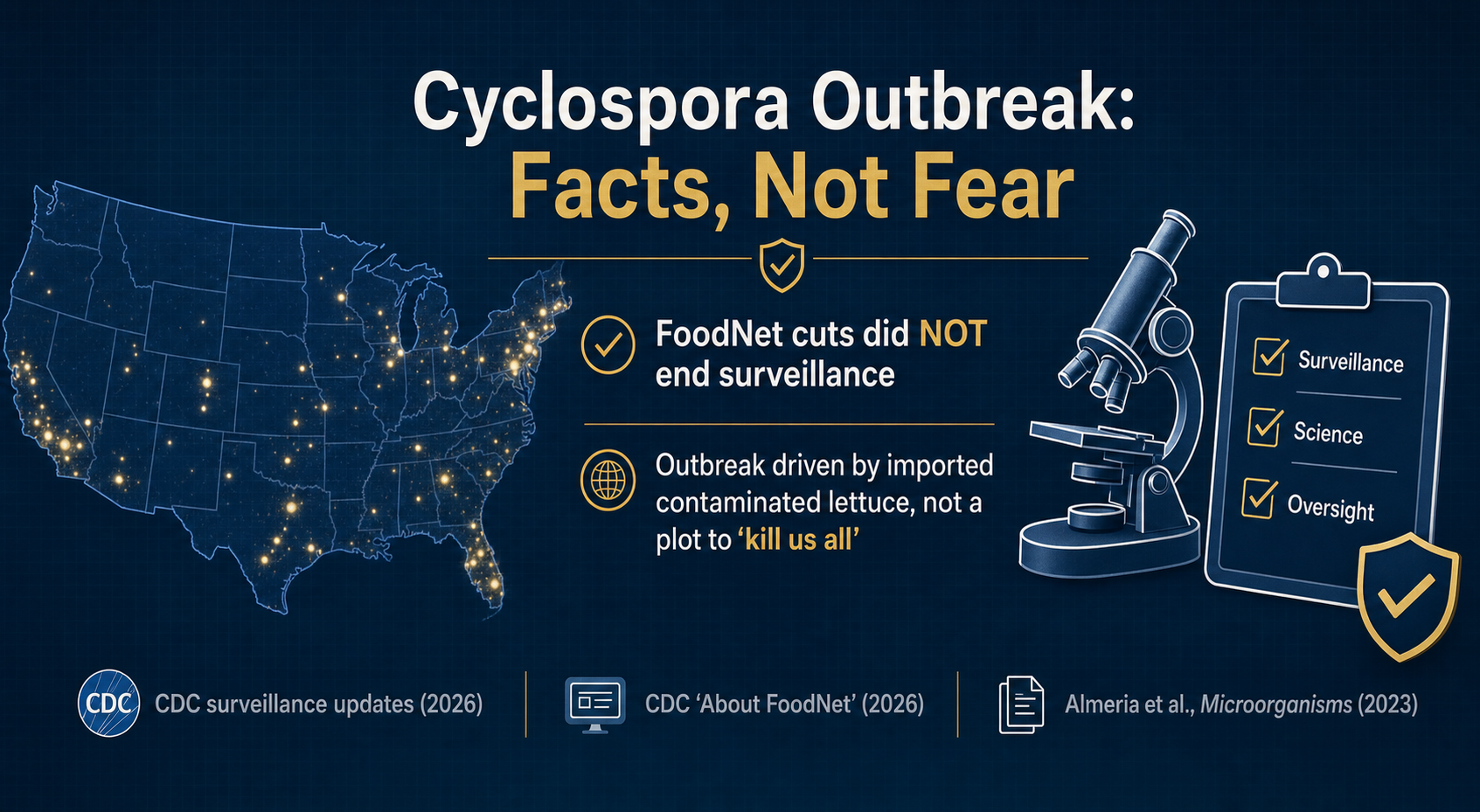
The Cyclospora Outbreak: Separating Fact From a Democratic Talking Point
A viral Facebook post blames RFK Jr. and Trump for the 2026 cyclosporiasis outbreak. So do Rep. James Talarico, Sen. Jon Ossoff, Sen. Elizabeth Warren, and Rep. Mike Levin. Here's what the CDC's own record actually shows.
The Claim
What the viral post says, and what checks out
A Facebook post circulating under the page "DeSoto, Let's Talk Politics" pairs images of Health and Human Services Secretary Robert F. Kennedy Jr., a microscope image of a parasite, and President Trump with text asserting: "The explosive diarrhea-causing cyclosporiasis outbreak has now spread to 31 states, with nearly 7,000 potential cases," and that "last year, RFK ordered the CDC's Foodborne Diseases Active Surveillance Network to stop tracking cyclosporiasis," concluding "Trump and RFK Jr. won't stop until they kill us all."
Two factual elements in the post check out: a large cyclosporiasis outbreak is genuinely underway, and CDC did narrow FoodNet's mandatory pathogen list in July 2025. But the causal claim — that this narrowing caused the outbreak — does not survive contact with CDC's own description of what FoodNet does.
CDC's most recent update, current through August 3, 2026, reports 10,468 confirmed cases across 47 states, 517 hospitalizations, and two deaths, both Michigan patients with underlying health conditions [CDC, 2026a]. And in July 2025, CDC did reduce FoodNet's required pathogen list from eight to two, making Cyclospora reporting through that specific program optional rather than mandatory [CDC, 2026b].
What the post omits is what FoodNet actually does, that its scope reduction did not eliminate federal Cyclospora surveillance, and that FoodNet was never the system responsible for detecting multistate outbreaks in the first place. Those distinctions are the difference between an accurate criticism of a budget decision and a claim that a specific policy choice directly caused this outbreak — the exact distinction this report examines in the statements made by Rep. James Talarico and several of his congressional Democratic colleagues.
Cyclosporiasis is a gastrointestinal illness caused by the microscopic parasite Cyclospora cayetanensis, transmitted through food or water contaminated with sporulated oocysts shed in human feces. It causes watery, sometimes explosive diarrhea, appetite loss, and weight loss, and is most often linked in the U.S. to imported or domestically grown fresh produce such as berries, herbs, and leafy greens [Almeria et al., 2023].
What FoodNet Actually Is
A burden-estimation network, not an outbreak-detection system
FoodNet (the Foodborne Diseases Active Surveillance Network) was established in 1995 as a partnership among CDC, USDA, FDA, and 10 state health departments covering about 16% of the U.S. population [CDC, 2026b]. Its stated objectives are to determine and monitor the burden of foodborne illness over time, attribute that burden to specific foods and settings, and inform prevention policy — not to serve as the front-line trigger for identifying active multistate outbreaks [CDC, 2026b].
“FoodNet's active surveillance activities were not designed to detect outbreaks of foodborne illness. No recent changes have been made to how CDC and our federal, state, and local partners detect and investigate outbreaks through existing epidemiologic or laboratory systems, such as the national laboratory network PulseNet.”— Centers for Disease Control and Prevention, About FoodNet (2026b)
Outbreak detection runs primarily through PulseNet (molecular subtyping to link cases to a common source) and the National Notifiable Diseases Surveillance System (NNDSS), a passive but mandatory reporting system through which cyclosporiasis has remained a nationally notifiable condition in 47 states, D.C., and New York City throughout this period [CDC, 2026a].
| Year | Confirmed Cases | Primary Suspected Source | FoodNet Cyclospora Status |
|---|---|---|---|
| 2016 | 87 | Blackberries (Mexico) | Mandatory |
| 2018 | 85 | Berries, tomatoes (Texas clusters) | Mandatory |
| 2019 | 2,408 | Fresh basil (Mexico) | Mandatory |
| 2020 | 1,241 | Bagged salad mix (domestic) | Mandatory |
| 2021 | 1,020 | Leafy greens (unknown origin) | Mandatory |
| 2022 | 1,129 | Leafy greens (unknown origin) | Mandatory |
| 2025 | — | N/A — no major outbreak reported | Became optional July 1, 2025 |
| 2026 (through Aug 3) | 10,468 | Shredded iceberg lettuce, Taylor Farms de México | Optional |
Effective July 1, 2025, CDC narrowed FoodNet's required reporting from eight pathogens (Campylobacter, Cyclospora, Listeria, Salmonella, STEC, Shigella, Vibrio, and Yersinia) to two (Salmonella and STEC), along with pediatric hemolytic uremic syndrome reporting [CDC, 2026b]. A CDC spokesperson attributed the change to funding: "Funding has not kept pace with the resources required to maintain the continuation of FoodNet surveillance for all eight pathogens" [Flynn, 2025]. The change was not publicly announced and became widely known only after NBC News reported it roughly two months later ["CDC Stopped Actively Tracking," 2025].
Critically, CDC states that the six deprioritized pathogens, including Cyclospora, continue to be monitored through other systems, chiefly NNDSS [CDC, 2026b]. States retained the option to continue active FoodNet-style Cyclospora surveillance at their own expense, and cyclosporiasis remained a mandatory notifiable condition nationwide, meaning healthcare providers were still legally required to report confirmed cases [CDC, 2026a].
Responding directly to this line of criticism on July 21, 2026, Secretary Kennedy said: "We've had no cuts in our surveillance program. We did cuts in the FoodNet program, but they were for redundant surveillance, and all the states will tell you that we're still doing forensics," calling the criticism "invalid" [Mosheh, 2026].
Congressional critics dispute that characterization on different grounds than the post does. Rep. Greg Stanton's July 16, 2026 letter to Secretary Kennedy does not claim FoodNet was the outbreak-detection mechanism; instead it asks HHS to identify which system replaced FoodNet's active laboratory outreach function — staff routinely contacting more than 700 clinical laboratories rather than waiting for passive reports — and whether that function performs equivalently [Stanton, 2026]. That is a legitimate, narrower question about surveillance speed and completeness, distinct from the post's claim that RFK Jr. "ordered" a stop to tracking cyclosporiasis altogether.
How This Outbreak Grew, and Where It Traces
A foreign-origin contamination event, not a surveillance failure
CDC's cyclosporiasis season runs May 1 through August 31, coinciding with warm-weather conditions that favor oocyst sporulation [CDC, 2026a]. The 2026 season began typically but accelerated sharply in Michigan and the Great Lakes region by late June. CDC, FDA, and state investigators subsequently linked a multistate cluster to shredded iceberg lettuce supplied by Taylor Farms de México and served at Taco Bell locations, an outbreak that expanded from an initial five states to nine by late July [CDC, 2026c]. Distribution of the same lettuce to Walmart and other retail and food-service outlets broadened potential exposure further [FDA, 2026].
By early August 2026, CDC confirmed the outbreak's first two associated deaths, both Michigan residents with underlying health conditions, alongside 517 total hospitalizations nationwide out of 10,468 confirmed cases [CDC, 2026d]. Michigan state health officials have separately reported case counts many times higher than the federal confirmed-case figure, citing reporting lag and describing more than 9,500 illnesses at the state level alone as of late July [CIDRAP, 2026]. This discrepancy reflects differences in state versus federal case-confirmation methodology, not a change in the underlying disease burden.
Two structural features matter for assessing causation: first, the rise in case counts between CDC updates substantially reflects a reporting lag catching up to infections that had already occurred, not new transmission accelerating in real time. Second, the traceback identifies an imported ingredient — lettuce supplied by a Mexican grower — as the proximate source, placing the point of contamination outside U.S. jurisdiction and outside the reach of any domestic surveillance program, active or passive [CDC, 2026d].
The New World screwworm outbreak offers a useful point of comparison because its origin is not contested. NWS had been eradicated from the U.S., Mexico, and Central America for decades through a sterile-fly release program maintained at a biological barrier on the Panama–Colombia border since 2006 [CDC, 2026e]. In 2023, Panama recorded a spike of more than 9,300 cases, and unregulated cattle movement allowed the parasite to spread north through Central America and into Mexico over the following two years [CDC, 2026e]. In both the cyclospora and screwworm cases, the biological hazard originated and proliferated outside U.S. borders before affecting American consumers or livestock through trade and import channels.
Talarico, Davis, and Democratic Statements
The claim is not fringe — it is a coordinated talking point among sitting officials
The claim in the viral Facebook post is not an isolated fringe talking point. It closely mirrors statements made in this same period by Rep. James Talarico and several sitting members of Congress, on the record and in their own words.
- Sen. Jon Ossoff (D-GA), official press release, July 19, 2026: "Amidst cyclospora parasite outbreak, Sen. Ossoff slams HHS Secretary Kennedy for canceling CDC's required surveillance of parasite" [Ossoff, 2026]
- Sen. Elizabeth Warren (D-MA), Facebook, July 29, 2026: "Donald Trump and RFK Jr. cut the team tracking cyclospora by more than 70%..." [Warren, 2026]
- Rep. Mike Levin (D-CA), Facebook, July 29, 2026: "We need to talk about cyclospora..." attributing the outbreak to Trump administration and RFK Jr. surveillance cuts [Levin, 2026]
These statements share the same core factual claim as the viral post: that a specific 2025 federal surveillance decision by the Trump administration and Secretary Kennedy is the cause of the 2026 outbreak.
Rep. Aicha Davis, the author's opponent in House District 109, has made no identified public statement on cyclosporiasis, the FoodNet surveillance change, or the 2026 outbreak as of this article's publication, despite extensive review of her official social media accounts and public record [Davis, 2026]. This is noted here as a factual observation of the public record, not as a criticism — Rep. Davis has simply not engaged publicly with this particular issue at the time of writing.
The Verdict
Does the causal claim advanced by Talarico, Ossoff, Warren, and Levin hold up?
The post, and the statements above from Rep. Talarico, Sen. Ossoff, Sen. Warren, and Rep. Levin, all assert the same causal chain: RFK Jr. and the Trump administration ordered a stop to Cyclospora tracking → therefore this outbreak occurred → therefore the administration is responsible for resulting harm. Breaking this into its component premises, using only sourced facts, clarifies where the argument holds and where it fails.
The five sourced premises
- Empirical, sourced. In July 2025, CDC made Cyclospora reporting through FoodNet optional rather than mandatory, reducing FoodNet's required pathogen list from eight to two [CDC, 2026b].
- Empirical, sourced. FoodNet was designed to estimate the burden of foodborne illness and was explicitly not designed to detect outbreaks; outbreak detection is performed by PulseNet and mandatory NNDSS notifiable-disease reporting, neither of which was altered by the 2025 change [CDC, 2026b].
- Empirical, sourced. Cyclospora remained a mandatory nationally notifiable condition throughout 2025 and 2026 [CDC, 2026a].
- Empirical, sourced. The 2026 outbreak has been traced to an imported produce ingredient (Mexican-grown lettuce) processed and distributed by a third-party supplier, a contamination event occurring outside U.S. jurisdiction [CDC, 2026d].
- Empirical, sourced. Multistate U.S. cyclosporiasis outbreaks exceeding 1,000 confirmed cases occurred in 2019, 2020, 2021, and 2022 — years in which FoodNet's full eight-pathogen mandatory surveillance was fully intact [Almeria et al., 2023].
From these five sourced premises, the claim advanced by Rep. Talarico, Sen. Ossoff, Sen. Warren, and Rep. Levin — that the FoodNet change directly caused the outbreak — does not follow, and is substantively contradicted by the record. FoodNet's narrowed scope did not remove the systems (PulseNet, NNDSS) actually responsible for detecting and investigating multistate outbreaks. Comparably large outbreaks recurred annually before the 2025 change existed, driven by produce contamination patterns rather than surveillance policy.
The premises support a narrower and more defensible conclusion than the one these officials have publicly stated: the 2025 change may have reduced the speed or granularity of case ascertainment in the ten FoodNet catchment states, a legitimate open question raised by congressional oversight letters [Stanton, 2026] — but it is not established, and the available evidence weighs against, the claim that the change caused an outbreak that would not otherwise have occurred. Attributing this year's severity, including the two confirmed deaths, to a domestic budget line item rather than to the imported-produce contamination event that investigators actually identified is not supported by the facts assembled in this report.
This mirrors the screwworm case: robust surveillance and rapid detection protocols exist to shorten response time and limit spread once an outbreak begins, but they are reactive tools. They do not prevent a foreign-origin biological hazard from entering the food or livestock supply in the first place. Treating a monitoring-program budget line as the root cause of either outbreak substitutes a simple political narrative for the more complex reality of import-dependent food and agricultural systems.
References
Sources are organized by the sections of this article they principally inform. Citations follow APA 7th Edition format. All sources are primary or peer-reviewed originals; no internal working documents are cited.
Case counts, hospitalization figures, and state totals in this bibliography have been updated from official CDC reporting as of August 3, 2026. Numbers cited here supersede those in the article's original edition.
Cyclospora & FoodNet — Sections 1–3
Almeria, S., Chacin-Bonilla, L., Maloney, J. G., & Santin, M. (2023). Cyclospora cayetanensis: A perspective (2020–2023) with emphasis on epidemiology and detection methods. Microorganisms, 11(9), 2171.
Peer-reviewed review article summarizing Cyclospora cayetanensis epidemiology, transmission, and outbreak history from 2019–2022, including a data table of confirmed case counts by year. Used to establish the pre-2025 baseline outbreak history and to define the parasite's biology.
Centers for Disease Control and Prevention. (2026a). Surveillance of cyclosporiasis. U.S. Department of Health and Human Services.
Official, continuously updated CDC surveillance page providing case counts, hospitalizations, deaths, and state-level data for the 2026 outbreak. Primary source for all current case statistics cited throughout this article.
Centers for Disease Control and Prevention. (2026b). About FoodNet. U.S. Department of Health and Human Services.
Official CDC program page describing FoodNet's history, objectives, and the July 2025 change making six of eight pathogens optional, including CDC's explicit statement that FoodNet was not designed to detect outbreaks.
Centers for Disease Control and Prevention. (2026c, July 23). Cyclospora outbreak linked to iceberg lettuce expanded to four new states [Press release]. U.S. Department of Health and Human Services.
Official CDC press release documenting the outbreak's expansion from five to nine states by late July 2026.
Centers for Disease Control and Prevention. (2026d, August 2). Investigation update: Cyclospora outbreak, July 2026. U.S. Department of Health and Human Services.
Official, continuously updated CDC outbreak investigation notice identifying shredded iceberg lettuce from Taylor Farms de México as the confirmed source, and reporting the outbreak's first two associated deaths.
Center for Infectious Disease Research and Policy. (2026, July 13). What we truly know about the huge US Cyclospora outbreak — and what we don't. University of Minnesota.
Secondary-source analysis summarizing state-versus-federal case count discrepancies, including Michigan's substantially higher state-reported case totals.
Flynn, D. (2025, August 28). CDC confirms cuts to program that tracks foodborne pathogens. Food Safety News.
News-media source reporting CDC's own confirmation and stated budget rationale for the FoodNet scope reduction, including a direct quote from a CDC spokesperson.
Mosheh [@mosheh]. (2026, July 21). Health Secretary Robert F. Kennedy Jr. said the U.S. outbreak of cyclosporiasis is "under control"… [Video]. Instagram.
Social media post containing Secretary Kennedy's direct, recorded public statement responding to criticism of the FoodNet cuts at a July 21, 2026 press briefing.
U.S. Food and Drug Administration. (2026, July 24). Investigation of 9-state outbreak of Cyclospora illnesses linked to iceberg lettuce [Official investigation page].
Official FDA investigation and recall notice detailing the Taylor Farms de México lettuce recall, affected retail distribution, and state-by-state case totals.
CDC stopped actively tracking 6 foodborne infections amid budget cuts. (2025, August 27). Ars Technica.
News-media source documenting that the FoodNet change was not publicly announced and became known only after NBC News inquired roughly two months after the change took effect.
Talarico & Democratic Statements — Section 4
Ossoff, J. (2026, July 19). Amidst cyclospora parasite outbreak, Sen. Ossoff slams HHS Secretary Kennedy for canceling CDC's required surveillance of parasite [Press release]. U.S. Senate.
Official congressional press release from Sen. Jon Ossoff (D-GA) directly attributing the outbreak to Secretary Kennedy's FoodNet decision.
Warren, E. [Sen. Elizabeth Warren]. (2026, July 29). "Donald Trump and RFK Jr. cut the team tracking cyclospora by more than 70%…" [Post]. Facebook.
Statement from Sen. Elizabeth Warren (D-MA) echoing the same surveillance-cut causal claim.
Levin, M. [Rep. Mike Levin]. (2026, July 29). "We need to talk about cyclospora…" [Post]. Facebook.
Statement from Rep. Mike Levin (D-CA) attributing the outbreak to Trump administration and RFK Jr. surveillance cuts.
Davis, A. [@aicha_davis]. (2026). [Instagram profile]. Instagram.
Official Instagram account of Rep. Aicha Davis (D-Dallas), reviewed in full for any public statement regarding cyclosporiasis, FoodNet, or the 2026 outbreak. No such statement was identified as of this article's publication.
Stanton, G. (2026, July 16). Letter to Secretary Robert F. Kennedy Jr. regarding the Cyclospora outbreak and FoodNet surveillance cuts [Official congressional correspondence]. U.S. House of Representatives.
Primary source: original congressional oversight letter from Rep. Greg Stanton (D-AZ) requesting documentation of the FoodNet decision and staffing changes.
Screwworm Comparative Case
Centers for Disease Control and Prevention. (2026e, January 20). New World screwworm: Outbreak moves into northern Mexico [Health Alert Network Advisory CDCHAN-00526]. U.S. Department of Health and Human Services.
Official CDC Health Alert Network advisory detailing the history of the New World screwworm eradication program, its 2023 resurgence in Panama, and its northward spread through Mexico by early 2026.
Centers for Disease Control and Prevention. (2026f, July 14). New World screwworm outbreak. U.S. Department of Health and Human Services.
Official CDC situation summary providing current U.S., Mexican, and Central American case counts for New World screwworm as of July 2026.
Polansek, T. (2026, June 2). Flesh-eating screwworm detected 25 miles from US border in Mexico, USDA says. Reuters.
News-media source reporting USDA Secretary Brooke Rollins's confirmation of the screwworm's advance to within 25 miles of the U.S. border.