
Relief for Sand Branch, TX - A Bill to Build Their Water and Wastewater Needs
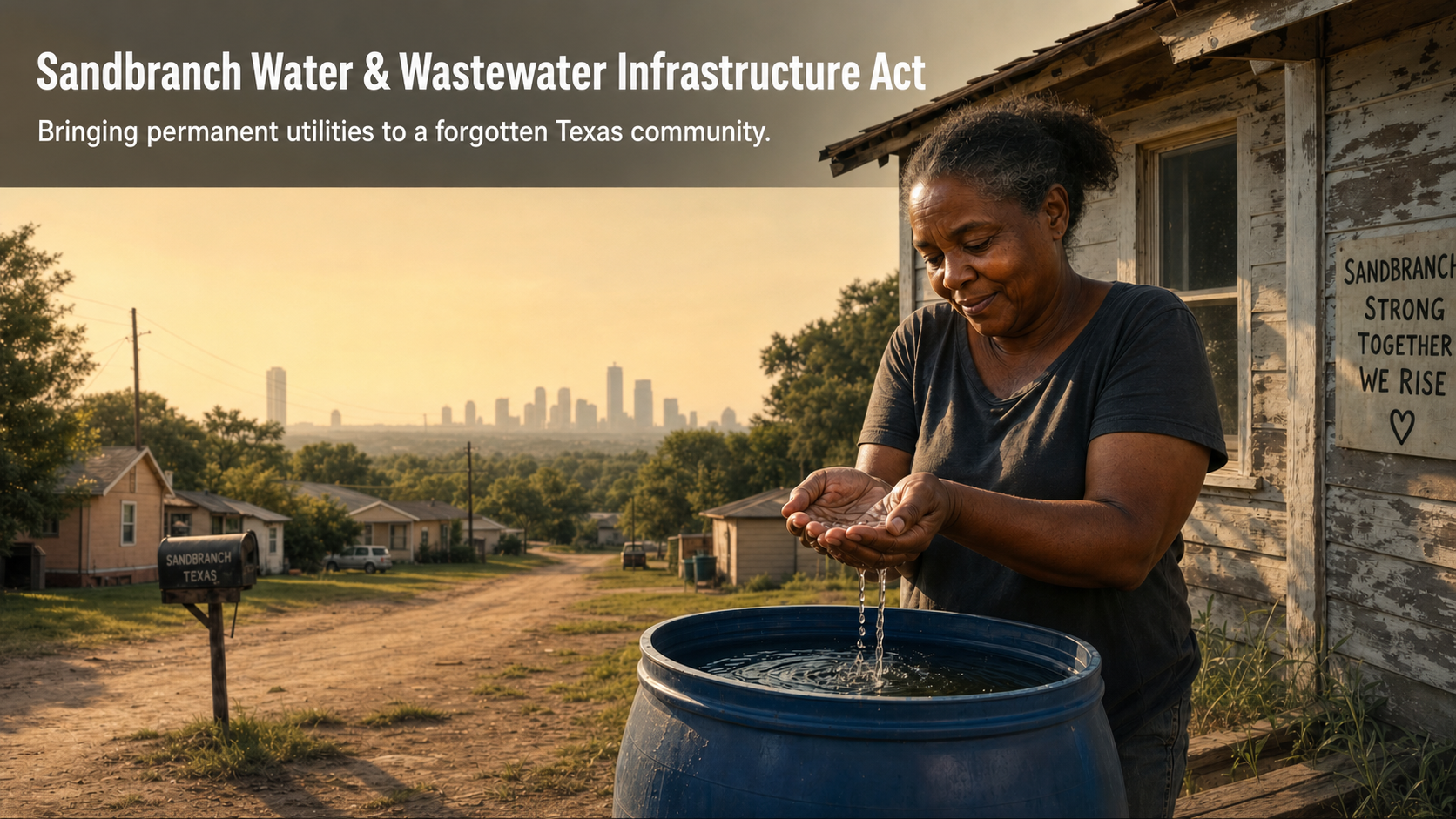
Sand Branch, Texas: The 148-Year Fight for Clean Water — And the Plan to Finally Fix It
A constituent briefing for House District 109 — Cedar Hill to Seagoville, on the history, the current crisis, and a debt-free state legislative solution — now also funding unconnected Seagoville homes — ready for filing in the 90th Texas Legislature.
Overview
Why this article matters to House District 109
If you live in Cedar Hill, DeSoto, Glenn Heights, Lancaster, Wilmer, Hutchins, or Seagoville, there is a good chance you have never heard of Sand Branch — even though it sits inside the same southeastern Dallas County corridor as your community. Sand Branch is a small, historic settlement located on Belt Line Road, roughly two miles south of U.S. Highway 175, near the Trinity River. (Texas A&M School of Law, 2022) For nearly 150 years, its residents have never had a working municipal water or sewer system — not a temporary outage, not a slow repair, but a complete, permanent absence of basic utility service that most Texans take for granted. (Texas Environmental Law Firm, 2021)
This article explains how that happened, what has been done about it so far, and what a new piece of state legislation — currently drafted and ready for filing in the 90th Texas Legislature — is designed to do about it. It also explains why Seagoville residents in particular have a direct stake in this story, because a permanent fix for Sand Branch may eventually involve extending Seagoville’s own city services into the area.
Sand Branch was founded in 1878 by twelve formerly enslaved people who traveled from Louisiana into Texas and, after being turned away from established towns, settled an unincorporated stretch of southeastern Dallas County as sharecroppers. (Movement Strategy Center, 2026) In 1910, residents Doc Glenn, Charlie Stark, and Cicero Floyd donated more than an acre of land for a community cemetery believed to hold the graves of many formerly enslaved settlers. (Movement Strategy Center, 2026)
At its peak, Sand Branch was home to roughly 400 residents, a population that held steady as recently as the 2000 U.S. Census. (Texas Almanac, 2008) Today, only an estimated 80 to 100 residents remain. (Movement Strategy Center, 2026)(Style Magazine, 2026) That collapse in population is not simply the story of a small town fading — it is the direct result of decisions made by government agencies over the past 40 years, covered in detail in Section 3 below.
A bill drafted for the 90th Texas Legislature would create a dedicated, debt-free state grant program for Sand Branch — not a bond, not a loan, and not new debt for residents or for Seagoville taxpayers.
Sand Branch is unincorporated, meaning it has no city government of its own and currently sits outside any city’s jurisdiction, including Seagoville’s extraterritorial jurisdiction (the roughly one-mile planning buffer around a city). (Seagoville Official City Limits and ETJ Map)
The Water Crisis
Four decades without clean water, and the advocates who kept the fight alive
Sand Branch’s well water began turning discolored and developing a foul, sulfur-like smell in the 1980s, eventually becoming unsafe to drink, cook with, or bathe in. (Texas Environmental Law Firm, 2021) Independent testing by Texas A&M scientists in 2016 confirmed the groundwater was heavily contaminated, although the exact cause remains disputed. Residents have long pointed to the City of Dallas’s Southside Wastewater Treatment Plant — built in 1964 as close as roughly 400 feet from Sand Branch homes — while Dallas County officials have instead pointed to historical livestock waste, septic systems, and nearby gravel mining. (The Guardian, 2017) Local environmental researcher Ben Sandifer has offered a middle explanation: Sand Branch sits on a shallow “perched aquifer” that is easy to reach with hand-dug wells, but just as easy for surface contamination from multiple sources to seep into. (The Guardian, 2017)
Whatever the precise cause, the result today is that roughly a quarter of Sand Branch’s population has no access to running water or sewer service of any kind, and residents must travel elsewhere in the county just to haul water home. (Texas Environmental Law Firm, 2021)
Reverend Eugene Keahey, pastor of Mt. Zion Missionary Baptist Church starting in 2010, became the community’s most visible advocate, pressing the City of Dallas, Dallas County, and FEMA simultaneously. In 2016, he helped found the Sandbranch Development & Water Supply Corporation (SDWSC), the volunteer nonprofit water utility that remains the community’s officially recognized water supply corporation and its primary vehicle for organizing infrastructure funding to this day, and spoke that same year at an EPA Region 6 environmental justice forum. In 2019, Keahey and his family were killed in a house fire that dramatically slowed the community’s organizing momentum for several years. (Movement Strategy Center, 2026)
Attorney Mark McPherson has represented Sand Branch pro bono since 2016 and picked up much of that advocacy work after Keahey’s death, helping secure a U.S. Department of Agriculture commitment to fund up to 75 percent of system construction costs and a $30,000 USDA-funded engineering study. (Texas Environmental Law Firm, 2021)
Who Is Doing the Work on the Ground
None of the recent momentum toward finally fixing Sand Branch would exist without sustained, dedicated organizing by the community’s own recognized water utility. SDWSC is the officially recognized water supply corporation for the community and the entity through which the Texas Water Development Board (TWDB) has already extended formal state assistance. SDWSC is also the entity the proposed legislation designates as an eligible grant recipient, positioning it to receive and administer state infrastructure funding directly. (Texas Water Development Board, 2020)
Alongside SDWSC, several other organizations have supported the community in recent years. The Water for Sand Branch Coalition, founded by Dallas-area real estate developer Derek Avery, is one such group, coordinating with residents, tracking household-level need, and publicly advocating for a permanent solution. As of the most recent 2026 reporting, the coalition identifies approximately 94 households still without permanent access to safe water and sewer service. (Style Magazine, 2026)
| Organization | Relief Provided | Scale / Start Year |
|---|---|---|
| Church of the Ascension | Quarterly bottled water deliveries | ~1,250 cases since 2020 |
| C’s Corner Store & Thrift | Weekly water distribution | Ongoing |
| Juggernaut Relief Inc. | Weekly water distribution | Ongoing |
| Water for Sand Branch Coalition | Coordination, tracking, public advocacy | 94 households tracked, 2026 |
| North Texas Conf., United Methodist Church | Modular water tanks & refill assistance | ~50 households |
For years, Wayside Missionary Baptist Church on South Belt Line Road has served as the literal and symbolic center of Sand Branch’s survival. Every Saturday morning, Pastor Frank Alexander and church volunteers distribute free cases of bottled water — and often food — to residents who have no other reliable source of clean water, a routine that has continued for years and shows no sign of stopping. (WFAA, 2020) (PhMuseum, n.d.) The church has also hosted community meetings, Juneteenth gatherings, and coalition town halls, making it the de facto hub where residents, advocates, and elected officials meet face to face on the ground in Sand Branch. (People’s World, 2024) (Dallas Weekly, 2024)
Wayside’s ongoing work is a reminder that the people of Sand Branch have not been waiting passively for government action — they have been sustaining themselves and each other for decades. Residents and supporters can join the effort or contribute bottled water directly at the church, located at 4128 S. Beltline Road, Seagoville, Texas. (Wayside Missionary Baptist Church, 2026)
The Floodplain Rule
The paperwork problem that emptied the town — not a flood that ever happened
This is the part of the story most people outside Sand Branch have never heard — and it is central to understanding why the community shrank so dramatically. Dallas County adopted floodplain regulations under FEMA’s National Flood Insurance Program sometime in the mid-to-late 1980s, restricting new construction in mapped floodplain areas unless built to flood-resistant standards. (PhMuseum, n.d.) Despite this rule, Dallas County allowed roughly 70 new structures to be built in Sand Branch between 1985 and 2000 — technically in violation of both the county’s own ordinance and federal flood program requirements. (PhMuseum, n.d.) In 2000, after Dallas County received a $400,000 state grant to study a water solution for Sand Branch, FEMA discovered the county’s flood-program violations and threatened to disqualify the entire county from the National Flood Insurance Program unless it enforced the rule — giving residents roughly 30 days to choose between building a levee, elevating their homes, relocating, or demolition. (PhMuseum, n.d.) That program is the primary reason Sand Branch’s population fell from roughly 400 to under 100 residents, and nearly everyone who remains today lives in a home that was “grandfathered in” because it was built before the floodplain rule took effect. (PhMuseum, n.d.)
“No historical record of actual flooding in Sand Branch has ever been documented — the floodplain designation that ultimately reshaped this community’s future was not a response to a flood that happened, it was a paperwork compliance problem that fell hardest on the people who could least afford to fight it.”— Analysis of PhMuseum flood-history research, 2026
In response to FEMA’s ultimatum, Dallas County created a relocation assistance program in 2004–2005 that funded the relocation of 36 households and led to the demolition of nearly 100 structures. After required demolition fees were deducted, some families were left with as little as $350 to $500 — not enough to cover even one month’s rent elsewhere. (Texas Environmental Law Firm, 2021)(PhMuseum, n.d.) The floodplain designation is still active today. Dallas County’s current effective flood maps for the area took effect in July 2014, and as recently as June 2026, the Water for Sand Branch Coalition confirmed on social media that new construction remains restricted “due to the flood plain unless built on stilts.” (Water for Sand Branch Coalition, 2026)
What the State Has Done
Real progress on paper — and the funding gap that remains
Sand Branch is not a problem the state has ignored entirely. In August 2020, the Texas Water Development Board approved $450,000 to the Sandbranch Water Supply Corporation for planning work related to water and wastewater infrastructure. (Texas Water Development Board, 2020) In the board’s most recent Clean Water State Revolving Fund plan for state fiscal year 2026, the Sand Branch wastewater project is ranked second statewide on the board’s project priority list, with a listed cost of $5,461,100 for roughly 30,000 linear feet of new sewer line, a lift station, and a connection to the City of Dallas’s Southside Wastewater Treatment Plant. (Texas Water Development Board, 2025)
That ranking is meaningful — it means the state already recognizes Sand Branch as a legitimate, high-priority infrastructure project, not a hopeless case. But a ranking on a priority list is not the same as guaranteed funding, and the $5.46 million figure covers wastewater only. It does not include a permanent drinking-water system, household connection costs, or protections to keep families from being priced out once service finally arrives. (Texas Water Development Board, 2025)
The 2025 Texas Legislature passed a supplemental appropriations bill giving TWDB just over $1 billion for a new Water Supply and Infrastructure Grants program. (LegiScan, 2025) That program explicitly excludes wastewater and flood-control projects, and nonprofit water supply corporations like SDWSC cannot apply on their own — they need to be paired with an interlocal government entity. (Texas Living Waters Project, 2026)
Estimates of the true cost to finish the job have grown over time as reporting has caught up with the full scope of the need — from roughly $6 to $6.5 million in earlier engineering estimates, to $8 million for core infrastructure plus $4.5 million for affordability and anti-displacement protection in the coalition’s most recent comprehensive plan, for a total of about $12.5 million. (Dallas Observer, 2024)(Dallas Weekly, 2025)
Separately, an additional source of funding potentially became available in 2025 that constituents should understand. The 2025 Texas Legislature also raised the bonding authority of the state’s long-standing Economically Distressed Areas Program (EDAP) to $100 million annually and increased the maximum grant share of EDAP financial assistance from 70 percent to 90 percent of total project costs for a qualifying economically distressed community — a description Sand Branch has long met given its complete lack of a functioning water or wastewater system. (Texas Water Development Board, 2026) The bill described below was updated to require the state to actively pursue this enhanced EDAP grant funding for Sand Branch and apply it before drawing down the bill’s own general-revenue backstop dollars, which could ultimately mean the state ends up spending less of its own new appropriation than the bill authorizes, while still guaranteeing the full amount remains available as a ceiling in case EDAP funding does not materialize on the needed timeline.
What the proposed bill would do differently
- It is a state grant, not a loan or a bond — no debt is created for Sand Branch residents, no bond election is required, and no interest costs accrue over time.
- It authorizes funding for the whole project, including planning, water and sewer lines, lift stations, household hookups, and board-approved affordability protections.
- It addresses the floodplain problem directly, requiring a formal federal map-revision review before flood-related construction money is spent, and now prioritizes certifying an existing, previously uncertified levee before ever funding new construction.
- It funds a solution for Seagoville’s own residents, independent of Sand Branch. City leadership disclosed that a meaningful number of Seagoville’s own residents are not currently connected to the city’s water system, even though that same system already extends service to the neighboring community of Combine. The bill directly funds extending Seagoville’s water and sewer lines to those unconnected homes and businesses, independent of Sand Branch’s timeline or whether annexation ever happens.
- It requires the state to actively pursue additional economically-distressed-area grant funding for Sand Branch before spending the bill’s own new dollars. Building on the 2025 Legislature’s expansion of the Economically Distressed Areas Program described above, the bill now directs TWDB to evaluate and pursue that enhanced 90 percent EDAP grant for Sand Branch and apply any funding secured that way before drawing on the bill’s own backstop appropriation — stretching every dollar of state money further and reducing the odds that new general revenue is needed at all beyond what other existing programs can already cover.
- It correctly limits which coordination funding programs Seagoville’s own project can rely on, based on the city’s actual size. An earlier version of the bill listed a state rural-utility assistance program among the outside funding sources Seagoville could coordinate with for its own project. Because Seagoville’s population of roughly 20,300 to 21,500 residents exceeds the state’s legal population threshold for “rural” status, and because Seagoville sits in a county containing urban areas well over that threshold as well, the bill has been corrected to remove that rural-only program from Seagoville’s list and to make clear that nothing in the bill creates rural-program eligibility Seagoville does not actually have under existing law. This does not affect Seagoville’s ability to draw on the Clean Water and Drinking Water State Revolving Funds, federal community development block grant funding, or USDA rural development loans and grants, none of which are limited to rural political subdivisions.
- It is written to work alongside annexation, not against it.
- It comes with a real appropriation attached, not just permission for an agency to act if it someday chooses to.
| Community | Bill Funding Amount | What It Covers |
|---|---|---|
| Sand Branch | Up to $29,500,000 (general revenue backstop ceiling, applied only after existing committed/prioritized state funding and any Economically Distressed Areas Program grant secured under the bill’s stacking directive are used first) | Water, wastewater, flood-control/levee certification or construction, electric utility line extension, utility certificate costs, household connections, and affordability protections |
| Seagoville | $12,000,000 (direct general revenue appropriation) | Extending water and sewer lines to currently unconnected Seagoville homes and businesses, replacing lead or noncompliant service lines, and expanding system capacity — including capacity to eventually serve Sand Branch |
Working with the community already on the ground
Critically, this bill was drafted specifically to complement — not compete with — the work SDWSC has already been doing as the community’s recognized water utility. It designates SDWSC and comparable community-serving nonprofit water entities as eligible recipients of the funding, meaning the organization already on the ground, already legally recognized by the state, and already trusted by residents is positioned to receive and administer the help, rather than having a new bureaucracy imposed on top of its work. (Texas Water Development Board, 2020)
Implications
Why Seagoville should care, and what happens next
Sand Branch currently sits outside any city’s jurisdiction — it is not within Seagoville’s city limits or even its extraterritorial jurisdiction (the roughly one-mile buffer zone around a city where that city has certain planning authority). (Seagoville Official City Limits and ETJ Map) That matters because Texas law no longer allows cities to forcibly annex outside communities. Since a 2019 state law change, annexation now requires the consent of the residents and landowners being annexed — Seagoville’s city council could not simply vote to absorb Sand Branch even if it wanted to. (Texas Municipal League, 2024)
Near-term effects
Any future annexation would have to be requested by Sand Branch residents themselves, and — if Seagoville agreed — the city would then be legally bound to deliver full municipal services, including water and sewer, typically within two and a half to four and a half years of annexation. (Texas Municipal League, 2024) For Seagoville taxpayers, the sequencing matters enormously: annexing an unincorporated area with no infrastructure and no funding would create an unfunded municipal obligation the city would have to pay for itself.
Long-term trajectory
The proposed legislation solves that problem by design — it authorizes state grant money to build the infrastructure either before or alongside any annexation process, so that if Sand Branch residents ever do request to join Seagoville, they would bring state-funded infrastructure with them rather than an expensive unfunded liability. (Dallas Observer, 2024)
The bill is explicit that annexation is never a condition of any funding under this Act — Sand Branch families get water, sewer, and power regardless of whether annexation ever happens, now or in the future. It also directly addresses a fairness question Seagoville leaders raised during recent discussions: it would be hard to justify extending city service to a newly annexed Sand Branch before finishing service to Seagoville’s own existing residents who still aren’t connected. That is why the bill’s Seagoville funding stands on its own, fully independent of anything happening with Sand Branch.
In practical terms, this legislation gives Seagoville residents a path to eventually welcome Sand Branch into the city — gaining new neighbors, new tax base, and closing a longstanding humanitarian gap in the district — without asking current Seagoville taxpayers to foot the bill for infrastructure the state can and should pay for instead, and without leaving Seagoville’s own unconnected families waiting on Sand Branch’s timeline. The bill described in this article has been fully drafted and is ready for formal submission to the Texas Legislative Council ahead of the 90th Legislative Session convening in 2027. Advocacy and coordination with SDWSC, the Water for Sand Branch Coalition, Dallas County officials, and the City of Seagoville’s mayor and city manager will continue in the months ahead of filing to make sure the bill reflects the realities on the ground.
By: ____________________ H.B. No. ______
90th Legislature, Regular Session, 2027
A BILL TO BE ENTITLED
AN ACT
relating to financial assistance for water, wastewater, flood-control, and electric utility infrastructure for the Sand Branch community in Dallas County and for related water and wastewater infrastructure improvements in the City of Seagoville necessary to serve Sand Branch and Seagoville residents; making an appropriation.
BE IT ENACTED BY THE LEGISLATURE OF THE STATE OF TEXAS:
SECTION 1. Subchapter C, Chapter 15, Water Code, is amended by adding Section 15.1025 to read as follows:
Sec. 15.1025. FINANCIAL ASSISTANCE FOR SAND BRANCH AND SEAGOVILLE WATER, WASTEWATER, FLOOD-CONTROL, AND UTILITY INFRASTRUCTURE.
(a) In this section:
(1) "Sand Branch community" means the unincorporated community commonly known as Sand Branch in Dallas County, Texas.
(2) "Seagoville" means the City of Seagoville, Texas, a home-rule municipality located in Dallas County.
(3) "Certificated electric utility" means an electric utility holding a certificate of convenience and necessity from the Public Utility Commission of Texas to serve the area in which the Sand Branch community is located.
(4) "Special Flood Hazard Area" has the meaning assigned by 44 C.F.R. Section 59.1 or its successor regulation.
(5) "Map revision determination" means a written determination by the Federal Emergency Management Agency, issued in response to an application under Subsection (d)(9)(A), stating whether the Sand Branch community or a specified portion of it qualifies for removal from a Special Flood Hazard Area under a Letter of Map Amendment or a survey-based Letter of Map Revision without new flood-control construction.
(6) "Existing levee structure" means an embankment, berm, or other flood-control structure already constructed in or around the Sand Branch community as of the effective date of this section.
(7) "Special district" means a conservation and reclamation district, municipal utility district, water control and improvement district, special utility district, fresh water supply district, or other special-purpose district authorized by general law to provide water, wastewater, drainage, flood-control, or related utility service in the area of the Sand Branch community.
(b) The board shall establish and administer a program to provide financial assistance in the form of grants for:
(1) projects that provide potable water service, wastewater collection service, wastewater treatment service, flood-control infrastructure, electric utility infrastructure, or related utility infrastructure for the Sand Branch community; and
(2) projects described by Subsection (k) that extend, upgrade, or modernize Seagoville's water and wastewater infrastructure, including infrastructure necessary to connect currently unconnected Seagoville residents and businesses to the city's water and wastewater systems and infrastructure necessary to facilitate service to the Sand Branch community.
(c) A grant under this section may be awarded to:
(1) the Sand Branch Water Supply Corporation;
(2) a nonprofit water supply or sewer service corporation created and operating under Chapter 67 that is designated to serve the Sand Branch community;
(3) a political subdivision that enters into an agreement to provide or facilitate water, wastewater, flood-control, or electric utility service to the Sand Branch community, including Seagoville;
(4) Seagoville, for costs described by Subsection (k);
(5) a certificated electric utility, for costs described by Subsection (d)(11);
(6) a special district created to serve or proposed to serve the Sand Branch community, for costs described by Subsection (d)(13); or
(7) a combination of eligible entities described by this subsection acting jointly under an interlocal contract, utility service agreement, memorandum of understanding, or other agreement acceptable to the board.
(d) Financial assistance under this section for the Sand Branch community may be used for:
(1) planning, engineering, and design;
(2) land or easement acquisition;
(3) permitting, environmental review, and review and approval of public drinking water and wastewater systems by the Texas Commission on Environmental Quality;
(4) water wells, water purchase arrangements, pump stations, storage, treatment, water distribution lines, meters, and appurtenances;
(5) wastewater collection lines, force mains, lift stations, treatment connections, and appurtenances;
(6) connection of the Sand Branch community to an existing regional or municipal water or wastewater utility system, including a system operated by Seagoville;
(7) household connection charges, utility hookup costs, and other costs necessary to initiate service to occupied residences;
(8) affordability measures approved by the board that are necessary to ensure residents of the Sand Branch community can obtain and maintain utility service;
(9) flood hazard determination and flood-control work, consisting of:
(A) engineering and land surveying studies, elevation certificates, structural condition assessments, and other costs necessary to apply for a map revision determination from the Federal Emergency Management Agency, which application shall be pursued before any funds are committed under Subparagraph (B) or (C);
(B) if an existing levee structure is present and a licensed professional engineer determines that the existing levee structure meets or can reasonably be brought into compliance with the applicable federal or state levee certification standards, including the standards administered by the Federal Emergency Management Agency under 44 C.F.R. Part 65, the costs of engineering analysis, repair, upgrade, and certification of that existing levee structure, and the costs of a subsequent Letter of Map Revision application based on that certified structure; or
(C) if the map revision determination states that the Sand Branch community or a portion of it does not qualify for removal from a Special Flood Hazard Area without new construction, and if no existing levee structure is present or a licensed professional engineer determines that an existing levee structure cannot reasonably be brought into compliance with applicable certification standards, the costs of new levee, drainage, fill, or structure elevation infrastructure, and the costs of a subsequent Letter of Map Revision application based on that construction, limited in either case to the area found ineligible under Subparagraph (A);
(10) costs of applying for, obtaining, or amending a certificate of convenience and necessity from the Public Utility Commission of Texas for water or sewer service to the Sand Branch community;
(11) electric utility line extension, transformers, metering, and connection costs necessary to provide electric service to the Sand Branch community, to be paid to or coordinated with the certificated electric utility serving the area;
(12) the costs of extending, upgrading, or improving an existing municipal or regional water, wastewater, or electric utility system, including Seagoville's system, to the extent necessary to provide or facilitate service to the Sand Branch community, including improvements that also enhance the host system's existing capacity, pressure, fire flow, reliability, resilience, or regulatory compliance; and
(13) if the board determines that creation or conversion of a special district is a reasonable and beneficial service-delivery option for the Sand Branch community, reasonable and necessary costs of evaluating, organizing, petitioning for, converting to, or confirming that special district.
(e) Prioritization required for flood-control work. In administering Subsection (d)(9), the board shall require that any existing levee structure be evaluated for certification feasibility before authorizing funds for new flood-control construction under Subsection (d)(9)(C). Funds may not be awarded for new levee, drainage, fill, or structure elevation infrastructure under Subsection (d)(9)(C) unless the board has received a written determination from a licensed professional engineer that no existing levee structure is present or that an existing levee structure cannot reasonably be certified.
(f) In awarding grants under this section, the board shall prioritize a project that:
(1) provides a permanent regional solution;
(2) uses existing nearby utility infrastructure when practicable, including certification and use of an existing levee structure under Subsection (d)(9)(B) when feasible;
(3) coordinates with Dallas County, the Texas Commission on Environmental Quality, the Public Utility Commission of Texas, the Federal Emergency Management Agency, and any municipality or utility whose system will receive or provide service;
(4) minimizes displacement of existing residents; and
(5) maximizes the use of other available state and federal financial assistance, including financial assistance administered by the board, the Texas Department of Agriculture, the United States Department of Agriculture, and the United States Environmental Protection Agency, and, for the Sand Branch community specifically, evaluates and pursues eligibility for the enhanced grant percentage available for an economically distressed area under the board's Economically Distressed Areas Program so that funding under that program may be stacked with a grant under this section before drawing on the appropriation under Section 2(a) of the Act enacting this section.
(g) The board may not award a grant for costs described by Subsection (d)(9)(C) until the board has received a map revision determination applicable to the affected area and the engineering determination required by Subsection (e). The board shall coordinate with the Dallas County floodplain administrator and, as necessary, the Federal Emergency Management Agency regarding the timing and sequencing of the map revision determination, any levee certification or flood-control construction, and the treatment of a structure in the Sand Branch community as a permitted rebuild, replacement, or improvement following removal of the structure's location from a Special Flood Hazard Area.
(h) The board may award a grant under this section for costs described by Subsection (d)(12) notwithstanding that the improved infrastructure also serves residents outside the Sand Branch community, provided that the board finds that a primary purpose of the grant is to provide first-time or improved water, wastewater, or electric utility service to the Sand Branch community or to create the system capacity necessary to make that service possible.
(i) Before awarding grant funds for costs described by Subsection (d)(13), the board shall evaluate whether direct service by an existing municipality, utility, or nonprofit water supply or sewer service corporation is more practicable and cost-effective than creation or conversion of a special district. The board may fund special-district formation or conversion activities only if the board determines that:
(1) direct service is not reasonably practicable within an acceptable timeframe;
(2) the special district option is reasonably likely to result in an accountable entity capable of owning, financing, constructing, operating, or contracting for the required infrastructure; and
(3) the special district option would materially improve the likelihood of timely service to the Sand Branch community.
(j) Nothing in this section requires or conditions financial assistance under this section on the annexation of the Sand Branch community, in whole or in part, by Seagoville or any other municipality. If the Sand Branch community or a portion of it is annexed by Seagoville after the effective date of this section, financial assistance under this section remains available for the annexed area on the same basis as before annexation.
(k) Financial assistance under this section for Seagoville may be used for:
(1) planning, engineering, and design for water distribution or wastewater collection system improvements;
(2) extension of water distribution lines and wastewater collection lines to currently unconnected residential and commercial parcels within Seagoville's city limits;
(3) identification of water service line composition and replacement of lead or otherwise noncompliant service lines, including costs associated with completing or acting on Seagoville's federally required service line inventory;
(4) wastewater lift station, force main, and collection line capacity improvements, including improvements necessary to support connection of the Sand Branch community to Seagoville's wastewater system;
(5) household connection charges and utility hookup costs necessary to initiate service to occupied residences or businesses within Seagoville that are not connected to the city's water or wastewater system as of the effective date of this section;
(6) permitting, environmental review, and review and approval of public drinking water and wastewater system improvements by the Texas Commission on Environmental Quality; and
(7) coordination and matching funds necessary for Seagoville to apply for or receive financial assistance from the Texas Water Development Board's Water Supply and Infrastructure Grants program during the commitment window described by Subsection (o), or from any successor water supply and infrastructure grant program the board may administer in a future biennium, the Clean Water State Revolving Fund, the Drinking Water State Revolving Fund, the Texas Community Development Block Grant program, or the United States Department of Agriculture Rural Development water and waste disposal loan and grant program; provided that Seagoville's eligibility for the Rural Water Assistance Fund or any other program limited to a rural political subdivision, as that term is defined by Section 15.001, shall be determined by the board under the applicable population and service-area criteria of that definition, and nothing in this subsection deems Seagoville eligible for such a program if it does not independently qualify.
(l) Financial assistance awarded to Seagoville under Subsection (k) is not contingent on, and may be awarded independently of, any financial assistance awarded for the Sand Branch community under this section.
(m) Financial assistance under this section is in addition to any other financial assistance otherwise authorized by this chapter.
(n) The board shall adopt rules necessary to implement this section.
(o) COMMITMENT OF EXISTING PRIORITIZED FUNDING; STATE BACKSTOP.
(1) Not later than March 1, 2027, the board shall determine the amount of funding currently appropriated to the board and already identified, ranked, or prioritized for a water or wastewater project serving the Sand Branch community, including but not limited to any amount identified for the Sand Branch Development Water Supply Corporation project on the board's Clean Water State Revolving Fund Intended Use Plan project priority list or on any Water Supply and Infrastructure Grants commitment list, and shall take formal board action to commit that funding to the project scope described by this section.
(2) The board shall complete all actions necessary to close, obligate, or contractually commit the funding described by Subdivision (1) not later than August 31, 2027, to ensure that funding is secured before the expiration of the board's authority to commit money appropriated under House Bill 500, Acts of the 89th Legislature, Regular Session, 2025, or under any other appropriation subject to a similar biennial expiration.
(3) The appropriation under Section 2(a) of the Act enacting this section is available to supplement, and is not reduced by, any amount committed under this subsection; provided, however, that the board shall first apply funding committed under this subsection toward eligible project costs before drawing on the appropriation under Section 2(a) of the Act enacting this section, so that the Section 2(a) appropriation functions as a backstop for costs not covered by previously committed funding.
(p) PROPERTY TAX PROTECTION FOR SAND BRANCH.
(1) The legislature finds that residents of the Sand Branch community who construct new or replacement housing following removal of floodplain-based construction restrictions may experience a significant one-time increase in appraised property value that is not limited by the appraisal increase limitation under Section 23.23, Tax Code, because that limitation does not apply to the value of new improvements.
(2) The board shall encourage and provide technical and coordination assistance to Dallas County and any municipality with jurisdiction over the Sand Branch community to designate a reinvestment zone under Chapter 312, Tax Code, covering the Sand Branch community and to enter into tax abatement agreements under that chapter providing for the maximum abatement period allowed by law, currently ten years, for new or improved residential structures constructed by existing Sand Branch residents following removal of floodplain-based construction restrictions.
(3) The board may condition or prioritize financial assistance under this section on documented progress by Dallas County or the applicable municipality toward designation of a reinvestment zone and adoption of abatement agreements described by Subdivision (2), but may not delay or withhold water, wastewater, flood-control, or electric utility infrastructure funding under this section solely because a reinvestment zone or abatement agreement has not yet been adopted.
(q) SPECIAL DISTRICT CONSIDERATION DOES NOT DELAY OR CONDITION CORE INFRASTRUCTURE FUNDING. The evaluation, pursuit, formation, conversion, delay, or abandonment of a special district under Subsection (d)(13) or (i) does not affect, delay, or serve as a condition precedent to the availability, award, or disbursement of financial assistance under Subsections (d)(1) through (d)(12) for the Sand Branch community or of financial assistance under Subsection (k) for Seagoville. The board shall proceed with providing potable water, wastewater, and, to the extent provided by Subsection (d)(11), electric utility service to the Sand Branch community, and with providing financial assistance to Seagoville under Subsection (k), regardless of whether a special district is ever formed, is still under evaluation, or is rejected as an option. A recipient's status or proposed status as a nonprofit water supply or sewer service corporation, political subdivision, or special district under Subsection (c) is not, by itself, grounds to delay or withhold financial assistance otherwise available under this section. The special district option under Subsection (d)(13) is available solely as an additional, optional tool for consideration in connection with the long-term governance and management of completed infrastructure, and not as a prerequisite, gating mechanism, or condition for the delivery of water, wastewater, or electric utility service funded under this section.
SECTION 2. (a) The amount of $29,500,000 is appropriated to the Texas Water Development Board for the state fiscal biennium ending August 31, 2029, as a supplemental backstop to the funding committed under Section 15.1025(o), Water Code, as added by this Act, for the purpose of providing grants for the Sand Branch community under Section 15.1025, Water Code, as added by this Act, to the extent that previously appropriated or prioritized funding committed under Section 15.1025(o), and any funding secured under Subsection (f)'s Economically Distressed Areas Program stacking directive, is insufficient to complete the project scope described by this section. This amount reflects the community's previously identified funding range, escalated for anticipated construction-cost inflation between the date of the underlying cost estimates and the anticipated start of construction in late 2027 or early 2028, as described in Subsection (c).
(b) The amount of $12,000,000 is appropriated to the Texas Water Development Board for the state fiscal biennium ending August 31, 2029, for the purpose of providing grants to Seagoville under Subsection (k) of Section 15.1025, Water Code, as added by this Act. This amount reflects the city's previously identified capital-cost baseline, escalated for anticipated construction-cost inflation between the date of the underlying cost estimates and the anticipated start of construction in late 2027 or early 2028, as described in Subsection (c).
(c) The appropriations in Subsections (a) and (b) incorporate a construction-cost inflation adjustment applied to the most recent publicly available cost baselines for the Sand Branch community and Seagoville, respectively, to reflect anticipated costs at the time construction is expected to begin in late 2027 or early 2028. The board shall review bid-ready engineering estimates developed under Section 15.1025(d)(1) and (k)(1), Water Code, as added by this Act, and shall request supplemental appropriations if those estimates exceed the amounts appropriated by this section.
SECTION 3. (a) Not later than September 1, 2027, and thereafter not later than December 1 of each year beginning in 2028 and ending in 2031, the Texas Water Development Board shall submit a report to the governor, the lieutenant governor, and the speaker of the house of representatives regarding:
(1) the status of each project funded under Section 15.1025, Water Code;
(2) the amount of money awarded and expended, itemized by water, wastewater, flood hazard determination, levee certification, new flood-control construction, electric utility infrastructure, Seagoville system improvements, and special-district evaluation or formation categories;
(3) the number of residential and business connections completed in the Sand Branch community and in Seagoville, reported separately;
(4) the status of any map revision determination request, any levee certification or flood-control construction, and any application for a certificate of convenience and necessity affecting the Sand Branch community;
(5) the status of Seagoville's service line inventory and any lead service line identification or replacement funded under this section;
(6) whether the board evaluated the creation or conversion of a special district to serve the Sand Branch community, the outcome of that evaluation, and the status of any resulting petition, application, election, or organizational action;
(7) whether the Sand Branch community or a portion of it has been annexed by Seagoville, and the status of any resulting utility extension project;
(8) the amount of previously appropriated or prioritized funding committed under Section 15.1025(o), Water Code, as added by this Act, the amount of any funding secured under Subsection (f)'s Economically Distressed Areas Program stacking directive, the amount of the Section 2(a) appropriation applied or anticipated to be needed as a backstop under that subsection, and any funding shortfall requiring further legislative action;
(9) the status of any reinvestment zone designation or tax abatement agreement described by Section 15.1025(p), Water Code, as added by this Act, and any additional statutory changes needed to protect Sand Branch residents from disproportionate appraisal increases following construction of new or replacement housing; and
(10) any additional statutory changes needed to complete utility service to the Sand Branch community or to Seagoville.
(b) The initial report required by Subsection (a) not later than September 1, 2027, need address only the matters described by Subdivisions (a)(8) and (a)(9); the board shall address all matters described by Subsection (a) in each subsequent annual report.
SECTION 4. This Act takes effect immediately if it receives a vote of two-thirds of all the members elected to each house, as provided by Section 39, Article III, Texas Constitution. If this Act does not receive the vote necessary for immediate effect, this Act takes effect September 1, 2027.
References
Sources organized by article section. APA 7th Edition. All sources are primary government records, official organizational records, or established news reporting; no internal working documents are cited.
Overview & Community History — Section 1
Texas A&M University School of Law Student Scholarship. (2022). The Story of Sandbranch and the Unincorporated Community Fight for Water. scholarship.law.tamu.edu
Law school student scholarship providing an academic, legally grounded account of Sand Branch’s founding, its unincorporated status, and its decades-long lack of municipal water and wastewater service. Used as a secondary academic source corroborating the community’s founding narrative and legal status in Section 1.
Texas Environmental Law Firm (McPherson Law Firm PLLC). (2021). The Sandbranch Community. texasenvironmentallaw.com
Attorney Mark McPherson’s own account, published by his law firm, of his pro bono legal advocacy for Sand Branch since 2016, including USDA funding commitments secured for the community. Used to document ongoing legal advocacy and USDA funding details in Sections 1 and 2.
Movement Strategy Center. (2026, January 7). Honoring the Legacy of Sandbranch: Yesterday and Today. movementstrategy.org
Community history blog post documenting Sand Branch’s 1878 founding by twelve formerly enslaved settlers, the 1910 cemetery land donation, and the leadership and death of Reverend Eugene Keahey, founder of the Sandbranch Development & Water Supply Corporation. Principal source for the community’s founding history and for establishing SDWSC’s origin as the community’s primary recognized advocacy and utility organization, used in Sections 1 and 2.
Texas Almanac. (2008). Sand Branch. texasalmanac.com
Texas Almanac reference entry reporting Sand Branch’s 2000 U.S. Census population of 400. Source for the community’s historical peak population figure in Section 1, establishing a baseline against which today’s population decline is measured.
The Water Crisis & Community Advocacy — Section 2
The Guardian. (2017, November 23). “America’s dirty little secret”: the Texas town that has been without running water for decades. theguardian.com
National news feature reporting on Sand Branch’s water contamination crisis, including competing theories on contamination sources from residents, Dallas County officials, and independent researchers. Used to document the range of explanations for the community’s groundwater contamination in Section 2.
SDWSC. (2024). Sandbranch Development & Water Supply Corporation — official website. sdwsc.org
Official website of the Sandbranch Development & Water Supply Corporation, the nonprofit utility entity recognized by the Texas Water Development Board as a funding recipient for Sand Branch water and wastewater infrastructure. Used to confirm SDWSC’s status as the community’s officially recognized water supply corporation and primary organizing entity, and its eligibility as a designated recipient under the proposed legislation in Sections 2 and 4.
Style Magazine. (2026, February 24). Sand Branch water crisis: Ongoing efforts highlight need for permanent infrastructure. stylemagazine.com
Most recent public reporting, as of February 2026, on the number of Sand Branch households still lacking permanent water and sewer access, the Water for Sand Branch Coalition’s household tracking figures, and ongoing interim relief efforts by community groups. Source for current population, household-need figures, and the interim relief table in Section 2.
WFAA. (2020, January 7). Sandbranch Church Helps Neighbors Who Don’t Have Running Water. wfaa.com
Broadcast news report confirming weekly Saturday water and food distribution by church volunteers serving Sand Branch families lacking running water. Source for the interim-relief callout on church-based support in Section 2.
People’s World. (2024, June 25). After 150 Years, Black Residents of Sandbranch, Texas, Still Have No Running Water. peoplesworld.org
Confirms a local church as the community’s weekly water-distribution hub and site of Juneteenth organizing events. Corroborates ongoing community-level relief efforts described in Section 2.
Dallas Weekly. (2024, March 4). Solutions for Sandbranch & Deconstructing Environmental Racism. dallasweekly.com
Confirms the community church as the site of coalition community meetings and ongoing water and food distribution. Supporting source for the community relief narrative in Section 2.
Wayside Missionary Baptist Church. (2026, August 6). Water Donation and Townhall Event [Facebook event listing]. facebook.com
Confirms the church’s current address and an active 2026 water-donation drive. Direct primary-source confirmation of ongoing 2026 community relief activity referenced in Section 2.
The Floodplain History — Section 3
PhMuseum. (n.d.). The Curious Case of Sand Branch. phmuseum.com
Photojournalism research project documenting Sand Branch’s history through firsthand reporting, including independent corroboration that no flood event has ever been recorded in the community since its founding. Used to substantiate the claim that the floodplain designation was not a response to an actual flood, central to Section 3’s floodplain narrative.
Water for Sand Branch Coalition. (2026, June 9). Day 137 — Sand Branch, TX [Instagram post]. instagram.com
Social media post from the Water for Sand Branch Coalition’s official Instagram account, confirming as of June 2026 that floodplain-based construction restrictions remain actively enforced. Direct, dated, primary-source confirmation used in Section 3.
State Response & Funding — Section 4
Texas Water Development Board. (2020, August 5). Texas Water Development Board approves $450,000 to the Sandbranch Water Supply Corporation (Dallas County) for water and wastewater projects [Press release]. texaswaternewsroom.org
Official press release announcing the 2020 approval of $450,000 in planning funds to SDWSC. Primary source confirming the state’s first direct financial assistance to Sand Branch and SDWSC’s official standing as a state-recognized funding recipient, used in the metrics strip and Section 4.
Texas Water Development Board. (2025). SFY 2026 Clean Water State Revolving Fund Intended Use Plan, Appendix J Project Priority List. twdb.texas.gov
Official TWDB planning document ranking wastewater infrastructure projects statewide for Clean Water State Revolving Fund financing, listing the Sand Branch project second overall with a total project cost of $5,461,100. Primary source for the state’s existing prioritization and cost estimate used in Section 4.
LegiScan. (2025). Texas House Bill 500, 89th Legislature, Enrolled. legiscan.com
Enrolled legislative text of House Bill 500, the supplemental appropriations act creating the $1.038 billion Water Supply and Infrastructure Grants program at TWDB. Primary legal source for the program’s funding amount and August 31, 2027 disbursement deadline, used in Section 4 and the legislative process figure.
Texas Living Waters Project. (2026, February 3). TWDB’s Water Supply & Infrastructure Grants are a special opportunity. texaslivingwaters.org
Analysis by a water-policy advocacy organization explaining WSIG program terms, including its exclusion of wastewater and flood-control projects and the interlocal-entity pairing requirement for nonprofit water supply corporations. Basis for the gold callout in Section 4.
Dallas Observer. (2024, February 28). Derek Avery says he will finally bring running water to Dallas County’s Sandbranch. dallasobserver.com
Local news feature profiling Water for Sand Branch Coalition founder Derek Avery, reporting the $8 million infrastructure plus $4.5 million affordability-fund cost estimate and the $7 million-plus historical levee-construction estimate. Used to source cost figures and coalition-side advocacy activity in Section 4 and the funding table.
Dallas Weekly. (2025, February 26). The Sand Branch Solution: One developer’s mission for water and justice. dallasweekly.com
Comprehensive planning-level cost estimate of approximately $12.5 million for a complete Sand Branch solution. Used to corroborate cost figures reported by the Dallas Observer and establish a cross-validated cost baseline for Section 4 and the funding table.
Texas Water Development Board. (2026). Economically Distressed Areas Program (EDAP). twdb.texas.gov
Official TWDB program page describing the Economically Distressed Areas Program, including the 2025 Legislature’s increase of the program’s bonding authority to $100 million annually and its maximum grant share from 70 percent to 90 percent of total project costs. Primary source for the EDAP grant-stacking discussion in Section 4.
Annexation Law & Seagoville Implications — Section 5
Texas Municipal League. (2024, September 13). Municipal Annexation in Texas. tml.org
Official Texas Municipal League publication summarizing the state’s consent-based municipal annexation framework enacted in 2019 and binding municipal service-plan requirements. Authoritative source for Section 5’s annexation discussion.
City of Seagoville. Official City Limits and Extraterritorial Jurisdiction Map. seagoville.us
Official City of Seagoville government document depicting current municipal boundaries and extraterritorial jurisdiction. Confirms Sand Branch lies outside both Seagoville’s city limits and its ETJ, a jurisdictional fact central to Sections 1 and 5.