
Screwworm, Talarico, and The Problem - Here’s What Happened
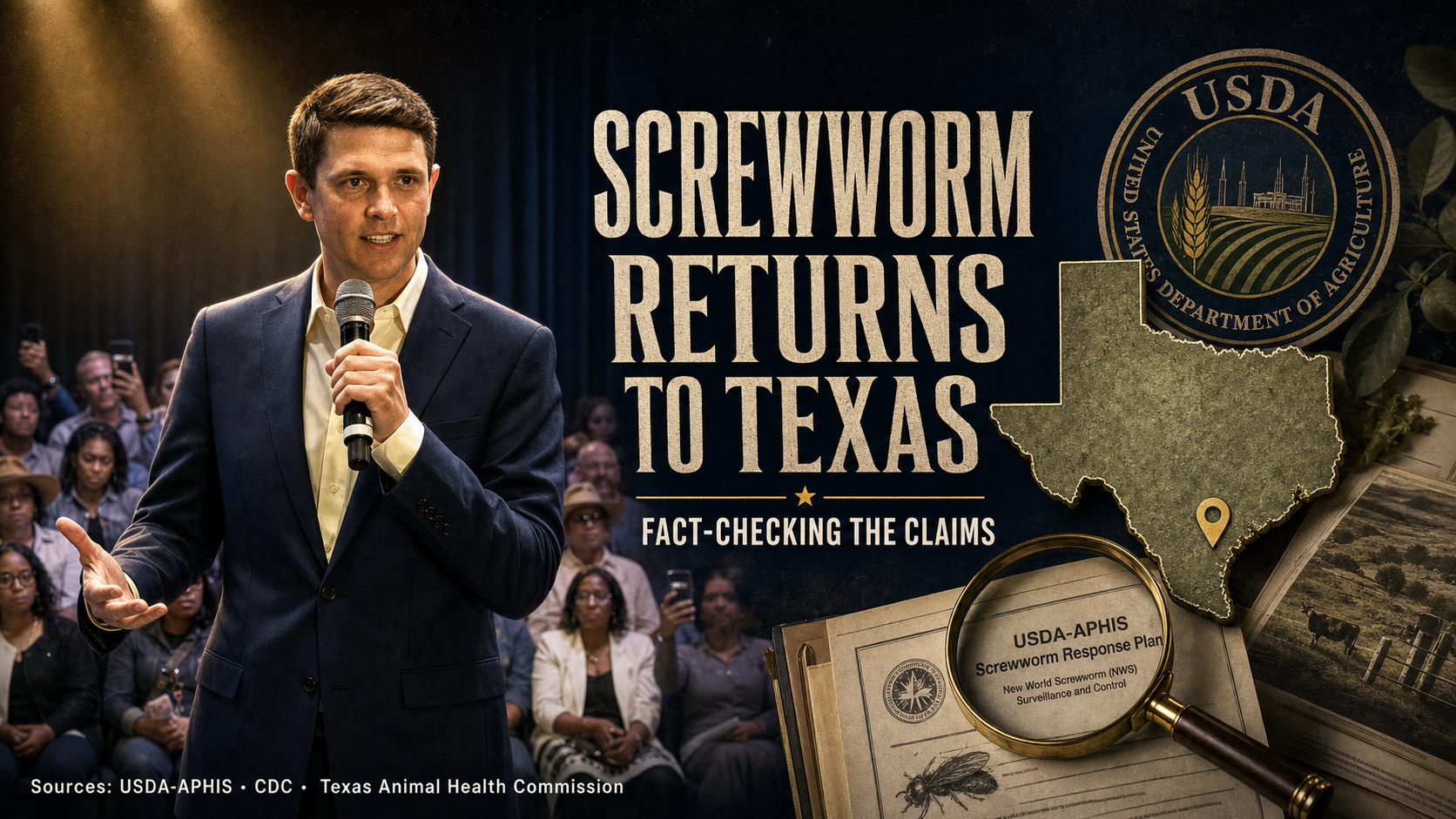
Screwworm Returned to Texas. Here's What Actually Caused It — and What Talarico Got Wrong
State Rep. James Talarico told a DeSoto crowd that a federal office in Uvalde was "fired" and that this let the New World screwworm into Texas. The federal record tells a different story — one that starts in Mexico in 2024, long before any staffing decision was made.
The Claim, In His Own Words
What Talarico said at D3 Church in DeSoto, and what he has said before
On July 20, 2026, Texas State Rep. and Democratic U.S. Senate nominee James Talarico held a campaign town hall at Disciple Central Community Church ("D3 Church") in DeSoto, inside Texas House District 109.(Star-Telegram, 2026) During a question about protecting rural Black farmers, Talarico turned to the New World screwworm outbreak and stated, on video, word for word: "There was an office in Uvalde that was responsible for tracking the worm and keeping it out of Texas but they were fired."(Talarico, 2026)
This was not an isolated remark. Talarico has raised the screwworm outbreak as a talking point against the current administration's staffing decisions since at least June 3, 2026, when he publicly called on the Trump administration to "fully staff" USDA so the agency could work with ranchers to keep the parasite out of Texas herds.(CommonDreams, 2026) The Texas Democratic Party has separately and repeatedly amplified a related version of this argument, publishing a statement titled "ICYMI: Ken Paxton Backed DOGE Cuts That Weakened Screwworm Defenses and Put Texas Cattle at Risk," which argued that federal budget reductions "weakened" the nation's defenses against the parasite.(Texas Democratic Party, 2026)
Rep. Talarico's assertion is that a federal office in Uvalde, Texas responsible for screwworm surveillance was eliminated through federal workforce reductions, and that this elimination is connected to the parasite's arrival in Texas. This article traces the verifiable historical and jurisdictional record to test that claim directly against USDA, CDC, and state agency documentation.
Taken together with his consistent public record since June, Rep. Talarico's argument is best understood as a claim about federal workforce reductions at the U.S. Department of Agriculture's Animal and Plant Health Inspection Service (APHIS), carried out under the Department of Government Efficiency (DOGE) initiative, and their alleged connection to the parasite's arrival in Texas.
Where Screwworm Actually Started
The outbreak's documented path from Panama to Texas, in the government's own words
New World screwworm (Cochliomyia hominivorax) was declared eradicated from the United States in 1966, with the final holdout population eliminated from Texas by 1982, through a sustained sterile-fly release program anchored at a biological containment barrier on the Panama-Colombia border.(National Agricultural Library, n.d.) That barrier held for more than four decades before a resurgence beginning around 2023, when Panama recorded a spike in confirmed cases and the parasite began moving north through Central America.(Food and Agriculture Organization, n.d.)
| Date | Event | Administration in Office |
|---|---|---|
| Nov. 22, 2024 | Mexico notifies USDA-APHIS of first NWS detection, in a cow in Chiapas near the Guatemala border | Biden |
| Sept. 2025 | Mexico confirms case in Nuevo León, roughly 70 miles from the U.S. border | Trump |
| Jan. 20, 2026 | CDC issues nationwide Health Advisory as NWS reaches Tamaulipas, directly bordering Texas | Trump |
| Feb. 9, 2026 | USDA/TAHC complete sterile-fly dispersal facility at Moore Air Base, Edinburg, TX | Trump |
| Mar. 9, 2026 | USDA and U.S. Army Corps of Engineers announce contract for domestic sterile-fly production facility | Trump |
| June 3, 2026 | First confirmed U.S. animal case: a calf in Zavala County, TX | Trump |
| June 4–10, 2026 | Additional confirmed cases in La Salle and Gillespie counties, TX, and Lea County, NM | Trump |
Over the following nineteen months, the parasite advanced roughly 1,000 miles north through six countries and multiple Mexican states before the first confirmed U.S. case appeared in Zavala County, Texas, on June 3, 2026.(Texas Animal Health Commission [TAHC], 2026) By late July 2026, additional cases had been confirmed in Starr County and elsewhere in South Texas.(Hidalgo County, Texas, 2026)
The first Mexican detection predates the current administration entirely. Nineteen months of cross-border spread through six countries occurred through mechanisms — cattle trade, wildlife movement, and regional agricultural conditions inside Mexico and Central America — that no single U.S. domestic office, staffed or unstaffed, could have interrupted.
Whose Job Is This, Really?
USDA leads. CDC supports. The distinction matters for assigning responsibility.
Screwworm surveillance, quarantine enforcement, sterile-fly production, and eradication strategy in the United States are led by the U.S. Department of Agriculture's Animal and Plant Health Inspection Service (APHIS) — not the Department of Health and Human Services. USDA's own screwworm.gov portal states without ambiguity: "USDA is leading a coordinated One Health response to combat NWS... This is not a food safety issue."(APHIS, 2025) In an August 2026 public statement, USDA-APHIS was even more direct, writing that USDA and APHIS "are the agencies directly responsible for surveillance, eradication efforts, preparedness, and public guidance" for screwworm.(APHIS, 2026)
CDC and HHS play a real but narrow supporting role: tracking the rare human cases of screwworm myiasis, issuing clinical guidance to health care providers, and — at USDA's and Congress's request — authorizing emergency use of certain animal drugs through the FDA.(U.S. Department of Health and Human Services [HHS] & U.S. Food and Drug Administration [FDA], 2025) CDC's own July 2026 situation summary confirms there have been zero U.S.-acquired human NWS cases during the entire outbreak; the single human case associated with this event was travel-related, involving a person returning from El Salvador.(Centers for Disease Control and Prevention [CDC], 2026)
| Function | Lead Agency | Official Source |
|---|---|---|
| Border inspection & import restrictions | USDA-APHIS | USDA-APHIS release, Nov. 2024 |
| Sterile fly production & dispersal | USDA-APHIS (with Army Corps) | USDA/Army Corps release, Mar. 2026 |
| Quarantine zones & livestock movement controls | USDA-APHIS / Texas Animal Health Commission | TAHC program page |
| Human case surveillance & clinical guidance | CDC (HHS) — supporting role | CDC situation summary, Jul. 2026 |
| Emergency-use animal drug authorization | FDA (HHS), at USDA's request | HHS/FDA press release, Aug. 2025 |
This jurisdictional reality is central to evaluating Rep. Talarico's claim: HHS and CDC have never operated the border-inspection, quarantine, or sterile-fly infrastructure that constitutes the country's actual defense against screwworm. Rep. Talarico's verified quote refers only to an unnamed "they" being "fired," consistent with his broader public record of focusing on USDA/APHIS workforce reductions rather than any HHS-specific claim.
The Uvalde Office: Fact vs. Framing
What was actually on the federal closure list, and what it did
Federal records confirm that a USDA-APHIS office lease in Uvalde, Texas appeared on the Department of Government Efficiency's 2025 federal office-closure list, with a projected annual lease savings of $58,615.(Clayton, 2025) This was one of ten APHIS office leases nationwide flagged for cancellation as part of a broader consolidation effort that, at its March 2025 peak, listed 110 USDA offices across nine agencies for closure; by June 2025, USDA leadership had already pushed that list down to 49 offices after internal review found several closures would harm front-line services.(Farm Policy News, 2025)
Independent reporting corroborates that this reduction was real: USDA-APHIS's workforce fell by roughly 2,000 employees — about 23 to 25 percent — between January 2025 and January 2026, as part of broader federal downsizing.(The Hill, 2026) Rep. Talarico's underlying factual premise, that federal employees who once worked in an APHIS office responsible for aspects of animal-disease monitoring were let go, is consistent with this documented record.
Nothing in the federal record establishes that the Uvalde office functioned as a border-inspection or live-quarantine checkpoint capable of intercepting an incoming parasite. APHIS field offices of this type typically perform administrative, veterinary-certification, and coordination functions. The actual interdiction points for screwworm are the southern ports of entry at Del Rio and Laredo — and those ports were not closed by budget cuts. They were the very facilities USDA used to actively suspend and later phase the reopening of Mexican cattle imports specifically because of the screwworm threat.(U.S. Customs and Border Protection, 2025)
USDA's own subsequent actions during this same period point away from a defense in retreat. The Moore Air Base sterile-fly dispersal facility in Edinburg, Texas was completed in February 2026 — months before the first Texas case — and a full domestic sterile-fly production facility contract was announced with the U.S. Army Corps of Engineers in March 2026.(Capital Press, 2026) By mid-2026, USDA reported more than 100 full-time employees dedicated specifically to the New World screwworm response, compared to roughly 10 under the prior administration, along with more than $1 billion obligated toward the response effort.(The Hill, 2026)
What Independent Fact-Checkers Found
Even sources aligned against the administration could not substantiate the causal claim
This is not the only version of the "budget cuts caused screwworm" argument that Texas Democrats have advanced. The Texas Democratic Party's official communications separately argued that Sen. Ken Paxton "backed DOGE cuts that weakened screwworm defenses," pointing to the cancellation of a roughly $250,000 USAID/FAO grant that had supported regional monitoring in Central America.(Texas Democratic Party, 2026) Snopes — a fact-checking outlet with no ideological stake in defending the current administration — investigated this specific claim and concluded it was unverified, stating plainly that "the available evidence does not support a definitive link between the canceled grant and the outbreak in the U.S."(Snopes, 2026)
"Politicians of both political parties have blamed either the Trump or the Biden administration for the arrival of the New World screwworm, a flesh-eating fly…"FactCheck.org, Annenberg Public Policy Center
FactCheck.org's broader review of the political back-and-forth over screwworm reached a similarly unflattering conclusion for partisan narratives on both sides, describing the dispute as a "blame spin" in which politicians from both parties selectively cite budget decisions to support conclusions they had already reached.(FactCheck.org, 2025–2026) These are not conservative-aligned outlets making this assessment — they are nonpartisan or left-leaning fact-checking organizations reaching the same conclusion this report reaches through primary-source federal documentation: the causal link asserted by Talarico and the Texas Democratic Party does not hold up under independent scrutiny.
It is worth noting explicitly for HD109 constituents: this report's findings are not dependent on those fact-checking organizations. The primary evidence — USDA and CDC's own timeline of the outbreak, USDA's own statements on jurisdiction, and USDA's own reported staffing and funding figures — independently establishes the same conclusion. The fact-checkers' independent agreement is offered here only as additional corroboration, not as the basis of the finding.
Where Responsibility Actually Belongs
A clear-eyed accounting, based on the documented record
- Primary cause — foreign disease ecology and cross-border animal movement. The resurgence began with a breakdown in the historic Panama-Colombia sterile-fly barrier around 2023, followed by cattle and wildlife movement carrying the parasite north through six countries over roughly two and a half years.(Food and Agriculture Organization, n.d.) This sits entirely outside U.S. federal jurisdiction.
- Secondary factor — the pace of the binational eradication response, including decades-long reliance on a single Panama-based sterile-fly facility for the entire hemisphere. This is a legitimate area for oversight, but it implicates international-assistance funding streams, not a Uvalde lease.
- Domestic response — led entirely by USDA-APHIS, in coordination with the Texas Animal Health Commission and Customs and Border Protection, with CDC/HHS playing only a narrow supporting role. USDA's domestic response capacity expanded, not contracted, throughout the outbreak period.(APHIS, 2025)
Rep. Talarico's specific claim — that an APHIS office in Uvalde responsible for "tracking the worm and keeping it out of Texas" was eliminated through firings, and that this connects to the parasite's arrival — does not survive contact with the documented timeline or the documented function of that office. The parasite was already advancing through Mexico for a full year before any relevant workforce reduction took effect, and it continued advancing while USDA's actual screwworm-response infrastructure was being expanded, not dismantled.
Screwworm's return to Texas traces to a foreign-origin agricultural and ecological failure, not to a domestic staffing decision. Blaming a single $58,615 office lease for a parasite's 1,000-mile, nineteen-month journey through six countries is not a serious causal argument — it is a scare tactic built on a kernel of true information (the office did exist; some staff reductions did occur) stretched well past what the evidence supports. My constituents deserve the full picture, not a partisan shortcut.
References
Sources are organized by the sections of this article they principally inform. APA 7th Edition. Preference is given throughout to primary official-agency statements; independent fact-checking organizations are included as secondary corroboration only.
The Claim — Section 1
Star-Telegram (Fort Worth). (2026, July 21). Black voters explain what they want to see from Senate candidate James Talarico. star-telegram.com
Confirms the July 20, 2026 town hall's location at Disciple Central Community Church in DeSoto and its general subject matter, establishing the event record.
Talarico, J. (2026, July 20). "There was an office in Uvalde that was responsible for tracking the worm and keeping it out of Texas but they were fired" [Speech excerpt, video repost]. Instagram; Instagram; Threads
Multiple independently re-posted video clips consistently transcribe the same verbatim quote — "There was an office in Uvalde that was responsible for tracking the worm and keeping it out of Texas but they were fired" — used here as the primary source for the precise wording and attribution of the claim being fact-checked.
CommonDreams. (2026, June 3). Talarico Calls on Trump USDA to 'Fully Staff' Agency Amid Screwworm Outbreak. commondreams.org
Documents Talarico's earlier, consistent public statements attributing screwworm risk to USDA staffing levels, establishing the pattern preceding his July 20 remarks.
Texas Democratic Party. (2026, June 14). ICYMI: Ken Paxton Backed DOGE Cuts That Weakened Screwworm Defenses and Put Texas Cattle at Risk [Official party statement]. texasdemocrats.org
Official Texas Democratic Party communication presenting the party's parallel argument attributing screwworm risk to DOGE-related federal budget cuts, cited here as the party's own words rather than a secondhand paraphrase.
Origin & Timeline — Section 2
Animal and Plant Health Inspection Service. (2024, November 23). Mexico Notifies United States of New World Screwworm Detection [Official press release]. U.S. Department of Agriculture. aphis.usda.gov
Primary source establishing the first confirmed detection of New World screwworm in Mexico on November 22, 2024, under the outgoing administration — the anchor date for the entire outbreak timeline.
Animal and Plant Health Inspection Service. (2025, September 21). Mexico Confirms Case of New World Screwworm in Nuevo León [Official press release]. U.S. Department of Agriculture. aphis.usda.gov
Confirms the parasite's advance to within roughly 70 miles of the U.S. border by September 2025, establishing the intermediate timeline point.
Centers for Disease Control and Prevention. (2026, January 20). New World Screwworm: Outbreak Moves Into Northern Mexico [Health Alert Network Advisory CDCHAN-00526]. U.S. Department of Health and Human Services. cdc.gov
Official advisory marking the outbreak's arrival in Tamaulipas, directly bordering Texas, roughly four and a half months before the first Texas case.
Texas Animal Health Commission. (2026). New World Screwworms [Official program page and case log]. tahc.texas.gov
Authoritative state-level record confirming the June 3, 2026 first Texas detection date and subsequent case counts.
Hidalgo County, Texas. (2026, June 6; July 23). Official statements on confirmed New World screwworm cases [County government press releases]. facebook.com/HidalgoCountyTexas
Local government statements corroborating additional case locations, including the Rio Grande Valley's first confirmed case in Starr County.
Food and Agriculture Organization of the United Nations / Novy, J. E. (n.d.). Screwworm Control and Eradication in the Southern United States [Technical report]. fao.org
Historical technical record detailing the original U.S. eradication program and the 1981 closure of the Mission, Texas production facility, establishing the long-run historical baseline.
Jurisdiction — Section 3
Animal and Plant Health Inspection Service. (2025). Screwworm.gov: Unified Government Response to New World Screwworm [Official program hub]. U.S. Department of Agriculture. aphis.usda.gov
Direct primary-source statement that USDA leads the coordinated national response and that screwworm "is not a food safety issue," establishing USDA's lead jurisdiction in USDA's own words.
U.S. Department of Agriculture Animal and Plant Health Inspection Service. (2026, August 4). Wondering How New World Screwworm Coordination Works? [Official agency statement]. facebook.com/USDAAPHIS
Direct agency statement naming USDA and APHIS as "the agencies directly responsible for surveillance, eradication efforts, preparedness, and public guidance" for screwworm.
U.S. Department of Health and Human Services & U.S. Food and Drug Administration. (2025, August 18). HHS Allows FDA Emergency Use of Animal Drugs to Combat New World Screwworm, Protect U.S. Food Supply [Official press release]. fda.gov
Documents the actual, narrow scope of HHS's screwworm-related action — an emergency-use drug authorization made at USDA's and Congress's request — not surveillance or eradication infrastructure.
Centers for Disease Control and Prevention. (2026, July 14). New World Screwworm Outbreak: Situation Summary [Official summary]. U.S. Department of Health and Human Services. cdc.gov
Confirms zero U.S.-acquired human cases and describes CDC's role as a coordinating partner to USDA rather than the lead agency.
Gonzales, T. [U.S. Representative]. (2025, July 10). Letter to HHS Requesting Coordination with USDA on Antiparasitic Drug Approvals for Screwworm Preparedness [Congressional correspondence]. gonzales.house.gov
Bipartisan congressional letter explicitly requesting that HHS assist USDA on drug approvals, further confirming HHS's supporting, not leading, role in the federal response.
The Uvalde Office — Section 4
Clayton, C. (2025, June 6). DOGE Pares List of USDA Agency Office Closures and Savings. DTN Progressive Farmer. dtnpf.com
Trade-press compilation of the full DOGE federal office-closure list as of June 2025, including the Uvalde, Texas APHIS office line item ($58,615 in projected annual lease savings) — the key source establishing the office's USDA-APHIS status and its reduced scope by mid-2025.
Farm Policy News, University of Illinois. (2025, June 8). DOGE Cuts USDA Office Closure List in Half. farmpolicynews.illinois.edu
Independent trade-press corroboration that the original 110-office DOGE closure list was reduced to 49 offices by June 2025 following USDA internal review.
Content.govdelivery.com / U.S. Customs and Border Protection. (2025, July 7). New World Screwworm and Phased Re-Opening of Ports for Livestock Trade [Official bulletin, TIN #65557556]. content.govdelivery.com
Official CBP bulletin documenting the phased reopening plan for the Del Rio and Laredo ports of entry, showing these were the primary active interdiction points, not casualties of budget cuts.
Animal and Plant Health Inspection Service. (2025, November 12). Current Status of New World Screwworm [Official status page]. U.S. Department of Agriculture. aphis.usda.gov
Documents active management of southern port-of-entry closures and reopenings as a direct screwworm-containment measure.
Capital Press / U.S. Department of Agriculture. (2026, February 10). USDA Completes Texas Sterile Fly Dispersal Facility to Fight Screwworm. capitalpress.com
Confirms completion of new domestic screwworm-response infrastructure during the period the outbreak was advancing, evidencing expanding rather than contracting USDA capacity.
U.S. Department of Agriculture. (2026, March 9). USDA and U.S. Army Corps of Engineers Advance New World Screwworm Preparedness with New Texas Sterile Fly Facility Contract [Official press release]. usda.gov
Announces the construction contract for a full domestic sterile-fly production facility, further evidencing expanding USDA capacity contemporaneous with the outbreak.
The Hill. (2026, July 16). Screwworm Spread Tests US Readiness After Trump Staffing Cuts. thehill.com
Reports USDA's own rebuttal figures — more than 100 full-time NWS-response employees versus 10 under the prior administration, and over $1 billion obligated toward the response — alongside confirmation of the roughly 23–25 percent APHIS workforce reduction.
Independent Fact-Check Validation — Section 5
Snopes. (2026, June 12). Did DOGE Cuts Cause Screwworm Outbreak in US? We Investigated. snopes.com
Independent fact-checking investigation concluding that a related claim — that DOGE's cancellation of a USAID/FAO grant caused the outbreak — is unverified. Included as secondary corroboration; the primary finding of this article rests on official agency documentation, not on this source.
FactCheck.org, Annenberg Public Policy Center. (2025–2026). Screwworm Archives. factcheck.org
Nonpartisan characterization of screwworm-outbreak blame attribution by both political parties as frequently conflicting and misleading. Included as secondary corroboration of this article's independently sourced conclusions.
Historical Background — Section 6
National Agricultural Library, U.S. Department of Agriculture. (n.d.). 1958–1969: STOP Screwworms [Historical exhibit]. nal.usda.gov
Official USDA historical archive documenting the original eradication program and the 1966 declaration of the U.S. as screwworm-free, establishing the decades-long historical baseline referenced throughout this article.