
The Voting Rights Act: A Bipartisan Record With Republican Majority Support Start to End
The Voting Rights Act: A Bipartisan Record, A Half-Century of Progress, and a Ruling That Restores Its Purpose
The full congressional vote history by party, the data on Black voter participation since 1965, and what the Supreme Court actually decided in Louisiana v. Callais.
A Law Born of Bipartisan Consensus
The original 1965 vote record, by party, in both chambers
The Voting Rights Act of 1965 (VRA) was not a partisan achievement claimed by one party. It passed the House of Representatives on July 9, 1965, by a vote of 333–85, and the Senate on May 26, 1965, by a vote of 77–19 (National Archives, 2019). When the final conference version was adopted on August 3–4, 1965, the House approved it 328–74 and the Senate 79–18 (National Archives, 2019). President Lyndon B. Johnson signed it into law on August 6, 1965 (National Archives, 2021).
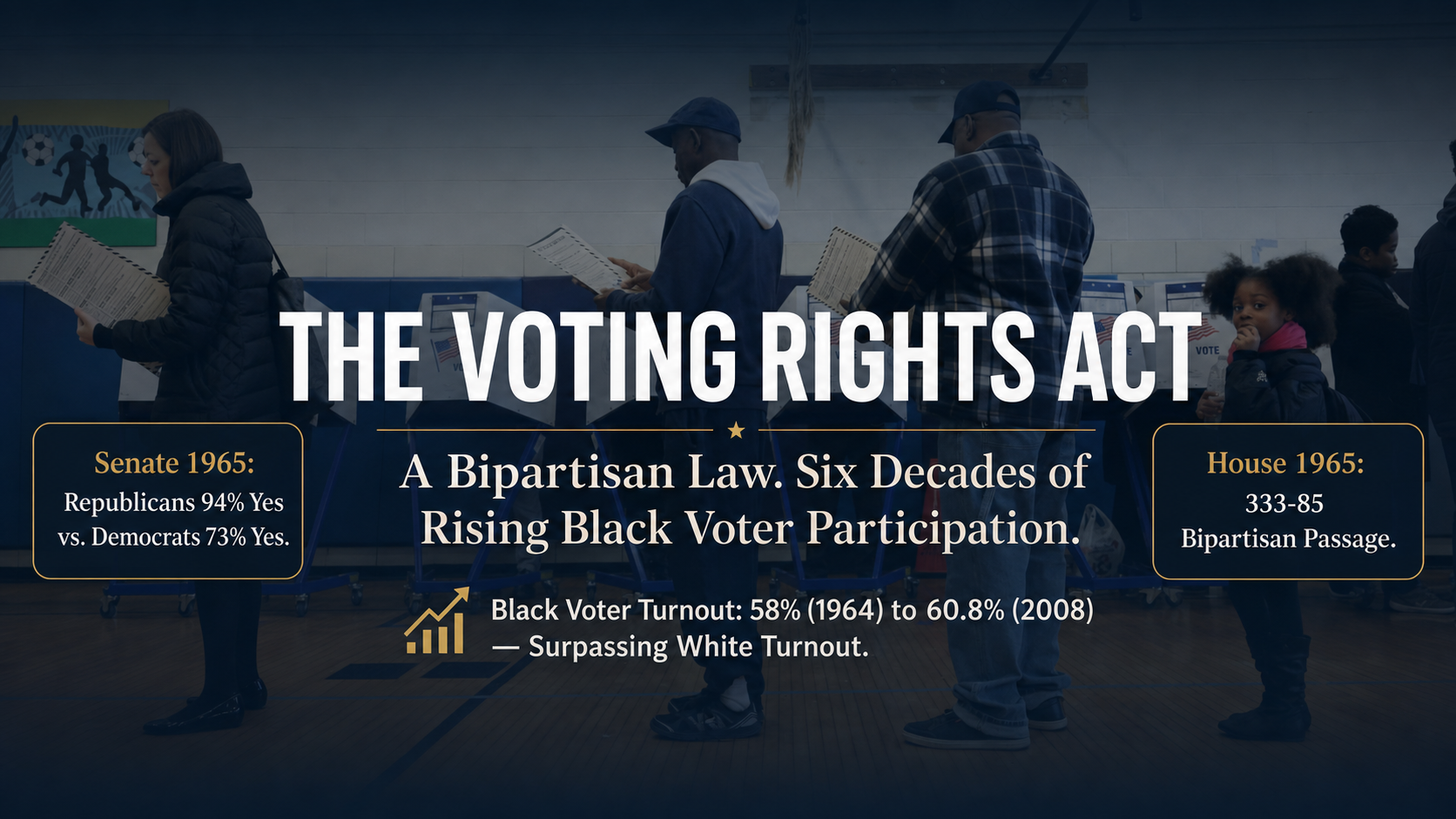
Republicans supported the bill at a higher rate than Democrats did. In the House, 112 of 135 voting Republicans — roughly 83% — voted yes, compared to 221 of 283 voting Democrats, roughly 78% (U.S. House Judiciary Committee, 2021). In the Senate, 30 of 32 Republicans voted yes — a 94% support rate — compared to 47 of 64 Democrats, roughly 73% (GovTrack, n.d.-a). Every senator who opposed the bill outright was a Democrat except two Republicans, Strom Thurmond of South Carolina and John Tower of Texas, both representing Southern states (GovTrack, n.d.-a).
Opposition to the Voting Rights Act in 1965 was concentrated among Southern members of both parties, while the Republican Party as a whole supported the bill at a higher rate than the Democratic Party as a whole (U.S. House Judiciary Committee, 2021).
| Chamber | Bill | Final Vote | Democrats (Yes–No) | Republicans (Yes–No) |
|---|---|---|---|---|
| House | H.R. 6400 | 333–85 | 221–62 | 112–23 |
| Senate | S. 1564 | 77–19 | 47–17 | 30–2 |
| House (conference report) | H.R. 6400 | 328–74 | 217–54 | 111–20 |
| Senate (conference report) | S. 1564 | 79–18 | 49–17 | 30–1 |
Every Reauthorization, 1970–2006
Five extensions, five bipartisan majorities — signed by four different presidents of both parties
As the VRA's original special provisions neared their five-year expiration, Congress extended the special provisions for five years in 1970, expanding the ban on literacy tests nationwide. The Senate passed the final compromise 64–12, with Republicans voting 33–1 in favor and Democrats voting 31–11 in favor (U.S. House Judiciary Committee, 2021). President Richard Nixon, a Republican, signed the amendments into law on June 22, 1970 (Congressional Research Service, 2023).
In 1975, at the urging of Representative Barbara Jordan (D-TX), Congress extended the special provisions for seven years and expanded the Act's protections to language minorities. The House passed the bill 341–70 and the Senate passed it 77–12 (New York Times, 1975). By party, 247 Democrats and 94 Republicans voted yes in the House; 49 Democrats and 27 Republicans voted yes in the Senate (U.S. House Judiciary Committee, 2021). President Gerald Ford, a Republican, signed the amendments into law on August 6, 1975 (Congressional Research Service, 2023).
The 1982 amendments were the most substantively significant since 1965, creating a "results test" under Section 2 that banned any voting practice with a discriminatory effect regardless of intent, while Senator Robert Dole (R-KS) authored language explicitly disclaiming any requirement of proportional representation (SciSpace, 2021). The House passed the bill 389–24, with 227 Democrats and 161 Republicans voting yes; the Senate passed it 85–8, with 42 Democrats and 43 Republicans voting yes (U.S. House Judiciary Committee, 2021). President Ronald Reagan signed the amendments into law on June 29, 1982 (Congressional Research Service, 2023).
The 1992 amendments extended and expanded the Section 203 bilingual-ballot mandate for 15 years. This is the point where meaningful, principled Republican opposition first appears in the legislative record — not opposition to protecting the Black vote, which Section 203 did not address, but opposition to an unfunded federal mandate requiring local governments to print and administer elections in multiple languages (Amendments to the Voting Rights Act of 1965, n.d.). The House passed the bill 237–125 and the Senate passed it 75–20, with most opposition coming from Republicans (Congressional Research Service, 2023). President George H.W. Bush, a Republican, signed it into law on August 26, 1992 (Congressional Research Service, 2023).
In 2006, with Republicans controlling the House, Senate, and presidency, Congress reauthorized the special provisions for another 25 years under the Fannie Lou Hamer, Rosa Parks, and Coretta Scott King Voting Rights Act Reauthorization and Amendments Act. The House passed it 390–33 on July 13, 2006; every single voting Democrat supported it (197–0), and 192 of 225 voting Republicans voted yes as well — all 33 "no" votes came from Republicans (Clerk of the U.S. House of Representatives, 2006). The Senate passed it unanimously, 98–0, on July 20, 2006, with 44 Democrats, 53 Republicans, and 1 independent voting yes (Amendments to the Voting Rights Act of 1965, n.d.). President George W. Bush signed the bill on July 27, 2006 (Amendments to the Voting Rights Act of 1965, n.d.).
| Year | Chamber | Final Vote | Democrats (Yes) | Republicans (Yes) | Signed By |
|---|---|---|---|---|---|
| 1970 | House | 224–183 | 165 | 59 | Nixon (R) |
| 1970 | Senate | 64–12 | 31 | 33 | Nixon (R) |
| 1975 | House | 341–70 | 247 | 94 | Ford (R) |
| 1975 | Senate | 77–12 | 49 | 27 | Ford (R) |
| 1982 | House | 389–24 | 227 | 161 | Reagan (R) |
| 1982 | Senate | 85–8 | 42 | 43 | Reagan (R) |
| 1992 | House | 237–125 | majority | minority | G.H.W. Bush (R) |
| 1992 | Senate | 75–20 | majority | split | G.H.W. Bush (R) |
| 2006 | House | 390–33 | 197 | 192 | G.W. Bush (R) |
| 2006 | Senate | 98–0 | 44 | 53 (+1 Ind.) | G.W. Bush (R) |
Did the Voting Rights Act Work? What the Data Shows
Registration gains in the Deep South, and six decades of Census turnout data by race
Before the Act, Black voter registration in the Deep South was suppressed to a fraction of the white rate through explicitly race-based laws — grandfather clauses, literacy tests, and poll taxes. In Mississippi, Black voter registration stood at just 6.7% in March 1965 (Economic Policy Institute, 2024). Within roughly two years of the Act's passage, that same rate rose to 59.8% (Economic Policy Institute, 2024).
| State | March 1965 | Sept. 1967 | Gain (pts.) |
|---|---|---|---|
| Mississippi | 6.7% | 59.8% | +53.1 |
| Alabama | 19.3% | 51.6% | +32.3 |
| Louisiana | 31.6% | 58.9% | +27.3 |
| Georgia | 27.4% | 52.6% | +25.2 |
| Virginia | 38.3% | 55.6% | +17.3 |
| South Carolina | 37.3% | 51.2% | +13.9 |
| Texas | 53.1% | 61.6% | +8.5 |
| North Carolina | 46.8% | 51.3% | +4.5 |
The gains were not temporary. U.S. Census Bureau Current Population Survey (CPS) data — the federal government's official, continuously collected series on voting behavior by race since 1964 — shows Black turnout has remained a durable, substantial share of the electorate for six decades, and at points has matched or exceeded white turnout (U.S. Census Bureau, 2021).
| Election Year | White Turnout | Black Turnout | Gap (pts.) |
|---|---|---|---|
| 1964 | 70.7% | 58.5% | 12.2 |
| 1968 | 69.1% | 57.6% | 11.5 |
| 1972 | 64.5% | 52.1% | 12.4 |
| 1976 | 60.9% | 48.7% | 12.2 |
| 1980 | 60.9% | 50.5% | 10.4 |
| 1984 | 61.4% | 55.8% | 5.6 |
| 1988 | 59.1% | 51.5% | 7.6 |
| 1992 | 63.6% | 54.0% | 9.6 |
| 1996 | 56.0% | 50.6% | 5.4 |
| 2000 | 56.4% | 53.5% | 2.9 |
| 2004 | 60.3% | 56.3% | 4.0 |
| 2008 | 59.6% | 60.8% | −1.2 |
| 2012 | 57.6% | 62.0% | −4.4 |
| 2016 | 58.2% | 55.9% | 2.3 |
| 2020 | 63.7% | 58.7% | 5.0 |
In both 2008 and 2012, Black voter turnout exceeded white voter turnout nationally — a full year before the Supreme Court's 2013 ruling in Shelby County v. Holder.U.S. Census Bureau CPS Data, 2021
Why the Argument Shifted: From Protecting the Vote to Federal Overreach
The 2006 debate, the coverage formula, and Shelby County v. Holder
The historical vote record shows something important that gets lost in today's political rhetoric: Republican opposition to the Voting Rights Act's core purpose — protecting the Black vote — was never the mainstream Republican position. Republicans provided the higher share of "yes" votes in 1965, and every reauthorization through 2006 passed with substantial, often overwhelming, Republican support, including unanimous Senate Republican support in 2006 (GovTrack, n.d.-a; Clerk of the U.S. House of Representatives, 2006).
What changed over time was not a view about whether Black Americans deserved equal access to the ballot. What changed was the argument over whether specific states should remain under permanent federal supervision based on discriminatory conditions that, by the government's own data, had been substantially remedied. The coverage formula in Section 4(b) determined which states and counties had to get federal "preclearance" before changing any election law, based on whether the jurisdiction used a discriminatory test or device and had low registration or turnout in 1964, 1968, or 1972 (U.S. Department of Justice, 2013). By 2006, when Congress last reauthorized the formula, it was still using data nearly 40 years old to decide which states were treated as presumptively discriminatory (U.S. Department of Justice, 2013).
Even in the overwhelmingly bipartisan 2006 vote, Republicans led by Rep. Lynn Westmoreland (R-GA) argued the reauthorization "unfairly targeted certain jurisdictions for long-past discrimination," while a separate group of 80 House Republicans led by Rep. Steve King (R-IA) objected to the bilingual mandate costs. Every amendment failed, and most of those Republicans still voted for final passage (Amendments to the Voting Rights Act of 1965, n.d.).
The Supreme Court itself — not just Republican legislators — concluded in Shelby County v. Holder (2013) that this had become a constitutional problem. In a 5–4 decision, the Court held that Section 4(b)'s coverage formula was unconstitutional because "coverage today is based on decades-old data and eradicated practices," even though "such tests have been banned nationwide for over 40 years" (U.S. Department of Justice, 2013). Critically, the Court did not strike down Section 2 — the permanent, nationwide ban on racial discrimination in voting that applies equally in all 50 states, in every county, all the time (U.S. Department of Justice, 2013).
“Our decision in no way affects the permanent, nationwide ban on racial discrimination in voting found in §2. We issue no holding on §5 itself, only on the coverage formula. Congress may draft another formula based on current conditions.”Shelby County v. Holder, 570 U.S. 529 (2013), Majority Opinion
This is the foundation of the modern conservative argument for treating covered and non-covered states equally: every state in the country, including Texas, Mississippi, Alabama, and Georgia, is already bound by Section 2's permanent ban on racial discrimination in voting, by the Fourteenth and Fifteenth Amendments, and by state-level voter protection laws (U.S. Department of Justice, 2013). The Black voter turnout and registration data presented in Section 3 shows those protections have functioned as intended for decades. This is the same federalism principle now animating Democratic-led opposition to certain federal election-standardization proposals such as the SAVE Act, where many Democrats argue election administration is a state function that should not be federally overridden absent a specific, current showing of a problem — the identical argument Republicans have made about the VRA coverage formula since 2006.
Louisiana v. Callais (2026): Reinforcing, Not Repealing, the VRA
What the Court actually decided, and what it means for Texas
On April 29, 2026, the Supreme Court decided Louisiana v. Callais, ruling 6–3 that Louisiana's congressional map — redrawn specifically to make race the predominant factor in creating a second majority-Black district — was an unconstitutional racial gerrymander under the Equal Protection Clause of the Fourteenth Amendment (Alito, 2026). The map connected Black communities across roughly 250 miles of geography for the explicit purpose of hitting a specific racial population target (Alito, 2026).
“Allowing race to play any part in government decision-making represents a departure from the constitutional rule that applies in almost every other context. Compliance with §2 thus could not justify the State’s use of race-based redistricting here.”Justice Samuel Alito, Majority Opinion, Louisiana v. Callais, 608 U.S. ___ (2026)
It is essential to state plainly what this ruling did and did not do. It did not repeal, gut, or weaken Section 2 of the Voting Rights Act, which remains fully in force and continues to ban any voting practice that denies or abridges the right to vote on account of race or color, nationwide, permanently (Alito, 2026). What the ruling changed is the evidentiary standard for proving a Section 2 violation in redistricting: a plaintiff must now show the state intentionally drew lines to deny minority voters equal opportunity specifically because of race, and illustrative maps offered as evidence cannot themselves use race as a drawing criterion (Alito, 2026).
Section 2 of the original 1965 Act prohibited any standard or practice imposed "to deny or abridge the right of any citizen of the United States to vote on account of race or color" (Voting Rights Act of 1965, Pub. L. 89-110, 79 Stat. 437). A district map drawn explicitly to sort voters by race is, under that plain text, exactly the kind of race-based classification the Act's authors set out to eliminate — regardless of which direction the sorting runs.
Setting the Record Straight
The claim that Republicans, or Republican-controlled states like Texas, are working to strip Black Americans of the right to vote does not hold up against the historical voting record or the current data. Republicans provided the higher share of support for the original 1965 Act; every reauthorization through 2006 passed with substantial bipartisan majorities, including unanimous Senate Republican support in 2006; and Black voter turnout has, at multiple points over the past two decades, matched or exceeded white voter turnout nationally under the very legal framework now in place (GovTrack, n.d.-a; Clerk of the U.S. House of Representatives, 2006; U.S. Census Bureau, 2021). No Texas law, and no recent Supreme Court ruling — including Shelby County v. Holder or Louisiana v. Callais — has removed Section 2's permanent, nationwide ban on racial discrimination in voting (U.S. Department of Justice, 2013; Alito, 2026).
What has changed is a legitimate, fact-based argument about federalism: whether states with decades of demonstrated compliance and dramatically closed voter-participation gaps should continue to be treated differently from every other state based on 60-year-old data, or whether they should be trusted, like all other states, to administer their own elections subject to the same permanent, nationwide protections that apply everywhere. That is not an argument against Black voting rights. It is an argument for treating Texas, and states like it, the same as every other state in the union.
Setting the Record Straight on "Suppression" and "Gutting" Claims
What Texas Democratic Party leadership and Rep. Aicha Davis have actually said, and why the record does not support it
In the aftermath of the 2025 Texas congressional redistricting and the Supreme Court's April 2026 ruling in Louisiana v. Callais, Texas Democratic leaders — including the candidate's own opponent for Texas House District 109, Rep. Aicha Davis (D-Dallas) — have repeatedly told constituents and the national press that Republicans are "taking away" the Black vote, "suppressing" Black and Latino voters, and that the Supreme Court "gutted" the Voting Rights Act. Those claims deserve a direct, sourced response, because the voting record laid out in Sections 1 through 5 above does not support them.
The claims, in their own words
While joining the Texas House Democratic quorum break in Illinois to block the 2025 congressional map, Rep. Davis told the Chicago Sun-Times: “You're taking away half the vote for Black Texans, and that is unacceptable.” She added that the new map would "wipe out two majority-Black districts in Texas" (WGLT/Chicago Sun-Times, 2025).
On the 60th anniversary of the VRA's signing, the Texas Democratic Party's official press release, titled "Texas Republicans Are Attacking Your Voting Rights," quoted Chairman Scudder saying Texas Republicans engaged in “this racist tradition” and that the 2025 map “diluted minority votes in a state that is 60% minority,” concluding that “Texas Republicans are actively seeking to dismantle” voting rights (Texas Democratic Party, 2025).
Responding to Louisiana v. Callais, Rep. Wu's official Texas House Democrats press release stated the Supreme Court “gutted the most important civil rights law of the last century, and…handed Republican legislatures across the country a permission slip…cracking and packing Black and Latino voters into districts where their voices won't matter” (Texas House Democrats, 2026).
Rep. Veasey called the Callais ruling “the most significant erosion of voting rights since Shelby County vs Holder in 2013” (Fort Worth Star-Telegram, 2026).
On the VRA's 60th anniversary, the DNC's official statement said Donald Trump and Governor Greg Abbott are “waging” attacks “on millions of Texas voters,” that Republicans have a “long and shameful history of attacking Americans' voting rights,” and accused Republican-led states of passing “laws designed to keep communities of color from voting” (Democratic National Committee, 2025).
These are serious, specific, and repeated public accusations — not vague political rhetoric. They deserve to be answered with the same rigor applied throughout this article: primary vote records, official court text, and government data, rather than a competing talking point.
Rebuttal 1: The Supreme Court did not "gut" the Voting Rights Act
Every one of the statements above characterizes Louisiana v. Callais as an act that "gutted," "eroded," or effectively repealed the Voting Rights Act. That characterization is not supported by the text of the ruling itself. As documented in Section 5 of this article, the Court's own majority opinion states plainly that the decision does not disturb the nationwide, permanent ban on racial discrimination in voting found in Section 2 (Alito, 2026). Even the Star-Telegram's own reporting on Democratic reactions concedes that “the court did not explicitly overrule the Voting Rights Act” (Fort Worth Star-Telegram, 2026). What changed is the evidentiary standard a plaintiff must meet to prove a Section 2 violation in redistricting — requiring proof that a map was intentionally drawn to disadvantage voters because of race, rather than allowing race itself to be used as the organizing principle of a district in the name of compliance (Alito, 2026). That is a narrowing of one legal test inside one part of the law, not the destruction of "the most important civil rights law of the last century," as Rep. Wu's statement claims (Texas House Democrats, 2026).
Rebuttal 2: Republicans wrote, passed, and signed the Act — repeatedly, for 41 years
Claims that "Republicans are attacking your voting rights" and engaging in a "racist tradition" (Texas Democratic Party, 2025) ignore the documented vote record in Sections 1 and 2 of this article. Republicans supported the original 1965 Act at a higher rate than Democrats in both chambers — 94% of Senate Republicans voted yes compared to 73% of Senate Democrats (GovTrack, n.d.-a). Every reauthorization from 1970 through 2006 was signed into law by a Republican president — Nixon, Ford, Reagan, George H.W. Bush, and George W. Bush — and the final 2006 reauthorization passed the Republican-controlled Senate 98–0 (Congressional Research Service, 2023; Amendments to the Voting Rights Act of 1965, n.d.). A party cannot simultaneously be the author, sponsor, and unanimous signer of a civil rights law for over four decades and also be engaged in a "racist tradition" of attacking that same law's purpose.
Rebuttal 3: Black voter turnout data contradicts the "suppression" narrative
The claim that Black Texans are having their vote "taken away" (WGLT/Chicago Sun-Times, 2025) is a claim about outcomes, and outcomes are measurable. As shown in Section 3, U.S. Census Bureau data confirms Black voter turnout rose from roughly 58% in 1964 to a peak of 66.6% in 2012, and Black turnout exceeded white turnout nationally in both the 2008 and 2012 presidential elections (U.S. Census Bureau, 2021). No credible national dataset shows a decline in Black voter registration or turnout coinciding with any recent Republican-authored legislation or court ruling; turnout figures respond to a wide range of factors including candidate enthusiasm and election competitiveness, not a single redistricting map or ruling.
Rebuttal 4: Redistricting disputes are not the same as vote denial
The 2025 Texas map dispute at the center of Rep. Davis's and Rep. Wu's statements is a redistricting fight — a dispute over how many majority-minority districts exist and how competitive they are — not a claim that any Black Texan was denied a ballot, turned away from a polling place, or prevented from registering to vote. These are legally and factually distinct issues. Section 2 of the Voting Rights Act, which remains fully in force after Callais, continues to prohibit denial or abridgment of the right to vote "on account of race or color" for every voter in every state (Voting Rights Act of 1965, Pub. L. 89-110, 79 Stat. 437). Redistricting litigation is ongoing in the normal course of the legal system on both sides of the aisle, as it has been for decades, and does not by itself constitute the "disenfranchisement" alleged in the Texas House Democrats' press release (Texas House Democrats, 2026).
Rep. Aicha Davis, Texas Democratic Party leadership, and national Democratic officials have made specific, repeated public claims that Republicans are suppressing the Black vote and that the Supreme Court gutted the Voting Rights Act. The documented congressional vote record shows Republicans provided the higher share of support for the original 1965 Act, signed every reauthorization into law through four different Republican presidents, and that Black voter turnout has risen and, at points, exceeded white turnout under the very legal framework these officials claim is under attack. The Supreme Court's own opinion in Callais explicitly preserves Section 2's permanent nationwide ban on racial discrimination in voting. The rhetoric does not match the record.
References
Sources are organized by the sections of this article they principally inform. Citations follow APA 7th Edition format. No internal working documents are cited as authoritative sources.
The 1965 Enactment — Section 1
National Archives. (2019, July 25). Roll call vote tally on S. 1564, the Voting Rights Act of 1965. U.S. National Archives and Records Administration. https://www.archives.gov/legislative/features/voting-rights-1965/roll-call.html
Official National Archives record of the original House and Senate roll calls and the conference report votes. Primary source for the exact 1965 vote tallies cited in Section 1.
National Archives. (2021, October 5). Voting Rights Act (1965). U.S. National Archives and Records Administration. https://www.archives.gov/milestone-documents/voting-rights-act
Official milestone document record confirming the signing date and text of the original Act, including the Section 2 language quoted in Section 5.
U.S. House Judiciary Committee. (2021, August 16). VRA reauthorization vote counts [Committee hearing document]. Congress.gov. https://www.congress.gov/117/meeting/house/114010/documents/HHRG-117-JU10-20210816-SD103.pdf
Official House Judiciary Committee compilation of party-line vote breakdowns for the 1965 Act and every subsequent reauthorization through 2006. Primary source for the by-party splits in Sections 1 and 2.
GovTrack. (n.d.-a). Senate Vote #78 (1965): To pass S. 1564, the Voting Rights Act of 1965. GovTrack.us. https://www.govtrack.us/congress/votes/89-1965/s78
Individual senator-level roll-call record for the original Senate passage vote, used to confirm the two Republican no-votes discussed in Section 1.
Reauthorizations, 1970–2006 — Section 2
New York Times. (1975, June 5). House votes, 341 to 70, to extend and broaden Voting Rights Act. https://www.nytimes.com/1975/06/05/archives/house-votes-341-to-70-to-extend-and-broaden-voting-rights-act.html
Contemporary news reporting on the 1975 House vote, used to corroborate the final tally reported by the House Judiciary Committee vote-count record.
SciSpace. (2021). The 1982 amendments to the Voting Rights Act: A legislative history [Legislative history compilation]. https://scispace.com/pdf/the-1982-amendments-to-the-voting-rights-act-a-legislative-268vb4bab7.pdf
Legislative history compilation detailing the Section 2 "results test," the Dole compromise language, and the 1982 committee and floor vote counts referenced in Section 2.
Amendments to the Voting Rights Act of 1965. (n.d.). Legislative history summary of the 1970, 1975, 1982, 1992, and 2006 amendments. https://en.wikipedia.org/wiki/Amendments_to_the_Voting_Rights_Act_of_1965
Secondary summary of the 1992 and 2006 amendment debates, used to source the 2006 Westmoreland and King amendment details and the final Senate vote breakdown in Sections 2 and 4. Cross-checked against the House Judiciary Committee vote-count record and the Clerk of the House roll call before use.
Clerk of the U.S. House of Representatives. (2006, July 13). Roll Call 374: Fannie Lou Hamer, Rosa Parks, and Coretta Scott King Voting Rights Act Reauthorization and Amendments Act. https://clerk.house.gov/Votes/2006374
Official House Clerk roll-call record for the 2006 reauthorization, the primary source for the exact by-party House vote cited in Sections 2 and 4.
Congressional Research Service. (2023, April 24). The Voting Rights Act: Historical development and policy background (CRS Report No. R47520). U.S. Congress. https://www.congress.gov/crs-product/R47520
Nonpartisan Congressional Research Service report confirming presidential signing dates and summarizing the 1992 amendment debate where a precise per-party roll call was not otherwise available.
Black Voter Participation Data — Section 3
Economic Policy Institute. (2024, September 30). Voter suppression makes the racist and anti-worker Southern economic development model possible. https://www.epi.org/publication/rooted-racism-voter-suppression/
Compiles original U.S. Commission on Civil Rights state-level Black voter registration figures for March 1965 and September 1967, the primary data source for the registration-gain table in Section 3. Percentage-point gains were calculated by the author from the raw figures reported.
U.S. Census Bureau. (2021, October 25). Table A-1: Reported voting and registration by race, Hispanic origin, sex and age groups: November 1964 to 2020 [Data table]. Current Population Survey, Voting and Registration Supplement. https://www.census.gov/library/visualizations/time-series/demo/voting-historical-time-series.html
Official, continuously published federal turnout series by race, 1964–2020. Primary source for the turnout-by-year table in Section 3.
The CPS Voting and Registration Supplement overstates turnout [Working paper]. (2021). https://static1.squarespace.com/static/5fac72852ca67743c720d6a1/t/5ff8a986c87fc6090567c6d0/1610131850413/CPS_AFS_2021.pdf
Academic working paper examining known overstatement bias in CPS self-reported turnout data by race, cited to responsibly caveat the Census Bureau figures used in Section 3.
Court Rulings — Sections 4 and 5
U.S. Department of Justice. (2013, June 27). Shelby County v. Holder, 570 U.S. 529 (2013) [Majority opinion]. https://www.justice.gov/sites/default/files/crt/legacy/2013/06/27/shelbymeritsopinion.pdf
Full text of the Supreme Court's majority opinion striking down Section 4(b)'s coverage formula. Source for the direct quotations and the confirmation that Section 2 remained untouched, used throughout Section 4.
Alito, S. (2026, April 29). Opinion of the Court, Louisiana v. Callais, 608 U.S. ___ (2026). Supreme Court of the United States. https://www.supremecourt.gov/opinions/25pdf/24-109_21o3.pdf
Full text of the 2026 majority opinion, the primary source for all direct quotations and factual claims about the ruling's scope and holding in Section 5.
Voting Rights Act of 1965, Pub. L. 89-110, 79 Stat. 437. https://www.archives.gov/milestone-documents/voting-rights-act
Original statutory text, cited directly for the plain-language definition of Section 2 discussed in Section 5.
Democratic Statements Rebutted — Section 6
WGLT / Chicago Sun-Times. (2025, August 4). Texas Democrats ready to stay in Illinois “as long as it takes” to fight GOP congressional maps. https://www.wglt.org/illinois/2025-08-05/texas-democrats-ready-to-stay-in-illinois-as-long-as-it-takes-to-fight-gop-congressional-maps
Original news report containing Rep. Aicha Davis's direct, on-the-record quote that Texas Republicans were "taking away half the vote for Black Texans." Primary source for Claim 1 in Section 6.
Texas Democratic Party. (2025, August 5). Texas Republicans are attacking your voting rights, but Texas Democrats are fighting to protect them [Press release]. https://www.texasdemocrats.org/media/texas-republicans-are-attacking-your-voting-rights-but-texas-democrats-are-fighting-to-protect-them
Official Texas Democratic Party press release quoting Chairman Kendall Scudder. Primary source for Claim 2 in Section 6.
Texas House Democrats. (2026, April 28). Texas House Democrats respond to Supreme Court gutting the Voting Rights Act [Press release]. https://texashousedems.com/press/texas-house-democrats-respond-to-supreme-court-gutting-the-voting-rights-act/
Official Texas House Democratic Caucus press release quoting House Minority Leader Gene Wu in full. Primary source for Claim 3 and part of Rebuttal 1 and Rebuttal 4 in Section 6.
Fort Worth Star-Telegram. (2026, May 1). Will Supreme Court decision promote discrimination or color-blindness? Texans react. https://www.star-telegram.com/news/politics-government/article315584946.html
Contemporary reporting quoting U.S. Rep. Marc Veasey, Rep. Gene Wu, Tarrant County Democratic Party executive director Reyne Telles, and Republican officials including Sen. Ted Cruz reacting to Louisiana v. Callais. Source for Claim 4 and for the article's own concession that the ruling did not explicitly overrule the VRA, used in Rebuttal 1.
Democratic National Committee. (2025, August 6). DNC statement on the 60th anniversary of the Voting Rights Act [Press release]. https://democrats.org/news/dnc-statement-on-the-60th-anniversary-of-the-voting-rights-act/
Official DNC press release quoting Chair Ken Martin. Primary source for Claim 5 in Section 6.