TPTRP - The Surplus Waterfall and Dedicated Funds
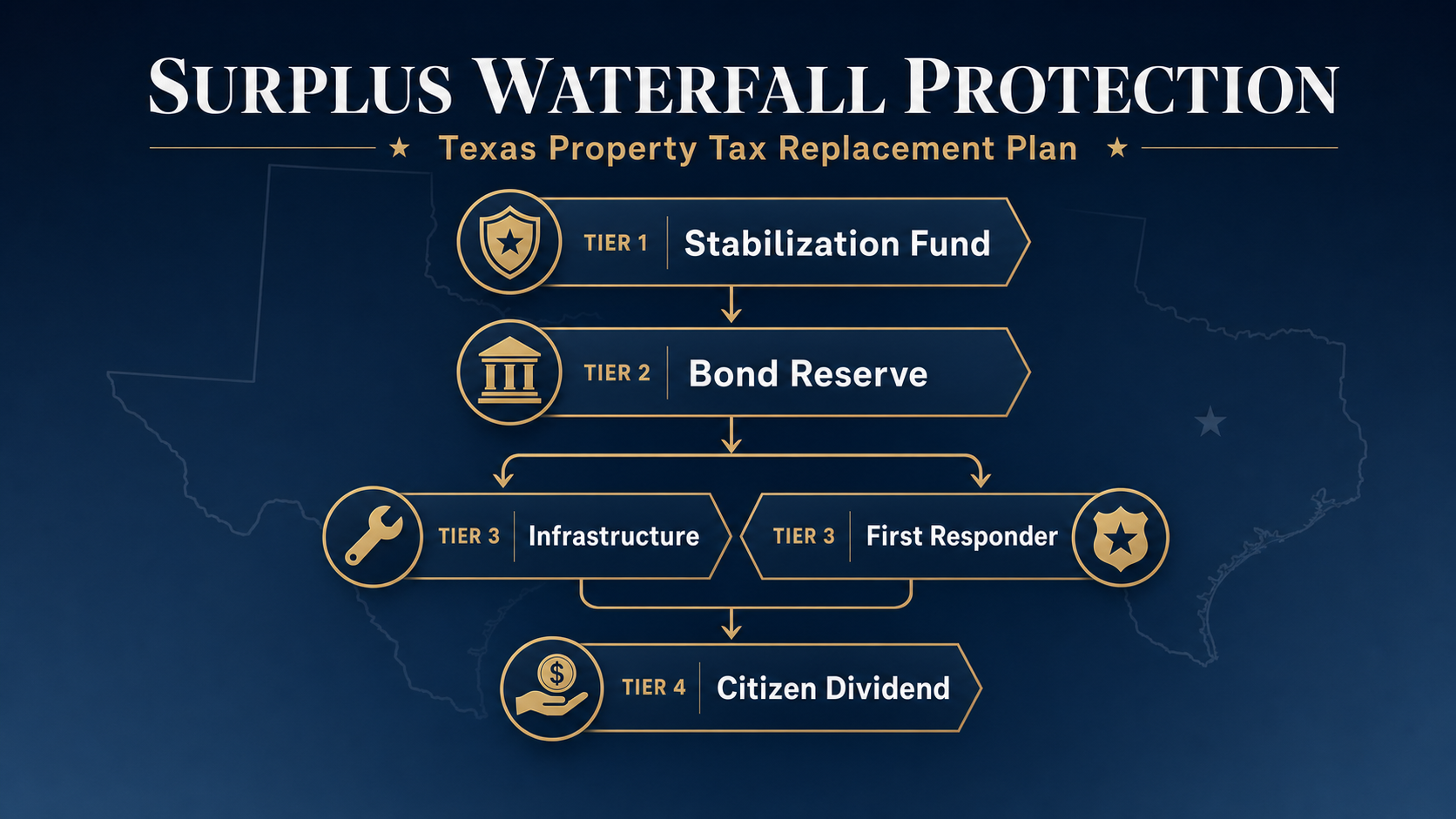
The TPTRP Fund System
Every Texas taxing entity gets a constitutionally protected reserve — and a waterfall that guarantees it gets funded, fills infrastructure and public safety needs next, and returns what is left directly to the citizens who paid it.
- Executive Summary
- What Changes From Current Law
- The Problem With No Constitutional Answer
- The Five TPTRP Funds
- The Stabilization Fund — Built on the ESF Model
- How the Funds Get Filled: The Surplus Waterfall
- The Good Faith Contribution Safe Harbor
- Fiscal Distress: What Happens When a Fund Runs Low
- The Tiered Disaster Cascade
- The Citizen Dividend Fund
- How the Existing Fund Structures Stay Intact
- Citizens Can Enforce This Directly
- What Other States Have Tried — And Why This Plan Is Built Differently
- Why This Structure Protects Texans and Gives Them Control
- Proposed Legislation
- References
Executive Summary
What the TPTRP Fund System does, and why every taxing entity in Texas is covered by it
Texas has 254 counties, 1,225 municipalities, 1,016 independent school districts, and roughly 4,000 special purpose districts. Only one government in the entire state — the State of Texas itself — is constitutionally required to keep a financial reserve for hard times. Every other taxing entity in Texas operates today with no constitutional or statutory obligation to save anything, leaving cities, counties, school districts, and special districts with exactly two tools when revenue falls short or disaster strikes: borrow money or raise taxes on the people who live there.
The TPTRP Fund System closes that gap. It amends the Texas Constitution to require every taxing entity in the state — not just Austin — to establish and maintain a Stabilization Fund modeled directly on the State's existing Economic Stabilization Fund, along with an Infrastructure Fund, a First Responder Fund, an IS Reserve Fund, and a Citizen Dividend Fund. These funds are financed automatically through the TPTRP Surplus Waterfall, a constitutionally mandated sequence that fills reserves first, pays down debt second, funds capital and public safety needs third, and returns whatever is left directly to the citizens who paid it — with no vote, no application, and no exceptions.
This article explains, in plain language and then in policy depth, exactly how each fund works, how the waterfall fills them, how a tiered disaster cascade puts them to use when hurricanes and floods hit, what existing Texas law already governs each layer of government finance and how this plan builds on rather than displaces that law, how citizens can sue to enforce every part of this system directly in court, and how similar reserve and dividend structures have performed — and sometimes failed — in other states. The goal is straightforward: give Texans control over how their money is taxed, saved, spent, and returned, and take that control out of the hands of officials who might otherwise be tempted to spend it.
Full Budget Funding Amount. An entity's most recently adopted annual maintenance and operations budget plus its certified annual bond debt service. Every balance threshold in this plan — the six-month minimum, the one-year maximum, and the 50 percent disaster escalation trigger — is calculated from this single figure.
The fund structure, the waterfall sequence, the disaster cascade, and the guaranteed minimum Citizen Dividend are written into the Texas Constitution itself, not into statute. The constitutional amendment and the implementing bill that carry out this design are reproduced in full in the Proposed Legislation section of this article.
What Changes From Current Law
Side-by-side comparison of today's requirements and the requirements under the TPTRP Fund System
Every row below states what Texas law requires of a given layer of government today, sourced to the controlling constitutional provision, statute, or agency guidance, and then states what the TPTRP Fund System would require instead. The pattern is consistent: the State already operates under a constitutional reserve mandate, and no one else does.
| Feature | Current Texas Law | Under the TPTRP Fund System |
|---|---|---|
| State reserve requirement | Constitutionally required — the Economic Stabilization Fund (ESF), Art. III, Sec. 49-g (Texas Legislature, 1988) | ESF continues, redesignated as the State's Stabilization Fund and conformed to the new balance standards |
| County reserve requirement | None — only the four constitutional operating funds under Art. VIII, Sec. 9 exist, with no reserve mandate (Texas Legislature, 1876) | Constitutionally mandated Stabilization Fund, Infrastructure Fund, First Responder Fund added alongside existing funds |
| City reserve requirement | None — Local Government Code Chapter 102 requires an annual budget but sets no reserve floor; any reserve policy is voluntary and charter-based (Texas Local Government Code, 1987) | Same five constitutionally mandated funds, floor set at six months of budget |
| ISD reserve requirement | None — TEA's “optimum fund balance” is guidance, not a mandate (Texas Education Agency, 2024) | Same five funds, parallel to and independent of TEA's FASRG fund codes |
| Special district reserve requirement | None — surplus O&M tax funds may be redirected for any lawful purpose at board discretion (Texas Water Code, 1971) | Same five funds, replacing discretionary O&M surplus redirection with a constitutional reserve requirement |
| Disaster funding mechanism | Ad hoc — borrowing, emergency tax increases, or waiting on state/federal disaster declarations | Automatic tiered cascade: city/ISD funds first, then county, then state ESF, then private insurance |
| Return of surplus to citizens | None — surplus revenue is generally retained and spent at government discretion | Constitutionally guaranteed minimum 5% Citizen Dividend, paid per-capita with no application or means test |
The Problem With No Constitutional Answer
One government in Texas is required to save. Everyone else borrows or raises taxes.
Article III, Section 49-g of the Texas Constitution established the Economic Stabilization Fund — commonly called the “Rainy Day Fund” — in 1987, and voters ratified it in November 1988 with 62 percent approval (Texas Taxpayers and Research Association, 2017). The ESF was built to smooth over the state's volatile oil and gas tax revenue and end what its authors called the “feast-or-famine budget cycle” (Texas Taxpayers and Research Association, 2017). Three-fourths of any oil and gas production tax collections above 1987 levels, plus half of any unspent general revenue at the end of a budget cycle, flow automatically into the fund, and the Legislature can appropriate additional amounts at its discretion (Texas Constitution, Art. III, Sec. 49-g).
The ESF has real limits by design. It is capped at 10 percent of the general revenue collected in the prior budget cycle, and most appropriations from it require a three-fifths vote of both chambers of the Legislature (Texas Constitution, Art. III, Sec. 49-g). The Comptroller's office also applies a working minimum-balance guideline of roughly 7 percent of general-revenue-related appropriations for fund management purposes (Texas Comptroller of Public Accounts, 2025). These guardrails have made the ESF one of the more disciplined reserve funds in the country — but they exist for the State alone.
The ESF was not designed as a general savings account. It was designed as a shock absorber for a state budget built on oil and gas severance taxes, which is why its deposit formula is tied directly to production tax collections above 1987 levels rather than to overall revenue growth (Texas Taxpayers and Research Association, 2017).
No Texas county, city, school district, or special district operates under any equivalent constitutional mandate. Counties have four constitutional funds under Article VIII, Section 9 — the general fund, the permanent improvement fund, the road and bridge fund, and the jury fund, all capped at a combined 80 cents per $100 of valuation — but none of them is a reserve fund, and Section 9(d) merely permits counties to combine those four operating funds, not to create a savings mechanism (Texas Constitution, Art. VIII, Sec. 9). Cities operate under Local Government Code Chapter 102, which requires only that a municipality adopt an annual budget and spend within it, with any reserve policy left entirely to the discretion of the city council or home-rule charter (Texas Local Government Code, Chapter 102). Independent school districts follow the Texas Education Agency's Financial Accountability System Resource Guide, which recommends — but does not require — an “optimum” general fund balance equal to roughly two months of operating cash (Texas Education Agency, 2024). Special districts operating under Water Code Chapter 49 may levy an operation and maintenance tax, but any surplus not needed for its original purpose “may be used for any lawful purpose” at board discretion — there is no reserve requirement at all (Texas Water Code, Sec. 49.107(e)).
The result is that when a school district's enrollment-driven revenue drops, when a small city's sales tax base takes a hit, or when a hurricane devastates a coastal county, the entity's realistic options are borrowing or an emergency tax increase. The TPTRP Fund System changes that reality by extending the ESF model — constitutionally, uniformly, and with an automatic funding mechanism — to every taxing entity in the state.
The Five TPTRP Funds
Purpose, balance rules, and waterfall placement for each constitutionally distinct fund
Every taxing entity subject to the TPTRP establishes and maintains five constitutionally distinct, legally segregated funds. Each has its own purpose, its own balance rules, and its own place in the waterfall sequence that fills it.
| Fund | Core Purpose | Balance Cap | Waterfall Level |
|---|---|---|---|
| Stabilization Fund (“Rainy Day Fund”) | Revenue shortfalls, disaster response, fiscal distress recovery, limited temporary debt service coverage | Six-month minimum; one-year maximum | Level 1 |
| IS Reserve Fund | Single dual-function bond fund — the account an entity pays its bond debt service from and its first-line reserve against a debt service shortfall; receives surplus for accelerated payoff of voter-approved debt | Governed under the TPTRP Bond Management amendment, Art. VIII, Sec. 1-o | Level 2 |
| Infrastructure Fund | Roads, water and wastewater systems, public buildings that deliver direct citizen-facing services, disaster repair of the same | No maximum cap | Level 3 |
| First Responder Fund | Capital, equipment, training, and emergency cost recovery for police, fire, and EMS departments | No maximum cap | Level 3 |
| Citizen Dividend Fund | Direct per-capita return of surplus revenue to citizens | Distributed in full each fiscal period — no balance carried beyond distribution | Level 3 (guaranteed minimum) / Level 4 (distribution) |
Each fund is legally segregated from every other fund of the entity, including its general fund, its M&O operating accounts, and its I&S debt service accounts. None of these funds may be commingled, and a governing body member who authorizes an improper transfer out of any of these funds is personally liable for the full amount, plus interest, and that liability is not covered by any governmental indemnity or insurance the entity carries.
One bond reserve, not two. The fund system amendment does not create a bond reserve of its own. It incorporates by reference the single IS Reserve Fund established by the TPTRP Bond Management amendment — a fund that serves simultaneously as an entity's bond debt service operating account and as its first-line emergency reserve for a debt service shortfall — and no taxing entity is required to establish, fund, or maintain any separate or additional bond reserve fund. An entity's Stabilization Fund still stands behind bond debt service, but only behind the IS Reserve Fund: the IS Reserve Fund is drawn first, down to its own required floor, before the Stabilization Fund is reached at all.
Legal segregation is what makes the rest of the system enforceable. Without it, a governing body could satisfy a reserve requirement on paper by relabeling general fund cash, then spend the same dollars on operations. Personal liability for improper transfers — uninsurable and not indemnified — is the enforcement mechanism attached to that segregation.
The Stabilization Fund — Built on the ESF Model
Balance standards, permitted uses, and prohibited uses
Balance Standards: Six Months to One Year
Every Stabilization Fund carries two constitutional thresholds calculated from the entity's Full Budget Funding Amount — its most recently adopted annual maintenance and operations budget plus its certified annual bond debt service:
- The Six-Month Minimum Balance equals 50 percent of the Full Budget Funding Amount. This is the constitutional floor. An entity below this floor is in its Accumulation Period and is required to keep building toward it.
- The One-Year Maximum Balance equals 100 percent of the Full Budget Funding Amount. Once a fund reaches this ceiling, mandatory waterfall deposits to that fund stop and the money passes through to the next level of the waterfall.
Between the floor and the ceiling, the governing body has discretion, exercised in public, on the record, with the Chief Financial Officer's written recommendation attached to every vote.
What the Fund Can and Cannot Be Used For
The Stabilization Fund has four permitted uses: covering a certified revenue shortfall against the adopted M&O budget, funding disaster response under the tiered cascade described below, supporting a Fiscal Recovery Plan during a declared Fiscal Distress Condition, and — in narrow, time-limited circumstances — temporarily covering a bond debt service payment that is due, subject to repayment within one fiscal year and a floor that the draw may never take the fund below 25 percent of its Six-Month Minimum Balance.
The fund cannot be used for routine operating expenses in any year without a declared shortfall, for capital projects or equipment outside a declared disaster, for compensation or bonuses for elected officials, to paper over a governing body's failure to comply with the constitutional Total Budget Cap, as loan collateral, as a substitute for required deposits into any other fund, or to avoid the mandatory expenditure reductions required after a failed rate election.
Accumulation Period and Maintenance Period. An entity is in its Accumulation Period until its Stabilization Fund reaches the Six-Month Minimum Balance for the first time. From that point forward the entity is in its Maintenance Period, and the standard fiscal distress rules apply in place of the accumulation-stage safe harbor described in Section 7.
How the Funds Get Filled: The Surplus Waterfall
The automatic four-level sequence that fills every fund without a vote or an application
The waterfall is the automatic, constitutionally mandated sequence that fills every fund without requiring a vote, an application, or ongoing legislative discretion. At the close of each fiscal period, after M&O expenditures are funded from the entity's certified budget, the remaining distributable surplus flows through four levels in order.
| Waterfall Level | What Happens | Example (Entity With $100,000 in Surplus) |
|---|---|---|
| Level 1 — Stabilization Fund | Up to 50% flows to the Stabilization Fund; during the Accumulation Period this share goes first toward the six-month minimum; once met, the governing body may vote to continue up to the one-year maximum, or let it pass through | $50,000 available; if fund is below minimum, full $50,000 deposited |
| Level 2 — IS Reserve Fund | Up to 50% of what arrives from Level 1 may go toward accelerated payoff of outstanding voter-approved bonds or toward maintaining the IS Reserve Fund's required balance; an entity with no outstanding bonds, or whose reserve requirement is already satisfied, passes the entire share through to Level 3 | Of the remaining $50,000 passed through, up to $25,000 may go to bond acceleration |
| Level 3 — Citizen Dividend (guaranteed floor), Infrastructure Fund, First Responder Fund | At least 5% of the amount reaching this level is locked for the Citizen Dividend Fund before any other allocation; of what remains, up to 45% each may go to Infrastructure and First Responder funds | Of $25,000 reaching Level 3: at least $1,250 locked for dividends; remainder split by governing body vote between Infrastructure, First Responder, and additional Citizen Dividend funding |
| Level 4 — Citizen Dividend Distribution | Everything credited to the Citizen Dividend Fund is distributed to citizens per-capita at the close of the fiscal period | Entire Citizen Dividend Fund balance paid out — no carryforward |
At every level, any amount not needed or not allocated by governing body vote passes through in full to the next level — nothing is trapped, and nothing defaults to the general fund. This pass-through design means an entity that has already filled its Stabilization Fund and paid down its debt sends a larger share of its surplus directly to infrastructure, public safety, and citizens, rather than the money simply disappearing into general operations.
Other Ways the Funds Get Capitalized
The waterfall is the primary mechanism, but it is not the only one. A governing body may directly appropriate unobligated fund balances to the Stabilization Fund at any time without a voter election, provided no rate increase is involved. During the TPTRP's multi-year transition period, the Transition Fund may provide non-repayable capitalization assistance to entities that have not yet reached their six-month minimum. Investment earnings on fund balances stay in the fund, compounding over time. Bond proceeds, by constitutional design, can never be used to capitalize a Stabilization Fund — a reserve against shortfalls and disasters cannot itself be built from borrowed money.
The prohibition on capitalizing a reserve with bond proceeds is written at the constitutional level rather than left to statute, which is what prevents a future legislature or a local governing body from borrowing its way to apparent compliance with the six-month minimum.
The Good Faith Contribution Safe Harbor
How an entity that genuinely had no surplus is treated during its Accumulation Period
Not every entity will reach its six-month minimum immediately, and the plan is built to recognize that reality without treating early-stage entities as failures. During an entity's Accumulation Period, a Contribution Shortfall — a fiscal period in which no surplus was available to deposit at Level 1 despite full compliance with the Total Budget Cap — triggers a Contribution Shortfall Notice and a referral to transition or Comptroller assistance rather than an immediate Fiscal Distress declaration. Only a second consecutive shortfall, or a Comptroller finding that the shortfall was not attributable to genuine economic conditions, escalates the matter to full Fiscal Distress status. Once an entity's Maintenance Period begins — meaning it has reached its six-month minimum at least once — this safe harbor no longer applies, and the standard Fiscal Distress rules govern going forward.
The safe harbor distinguishes between an entity that cannot deposit because there was genuinely nothing to deposit and an entity that failed to manage its budget. Only the second situation carries the spending restrictions and oversight described in the next section.
Fiscal Distress: What Happens When a Fund Runs Low
Automatic declaration, mandatory recovery planning, escrowed distributions, and due process
A Fiscal Distress Condition is declared automatically, by operation of law, whenever a Stabilization Fund balance falls below 50 percent of the entity's required six-month minimum. The Comptroller must issue written notice within 10 days, the governing body must respond within 10 days with a full accounting of the drawdown's causes, and a Fiscal Recovery Plan — identifying the causes, the exact restoration steps, and a timeline with no single step deferred more than 24 months without documented Comptroller approval — must be adopted and filed within 60 days.
Until that plan is filed, certified sufficient, and the entity has demonstrated at least one full quarter of compliance, the entity's quarterly TPTRP waterfall distribution is suspended and held in a Comptroller-managed escrow account. During the distress period, the governing body cannot approve new non-essential spending, new non-emergency positions, new non-essential contracts, new discretionary capital projects, or new compensation increases for elected officials. If the condition is not resolved within one fiscal year, the Comptroller may appoint a fiscal manager — through a defined due-process sequence that includes written notice, a 30-day response period, and the right to appeal to a Travis County district court — who operates the entity's financial functions alongside, not in place of, its elected governing body.
A fiscal manager works alongside the elected governing body rather than replacing it. Elected officials remain in office and retain their offices' non-financial authority throughout the recovery period, and the appointment itself is appealable to a district court.
The Tiered Disaster Cascade
Four tiers, one escalation trigger, and a fixed spending priority order
Why a Cascade Instead of a Single Pool
The constitutional design behind the cascade rests on a simple principle: a disaster should be resolved at the lowest level of government capable of fully addressing it, so that resources at every higher tier remain available for events that genuinely exceed local capacity. But the trigger for escalation is not the six-month minimum itself. The trigger is fifty percent (50%) of that required minimum balance. In practice, that means an entity first uses the half of its required six-month minimum that sits above the 50 percent trigger before the next tier activates. This structure also creates a built-in incentive for every entity to keep its own fund at or above its six-month minimum, because a depleted local fund pulls county and state resources into play sooner — and with them, more oversight.
The escalation threshold is 50 percent of the required six-month minimum balance — not the six-month minimum itself. An entity draws down to that halfway point before the next tier activates, at every level of the cascade.
How the Cascade Escalates
| Tier | What Activates | Trigger | Who Draws |
|---|---|---|---|
| Tier 1 — City and ISD Funds | Each affected municipality's and ISD's own Stabilization, Infrastructure, and First Responder Funds | Immediately upon a local or state disaster declaration, or an imminent-threat advisory with formal declaration required within 72 hours | The affected city or ISD directly |
| Tier 2 — County Fund | The county's Stabilization, Infrastructure, and First Responder Funds | Any municipality or ISD in the county has drawn its own fund down to or below 50% of its required six-month minimum in connection with the disaster | The county, providing direct assistance to affected cities/ISDs or funding its own response |
| Tier 3 — State Fund (ESF) | The State's Economic Stabilization Fund | Any county's fund has been drawn down to or below 50% of its required six-month minimum in connection with the disaster | The Governor, subject to the Legislature's existing appropriation authority under Article III, Sec. 49-g (Texas Constitution, Art. III, Sec. 49-g) |
| Tier 4 — Private and Entity-Level Insurance | Existing private homeowners, business, flood, and windstorm coverage, and existing entity-level property and casualty coverage | The State ESF has been drawn down to or below 50% of its own required six-month minimum in connection with the disaster | Citizens, businesses, and entities through their existing insurance carriers, TWIA, NFIP, and TDI-regulated coverage |
Tier 4 does not create any new state insurance program. It relies entirely on the private insurance market and existing mechanisms such as the Texas Windstorm Insurance Association and the National Flood Insurance Program, coordinated by a Disaster Response Team convened through the state's existing emergency management structure under the Texas Disaster Act of 1975. The intent is explicit: exhaust three full layers of public reserve funds before citizens and businesses are asked to rely on private coverage as the primary path to recovery — the reverse of how disaster costs are typically absorbed today.
The Spending Priority Order
Within every tier, disaster dollars are spent in a fixed constitutional order:
- Restoring essential utilities — water, wastewater, power, and communications.
- Protecting health and safety, including emergency medical response and temporary shelter.
- Repairing public infrastructure necessary to restore essential government function.
- To the extent funds remain above the six-month minimum being drawn upon, helping restore citizen property and local business losses.
This sequence cannot be reordered by administrative convenience — it is the same at the city, county, and state level.
The Citizen Dividend Fund
A flat per-capita return of surplus, defined constitutionally as a return of taxes paid
At least 5 percent of every entity's surplus reaching Level 3 of the waterfall is locked, unconditionally, for the Citizen Dividend Fund before anything else is allocated at that level — and any amount not claimed by the Infrastructure or First Responder Funds also flows to the dividend. Every adult who is a citizen of both Texas and the taxing entity's jurisdiction as of the close of the fiscal period receives an equal per-capita share, with no application, no means test, and no income qualification. Minors' shares go into custodian accounts that a parent or guardian cannot access or borrow against, released in full to the child at age eighteen. Every distribution comes with a Citizen Distribution Statement disclosing the exact dividend amount, the source entities and rates behind it, and the recorded votes each governing body made at every waterfall decision point.
How the money actually arrives is the citizen's own decision. Each citizen elects the method of receipt and designates where the payment goes — direct deposit to an account the citizen sets up on whatever terms the citizen arranges with the citizen's own financial institution, a check or payment card issued by the Comptroller, a Texas Family Fund Account, a credit against what the citizen owes in Unified Transaction Tax, or any additional method the Comptroller makes available. No citizen can be pushed into a particular method, a particular bank, or a particular type of account as the price of getting a dividend, and no dividend may be withheld, reduced, or delayed because of the method the citizen chose. No fee, administrative charge, or deduction of any kind may be taken out of a dividend by a taxing entity, by the Comptroller, or by any institution handling the payment — the citizen receives the full per-capita share.
The dividend is constitutionally defined as a return of taxes already paid — not a government benefit or welfare program — and that characterization cannot be altered by statute or agency rule. It is also strictly contingent: no dividend is owed, and no deposit required, in any period where no actual, Comptroller-certified surplus exists. And it cannot be suspended, reduced, or redirected to any other fund under any circumstance, including during a declared Fiscal Distress Condition or an active disaster, except where the dividend is properly zero because there was no surplus to distribute.
Two protections work together here. The dividend cannot be suspended or redirected by any official action, and it is owed only when a certified surplus actually exists — so the guarantee is absolute without creating an obligation the entity cannot fund.
How the Existing Fund Structures Stay Intact
Every TPTRP fund is a parallel, additional layer — not a replacement for current law
None of the TPTRP's new funds replace or absorb the fund structures Texas taxing entities already operate under existing law. Each is designed as a parallel, additional layer.
Counties keep their four Article VIII, Section 9 constitutional funds — general, permanent improvement, road and bridge, and jury — along with the Farm-to-Market/Lateral Road Fund under Article VIII, Section 1-a (Texas Constitution, Art. VIII, Sec. 9). The county's consolidation option under Section 9(d) does not extend to any TPTRP fund, and the Road and Bridge Fund's existing statutory purpose restriction under Transportation Code Section 256.001 remains in full force (Office of the Attorney General of Texas, 2018).
Municipalities keep their General Fund, Debt Service Fund, Capital Projects Funds, Enterprise Funds, Internal Service Funds, and Special Revenue Funds under Local Government Code Chapter 102, and home-rule charter provisions on fund structure remain in force to the extent they do not conflict with the new constitutional minimums (Texas Local Government Code, Chapter 102).
Independent school districts keep their FASRG fund codes exactly as they exist today — the General Fund (199), Special Revenue Funds (200–499), Debt Service Fund (511), and Capital Projects Funds (600–699) (Texas Education Agency, 2024). The TPTRP funds are maintained as separate, parallel accounts and have no effect on PEIMS reporting, federal grant accounting, or Foundation School Program determinations.
Special districts keep their Operations and Maintenance Fund and Debt Service Fund under Water Code Chapter 49. The only change is that surplus O&M tax revenue that current law allows a district to redirect “for any lawful purpose” at board discretion is instead routed through the constitutional waterfall to the extent the district operates under the TPTRP's tiered rate structure (Texas Water Code, Sec. 49.107(e)).
Citizens Can Enforce This Directly
A private right of action against local entities and against the state's own oversight agency
Every obligation in this plan is backed by a private right of action. Any Texas citizen who resides in or pays taxes in a jurisdiction has legal standing to sue in the appropriate district court to compel an entity to establish a required fund, to compel compliance with a filed Fiscal Recovery Plan, to enjoin any prohibited use of any fund — including disaster spending outside the mandated priority order — or to compel any required public disclosure. Citizens can also sue the Comptroller directly, in Travis County district court, to compel the timely issuance of Fiscal Distress Notices, Contribution Shortfall Notices, annual certifications, or the publication of a Fiscal Recovery Plan. A prevailing citizen recovers reasonable attorneys' fees and costs; a citizen who does not prevail bears no penalty beyond the loss of the claim. This dual enforcement track — against local entities and against the state's own oversight agency — closes the loophole that exists in most reserve-fund systems, where the law says a reserve is required but no one outside government has standing to make sure it actually happens.
“If a city refuses to build its fund, if the Comptroller sits on a required notice, or if a Fiscal Recovery Plan is fabricated instead of followed, an ordinary Texan can walk into a courthouse and force compliance without waiting on the next election cycle.”— The enforcement premise of the TPTRP Fund System
What Other States Have Tried — And Why This Plan Is Built Differently
National rainy day fund practice, Colorado's TABOR refund, and Alaska's Permanent Fund Dividend
State Rainy Day Funds: The National Picture
The Texas ESF is not unique in concept, but it is disciplined relative to most of its peers. A national study of state rainy day fund design found that 38 states have no rule tying deposits to actual economic or revenue conditions — most simply deposit based on year-end fiscal position or an ad hoc legislative decision, and four states, including Illinois and Kansas, have no formal budget stabilization fund at all (Pew Charitable Trusts, 2014). Missouri requires a two-thirds vote of each legislative chamber to withdraw from its constitutionally required reserve — a stricter threshold than Texas's three-fifths — while states like Virginia, Tennessee, Idaho, Washington, and Hawaii tie deposits directly to revenue volatility rather than leaving the decision to annual discretion (Pew Charitable Trusts, 2014).
The TPTRP Fund System takes the strongest features from across these approaches and extends them further than any state currently does. It ties deposits to an objective, formulaic minimum and maximum balance rather than leaving deposit decisions to ad hoc legislative or council discretion. It applies that same discipline not just at the state level but at every level of government within the state — something no other state has attempted for its cities, counties, and school districts as a matter of constitutional mandate.
Colorado's TABOR: Automatic Refunds Without a Structured Reserve
Colorado's Taxpayer's Bill of Rights (TABOR) returns excess state revenue collected above a constitutional cap directly to taxpayers, primarily through the state income tax return, using a tiered refund structure based on income (Colorado Department of Revenue, 2025). TABOR proves that a constitutional mechanism forcing government to return surplus revenue to citizens is both workable and popular — refund amounts are published and distributed on a predictable schedule every year. But TABOR's refund is tied to income level, which means larger taxpayers receive larger refunds regardless of what they actually paid in the underlying tax, and it operates with no equivalent constitutional reserve-fund requirement layered underneath it, so the state's stabilization capacity and its refund mechanism are not connected to one another.
The TPTRP's Citizen Dividend improves on this in two ways. First, it is a flat per-capita distribution rather than an income-tiered one — every citizen gets the same share of the surplus their jurisdiction generated, consistent with the plan's principle that this is a return of taxes paid on transactions, not an income-based benefit. Second, the dividend is only one part of an integrated four-level waterfall that fills reserve, debt, and infrastructure funds first — so citizens receive a dividend precisely because the entity has already built its safety net, rather than a state returning money it might need for a reserve it never established.
Alaska's Permanent Fund Dividend: A Cautionary Tale on Definition and Drift
Alaska's Permanent Fund Dividend is the best-known citizen dividend program in the country, and its history is instructive about what happens when a distribution's purpose is not locked down at the constitutional level. The Alaska Permanent Fund itself was created by constitutional amendment in 1976 to convert a share of finite oil revenue into a long-term savings vehicle for the state (Alaska Department of Revenue, Permanent Fund Dividend Division, 2020). The dividend, by contrast, was created by ordinary statute in 1982 — not by the Constitution — specifically so lawmakers would have room to change or eliminate it later (Alaska Watchman commentary, 2025). Because the dividend was never constitutionally guaranteed, the Alaska Supreme Court ruled in 2017 that the amount is subject each year to legislative appropriation and gubernatorial veto, and Governor Bill Walker vetoed roughly half of the 2016 dividend outright, cutting it from a calculated $2,052 to $1,022 (Basic Income News, 2017). The formula itself has also drifted over decades of legislative tinkering, moving from an earnings-based calculation to a percent-of-market-value formula that critics on multiple sides describe as less predictable and less faithful to the original design (Alaska Watchman, 2022).
The TPTRP is built specifically to avoid this failure mode. The Citizen Dividend, the waterfall sequence that funds it, and the guaranteed minimum percentage are written directly into the Texas Constitution rather than left to statute, meaning no governor, comptroller, or legislature can unilaterally reduce, veto, or redefine the distribution the way Alaska's governor did. The formula is a fixed percentage of certified surplus, not a variable calculation subject to methodology changes, and the underlying reserve funds the dividend depends on are filled first, in a fixed order, before any dividend is calculated — removing the discretion that allowed Alaska's program to be reshaped repeatedly over four decades.
Why This Structure Protects Texans and Gives Them Control
Reserved for a visible purpose, or returned — decided in public, on the record
The TPTRP Fund System is built around a single premise: money that belongs to Texas taxpayers should either be reserved for a purpose the taxpayers themselves can see and verify, or returned to them — and the decision about which of those two things happens should be made in public, on the record, by elected officials whose votes are visible, not buried in a general fund where surplus quietly becomes the baseline for next year's spending. The six-month minimum protects every entity against ordinary revenue swings without giving officials open-ended savings authority beyond a one-year ceiling. The disaster cascade makes sure the closest, most locally accountable government responds first, while keeping state and federal resources in reserve for events that truly exceed local capacity. The citizen enforcement provisions mean that if any of this fails to happen — if a city refuses to build its fund, if the Comptroller sits on a required notice, if a Fiscal Recovery Plan is fabricated instead of followed — an ordinary Texan can walk into a courthouse and force compliance without waiting on the next election cycle. And the Citizen Dividend guarantees that surplus revenue collected above what government actually needs eventually finds its way back into the hands of the people who paid it, on a schedule set by the Constitution rather than the discretion of whoever happens to hold office that year.
Proposed Legislation
The constitutional amendment and the implementing bill that carry out the fund system described above, reproduced in full
Both drafts below are reproduced in their entirety. Use the tabs to switch between the constitutional amendment and the implementing bill; each read pane scrolls independently, expands to full length, and can be printed, saved as a PDF, or downloaded as a Word document or plain text file.
TPTRP Fund System — Constitutional Amendment and Implementing Bill
Rep. Will Campbell · House District 109 · 90th Legislature · Review each draft in the tabs below
By: ___________________
H.J.R. No. _____
A JOINT RESOLUTION
proposing constitutional amendments to Article III and Article VIII of the Texas Constitution to establish the TPTRP Fund System and the TPTRP Surplus Waterfall — creating for the State of Texas and for every county, municipality, independent school district, and special district in this state a Stabilization Fund, an Infrastructure Fund, a First Responder Fund, an IS Reserve Fund, and a Citizen Dividend Fund; defining the purpose, minimum requirements, permitted uses, and prohibited uses of each fund; establishing the constitutionally mandated sequence by which surplus revenue flows through those funds and, ultimately, to citizens; establishing the tiered disaster response cascade, the priority order of disaster response spending, and the fund carryforward and purpose-lock protections by which the funds are deployed in response to declared disasters and fiscal emergencies; and making conforming changes to the Economic Stabilization Fund under Article III, Section 49-g.
BE IT RESOLVED BY THE LEGISLATURE OF THE STATE OF TEXAS:
PREAMBLE — LEGISLATIVE FINDINGS
The Legislature of the State of Texas finds:
1. The current Texas Constitution mandates a rainy day fund mechanism only for the State of Texas through Article III, Section 49-g — the Economic Stabilization Fund (ESF). No equivalent constitutional requirement exists for the 254 counties, 1,225 municipalities, 1,016 independent school districts, or approximately 4,000 special purpose districts of this state, and no Texas taxing entity of any kind is subject to a constitutional or statutory requirement to maintain dedicated reserves for infrastructure, first responder capital needs, bond debt service, or return of surplus revenue to citizens.
2. The TPTRP replaces all ad valorem property taxes and applicable state taxes for all taxing entities in the state with a unified, tiered sales and use tax, and establishes the TPTRP Surplus Waterfall as the constitutionally mandated sequence by which surplus collections are distributed. The fiscal resilience, infrastructure capacity, public safety readiness, and citizen accountability of this new revenue structure depend on the existence of constitutionally protected, purpose-restricted funds into which the waterfall deposits surplus revenue, and on the waterfall sequence itself being a constitutional guarantee rather than a matter of ordinary legislative discretion.
3. Extending a stabilization reserve requirement from the State alone to every taxing entity in Texas, and creating parallel constitutional funds dedicated to infrastructure, first responder capacity, bond debt service, and citizen dividends, creates a statewide fiscal resilience and accountability architecture that reduces the risk of local government fiscal failure, ensures true public infrastructure and public safety capacity are funded before any other discretionary use of surplus, and guarantees that surplus revenue in excess of an entity's actual need is either reserved for a constitutionally defined purpose or returned to the citizens who paid it.
4. Each fund established by this section is deliberately narrow in constitutional definition — establishing the fund's existence, its core purpose, its minimum requirements, and its outer boundaries — so that the details of administration, distribution procedure, and day-to-day management are left to implementing legislation, consistent with the principle that a state constitution should establish durable structure and boundaries, not operational detail.
5. The State of Texas's existing Economic Stabilization Fund (ESF) is redesignated as the State's Stabilization Fund under this amendment and is updated to reflect the TPTRP revenue base, the six-month minimum / one-year maximum balance standard, and the tiered disaster cascade structure consistent with the funds created for all other taxing entities.
6. The purpose of the tiered disaster cascade is not merely to fund government operations during a disaster — it is to reduce, to the greatest extent achievable, the cost of recovery borne directly by citizens whose homes and property are damaged and by local businesses whose operations are disrupted, and to reduce the state's and its citizens' long-term dependence on private insurance and federal disaster assistance for that recovery. A disaster that can be fully addressed by the resources of the affected city, county, or ISD should be resolved at that level, without escalating the cascade to the county or State tier, so that disaster resources remain available at the State level for events that genuinely exceed local and regional capacity.
7. A fund that retains unused balances, earns interest on those balances, and is never diverted from its constitutional purpose — including during a disaster — builds the compounding capital base necessary to reduce every taxing entity's long-term dependence on bond issuance to fund infrastructure and capital needs. This principle applies with equal force during ordinary operations and during declared disasters: a fund used for its own purpose during a disaster is not thereby weakened in its capacity to serve that same purpose in the future, because unused amounts always remain in the fund, invested, until needed.
8. The TPTRP Surplus Waterfall is, in itself, a constitutional citizen protection. It guarantees that no taxing entity may accumulate and spend surplus revenue beyond its constitutionally capped budget, that entities which manage their affairs well see their reserved funds and citizen dividends grow over time rather than their government's spending, and that any revenue not needed for a fund's defined purpose is ultimately returned to the citizens who paid it as a Citizen Dividend.
SECTION 1. AMENDMENT TO ARTICLE VIII
(New Section to be designated by the Texas Legislative Council consistent with the primary TPTRP Article VIII amendment numbering)
Sec. [X]. TPTRP FUND SYSTEM — STABILIZATION, INFRASTRUCTURE, FIRST RESPONDER, IS RESERVE, AND CITIZEN DIVIDEND FUNDS FOR ALL TAXING ENTITIES.
(a) Definitions.
In this section:
(1) "Taxing entity" means the State of Texas, any county, any incorporated municipality, any independent school district, and any special district authorized to receive a distribution of Unified Transaction Tax revenue under the TPTRP tiered rate structure established by this Article.
(2) "Full Budget Funding Amount" means the sum of an entity's most recently adopted annual Maintenance and Operations budget plus the entity's certified annual Interest and Sinking bond debt service obligation for the same period.
(3) "Six-Month Minimum Balance" means an amount equal to one-half (50%) of the entity's Full Budget Funding Amount for the most recently completed fiscal year.
(4) "One-Year Maximum Balance" means an amount equal to the entity's Full Budget Funding Amount for the most recently completed fiscal year.
(5) "Stabilization Fund" or "Rainy Day Fund" means, for every taxing entity other than the State of Texas, the constitutionally required general fiscal reserve fund created by subsection (b) of this section. For the State of Texas, "Stabilization Fund" means the Economic Stabilization Fund established by Article III, Section 49-g of this Constitution, as amended by this Article to conform to the standards of this section.
(6) "Infrastructure Fund" means the constitutionally required, purpose-restricted fund created by subsection (m) of this section, dedicated exclusively to Qualifying Infrastructure as defined by that subsection.
(7) "First Responder Fund" means the constitutionally required, purpose-restricted fund created by subsection (n) of this section, dedicated exclusively to the capital, equipment, training, and emergency-event cost-recovery needs of First Responder Departments as defined by that subsection.
(8) "IS Reserve Fund" means the single, dedicated, entity-level fund required of every taxing entity to serve simultaneously as the operating account from which the entity pays bond debt service and as the entity's first-line emergency reserve for bond debt service shortfalls, as established and defined by Article VIII, Section 1-o of this Constitution (TPTRP Bond Management), and incorporated into the waterfall sequence of this section by subsection (o) of this section. No taxing entity is required to establish, fund, or maintain any separate or additional bond reserve fund; the IS Reserve Fund is the sole entity-level bond reserve contemplated by this Constitution. The detailed structure, minimum balance, and administration of the IS Reserve Fund is governed exclusively by Article VIII, Section 1-o, and by implementing legislation enacted under that section.
(9) "Citizen Dividend Fund" means the constitutionally required fund created by subsection (p) of this section, into which the guaranteed minimum share of surplus revenue described by that subsection is deposited pending distribution to citizens.
(10) "Fiscal Distress Condition" means the condition declared when a taxing entity's Stabilization Fund balance falls below fifty percent (50%) of the required Six-Month Minimum Balance, except as otherwise provided by subsection (i-1) of this section during an entity's Accumulation Period.
(11) "Declared Disaster" means a natural disaster, public health emergency, or other catastrophic event for which a declaration has been issued by the appropriate authority under applicable law, including a declaration by a city's mayor, a county judge, the Governor of the State of Texas, or the President of the United States under applicable federal law.
(12) "Chief Financial Officer" or "financial officer" means the officer or employee of a taxing entity charged by law or by the governing body with primary responsibility for the entity's financial administration.
(13) "Essential Utility" means a publicly or privately operated water, wastewater, electric power, natural gas, or communications infrastructure system whose function is necessary to sustain public health, safety, and basic habitability within the affected jurisdiction.
(14) "Restoration of Citizen Property and Local Business" means the repair, rebuilding, or replacement of a damaged or destroyed primary residence, other citizen-owned real or personal property, or a local business's damaged or destroyed real property, equipment, or inventory, directly resulting from a Declared Disaster.
(15) "Accumulation Period" means, with respect to a taxing entity's Stabilization Fund, the period beginning on the effective date applicable to that entity under this Article, or the date of the entity's formation if later, and ending on the date the entity first reaches its required Six-Month Minimum Balance.
(16) "Maintenance Period" means the period beginning on the date a taxing entity first reaches its required Six-Month Minimum Balance and continuing thereafter, including any later period in which the fund is drawn below that balance.
(17) "Contribution Shortfall" means a fiscal period during an entity's Accumulation Period in which no amount was available to be deposited to the entity's Stabilization Fund through Level 1 of the waterfall because the entity had no Comptroller-certified distributable surplus pool for that fiscal period, notwithstanding the entity's compliance with the Total Budget Cap and the other applicable requirements of this Article.
(b) Stabilization Fund Required for Every Taxing Entity.
Every taxing entity subject to this Article shall establish and maintain a Stabilization Fund as a legally segregated, purpose-restricted special fund separate from all other funds of the entity, including the Infrastructure Fund, First Responder Fund, IS Reserve Fund, and Citizen Dividend Fund established by this section. The Stabilization Fund of each taxing entity is not part of the entity's general fund, M&O operating accounts, or I&S debt service accounts and may not be commingled with those funds or with any other fund under any circumstances.
The Stabilization Fund of the State of Texas is the Economic Stabilization Fund (ESF) established by Article III, Section 49-g of this Constitution, which is hereby amended and redesignated as provided in Section 3 of this Joint Resolution to conform to the minimum balance, maximum balance, permitted use, and capitalization standards established by this section.
(c) Minimum and Maximum Balance; Fund Retention and Investment.
(1) Minimum Balance. Every taxing entity shall maintain its Stabilization Fund at or above the Six-Month Minimum Balance. The Six-Month Minimum Balance is a constitutional floor — it is not a target. An entity that has not yet reached the Six-Month Minimum Balance is actively in the process of building its fund through waterfall capitalization and may not divert Stabilization Fund waterfall deposits to any other use until the minimum is met.
(2) Maximum Balance. No taxing entity's Stabilization Fund may exceed the One-Year Maximum Balance. Revenue that would otherwise flow to the Stabilization Fund at Level 1 of the waterfall, when the fund has reached or would exceed the One-Year Maximum Balance, passes in full to Level 2 of the waterfall as provided by this Article.
(3) Recertification. The Texas Comptroller of Public Accounts shall certify each entity's Six-Month Minimum Balance and One-Year Maximum Balance annually, within 60 days of the close of the entity's fiscal year, based on the entity's most recently adopted annual budget figures. Upon recertification, the new minimum and maximum apply prospectively.
(4) Retention of Unused Balances — No Lapse. Any amount in the Stabilization Fund not expended in a fiscal period, up to the One-Year Maximum Balance, shall carry forward to the next fiscal period without lapsing, reverting to the general fund, or being subject to any other year-end sweep, reallocation, or "use it or lose it" budgetary practice. The building of the Stabilization Fund toward and, where the governing body elects, up to the One-Year Maximum Balance over multiple fiscal periods is the intended constitutional design of this section, not an irregularity to be corrected.
(5) Investment for Interest. The Chief Financial Officer of each taxing entity may invest amounts held in the Stabilization Fund in accordance with the entity's lawful investment policy and applicable law governing the investment of public funds. All investment earnings on the Stabilization Fund are credited to and remain within the Stabilization Fund, subject to the One-Year Maximum Balance, and serve the constitutional purpose of building each entity's reserve capacity over time and reducing each entity's long-term reliance on bond issuance to fund its needs.
(c-1) Baseline Certification for Newly Formed Entities.
For a taxing entity formed or first authorized to receive a distribution of Unified Transaction Tax revenue after the effective date applicable to that entity under this Article, the entity's initial Full Budget Funding Amount, Six-Month Minimum Balance, and One-Year Maximum Balance shall be determined as follows:
(1) the entity's actual Comptroller-certified Unified Transaction Tax collections for its first full fiscal quarter of operation shall be projected forward on an annualized basis;
(2) that projected figure shall serve as the entity's estimated Full Budget Funding Amount for the entity's first fiscal year;
(3) the entity's governing body shall adopt its first annual budget using that projected figure; and
(4) not later than 60 days after the close of the entity's first full fiscal year, the Comptroller shall recertify the entity's Full Budget Funding Amount, Six-Month Minimum Balance, and One-Year Maximum Balance based on the entity's actual full-year collections, and that recertified figure governs prospectively in the same manner as the annual recertification required by subsection (c)(3).
(c-2) Certification Dispute Process.
A taxing entity that disputes a Comptroller certification issued under subsection (c)(3) or subsection (c-1) of this section may contest that certification as follows:
(1) Step One — Comptroller Reconsideration. The entity shall first submit a written contest to the Comptroller, together with supporting documentation, not later than 30 days after the certification is issued. The Comptroller shall issue a written determination not later than 30 days after the contest is filed, either affirming, revising, or withdrawing the disputed certification.
(2) Step Two — Judicial Review. If the entity is not satisfied with the Comptroller's determination under subdivision (1) of this subsection, the entity may seek judicial review in a district court of Travis County not later than 30 days after the Comptroller's determination is issued.
(3) No Automatic Stay. A contest, reconsideration, or judicial review under this subsection does not stay the disputed certification, any Fiscal Distress Condition determination, or any other obligation of this section pending resolution, except that a court may order interim relief upon a showing of clear and irreparable harm.
(4) Implementing Legislation. The Legislature shall provide by general law for the administrative procedures necessary to carry out this subsection, including filing deadlines, documentation standards, and coordination with any parallel dispute process established under the TPTRP Transition Board Act for Final Year Baseline certifications during the Transition Period.
(d) Capitalization of the Stabilization Fund — Primary Mechanism: The Waterfall.
The primary mechanism by which every taxing entity's Stabilization Fund is capitalized is the TPTRP Surplus Waterfall established by Section 1-A of this Article. At Level 1 of the waterfall:
(1) not more than fifty percent (50%) of the entity's distributable surplus pool for the fiscal period may be contributed to the Stabilization Fund;
(2) during the Accumulation Period, the Level 1 share shall be applied first toward reaching the Six-Month Minimum Balance;
(3) once the Six-Month Minimum Balance is met, the governing body of the entity may, by recorded vote at a public meeting, elect to continue directing some or all of the Level 1 share to the Stabilization Fund until the fund reaches the One-Year Maximum Balance; this election is discretionary each fiscal period and must be made on the public record with the Chief Financial Officer's written recommendation accompanying the governing body's recorded vote;
(4) any portion of the Level 1 share that is not contributed to the Stabilization Fund in a given fiscal period — whether because the Stabilization Fund has reached the One-Year Maximum Balance or because the governing body elects to contribute less than the full available amount once the Six-Month Minimum Balance has been met — passes in full to Level 2 of the waterfall for that fiscal period; and
(5) in no event may more than fifty percent (50%) of the distributable surplus pool be contributed to the Stabilization Fund in a single fiscal period.
(e) Capitalization of the Stabilization Fund — Additional Mechanisms.
In addition to waterfall distributions, a Stabilization Fund may be capitalized through:
(1) Direct Legislative or Governing Body Appropriations. The Legislature, for the State's ESF, and each entity's governing body, for local entities, may appropriate general funds or unobligated fund balances to the Stabilization Fund at any time. For local entities, such appropriation does not require a voter election provided it does not require a rate increase.
(2) State Transition Fund Disbursements. During the TPTRP Transition Period, the TPTRP Transition Fund administered by the Transition Board may provide capitalization assistance to any taxing entity that has not yet reached its Six-Month Minimum Balance, in accordance with the Transition Fund deployment priorities established by implementing legislation.
(3) Investment Earnings. Governed by subsection (c)(5) of this section.
(4) Gifts, Grants, and Donations. A taxing entity may accept and deposit gifts, grants, or donations to its Stabilization Fund from any lawful source.
(5) Bond Proceeds — Prohibited. Bond proceeds may not be used to capitalize any Stabilization Fund. The Stabilization Fund is a reserve against revenue shortfalls and disaster response — not a use of borrowed money.
(f) Permitted Uses — Stabilization Fund.
A taxing entity's Stabilization Fund may be used only for the following purposes:
(1) Revenue Shortfall Coverage. When the entity's actual Unified Transaction Tax collections in a fiscal period are insufficient to fund the entity's adopted M&O budget plus the required 5% minimum M&O operating buffer, the entity may draw from the Stabilization Fund to cover the shortfall. The governing body must document the shortfall determination in a public resolution filed with the Texas Comptroller within 30 days of the draw.
(2) Declared Disaster Response — Tiered Cascade. The Stabilization Fund is the constitutionally designated primary government-side financial resource for disaster response under the TPTRP tiered disaster cascade established by subsection (h) of this section, subject to the use-of-funds priority sequence established by subsection (h-1). An entity may draw from its Stabilization Fund to fund disaster response costs upon issuance of a valid declaration as provided by subsection (h).
(3) Fiscal Distress Recovery. When a Fiscal Distress Condition is declared under subsection (i) of this section, the entity may draw from the Stabilization Fund as part of its Fiscal Recovery Plan to stabilize operations and restore fiscal compliance.
(4) Debt Service Temporary Coverage — Limited. If, in an extraordinary circumstance, I&S collections are temporarily insufficient to meet a bond debt service payment that is due, the entity may draw from the Stabilization Fund to cover the shortfall, provided: (i) the draw is documented in writing filed with the Texas Comptroller and the Bond Review Board within 10 business days; (ii) the draw is repaid from the I&S stream or the IS Reserve Fund as soon as collections permit and in no event later than the close of the following fiscal year; and (iii) no draw may reduce the Stabilization Fund below twenty-five percent (25%) of the Six-Month Minimum Balance.
(g) Prohibited Uses — Stabilization Fund.
A taxing entity's Stabilization Fund may not be used for the following purposes:
(1) General operating expenses, salaries, or administrative costs in any year in which no Fiscal Distress Condition has been declared.
(2) Capital projects, infrastructure improvements, or equipment purchases except when expressly authorized as part of a Declared Disaster response under subsection (f)(2), and then only to the extent and in the priority order established by subsection (h-1).
(3) Compensation for elected officials, bonuses, or performance incentives.
(4) To cover a budget deficit resulting from the governing body's failure to comply with the Total Budget Cap sequence established by this Article.
(5) As collateral for borrowing of any kind.
(6) As a substitute for required waterfall distributions — including deposits to the IS Reserve Fund, Infrastructure Fund, First Responder Fund, or Citizen Dividend Fund — except as provided by the Fiscal Distress Condition rules of subsection (i).
(7) To fund a Mandatory Expenditure Reduction Plan required under this Article as a consequence of a failed rate increase election. The Stabilization Fund may provide temporary bridge support during a declared Fiscal Distress Condition, but the MERP obligation itself — the budget reduction — must be executed and may not be substituted by fund draws.
(h) Tiered Disaster Cascade — Fund Deployment Upon Declared Disaster.
When a Declared Disaster is issued affecting one or more taxing entities, the TPTRP Stabilization Fund System deploys in the following constitutionally mandated sequence. No tier of this cascade may be activated until the prior tier has been drawn down to or below fifty percent (50%) of its required Six-Month Minimum Balance, which is the threshold specified for escalation under this subsection. The overriding constitutional principle governing this cascade is that a disaster shall be resolved at the lowest level of government capable of fully addressing it, so that funds at each higher tier remain available for events that genuinely exceed lower-tier capacity.
Tier 1 — City and ISD Funds: The Stabilization Funds of all affected municipalities and independent school districts within the declared disaster area are deployed first. Each entity draws from its own Stabilization Fund as needed for disaster response costs within its jurisdiction, applied in the priority order established by subsection (h-1). An entity's First Responder Fund, established by subsection (n), is available concurrently at Tier 1 for the operational cost-recovery and equipment needs of its First Responder Departments responding to the disaster, and an entity's Infrastructure Fund, established by subsection (m), is available concurrently at Tier 1 for Qualifying Infrastructure damaged by the disaster.
Tier 2 — County Fund (Activated at 50% of Minimum Balance): When any municipality or ISD within a county has drawn its Stabilization Fund down to or below fifty percent (50%) of its required Six-Month Minimum Balance in response to the declared disaster, the county's Stabilization Fund activates. The county may draw from its Stabilization Fund to provide direct financial assistance to affected municipalities and ISDs within its boundaries, or to fund county-level disaster response operations, or both, applied in the priority order established by subsection (h-1). A disaster that can be fully resolved through the combined resources of the affected city or ISD and, where activated, the county under this Tier 2, shall not escalate to Tier 3.
Tier 3 — State Fund / ESF (Activated at County 50% of Minimum Balance): When any county's Stabilization Fund has been drawn down to or below fifty percent (50%) of its required Six-Month Minimum Balance in response to a declared disaster, the State Economic Stabilization Fund activates. The Governor may authorize draws from the ESF for disaster relief assistance to affected counties, municipalities, and ISDs, and for state agency disaster response operations, including the Texas Military Department, applied in the priority order established by subsection (h-1). ESF draws for disaster relief under this cascade are subject to the appropriation and legislative authorization requirements of Article III, Section 49-g, as amended.
Tier 4 — Catastrophic Risk Transfer Threshold: Once the State ESF has been drawn down to or below fifty percent (50%) of its required Six-Month Minimum Balance, the state's catastrophic risk insurance, reinsurance, or other risk-transfer coverage and applicable federal disaster assistance mechanisms take effect as the next layer of financial protection. Implementing legislation shall establish the state's risk-transfer program structure, coverage attachment points, and federal coordination protocols consistent with this cascade sequence.
Cascade Intent: This tiered sequence reduces state-level ESF exposure by requiring lower tiers of government to deploy their own reserves first, in proportion to their jurisdiction and fiscal capacity. It creates incentives for every entity to maintain its Stabilization Fund at or above the Six-Month Minimum Balance — because an entity with a depleted fund activates county-level and state-level backstops sooner, increasing the scrutiny and oversight placed on that entity's fiscal management. The tiered cascade also provides a rational structure for the private insurance market to price state-level catastrophic risk, which is expected over time to reduce the cost of the State's catastrophic insurance coverage, and to reduce the practical dependence of Texas citizens and local businesses on private insurance as their primary avenue of disaster recovery.
(h-1) Use-of-Funds Priority Sequence — Disaster Response Spending Order.
Within every tier of the cascade established by subsection (h), and regardless of which tier's fund is deployed, disaster response expenditures from a Stabilization Fund, First Responder Fund, or Infrastructure Fund shall be applied in the following constitutional priority order. A lower-numbered priority must be substantially addressed before funds are applied to a higher-numbered priority, except that nothing in this subsection prevents concurrent response activity across priorities where the nature of the emergency requires simultaneous action:
(1) First Priority — Essential Utilities. Restoration of Essential Utility service to the affected population, including emergency repair, temporary restoration, and coordination with utility providers, whether publicly or privately operated.
(2) Second Priority — Health and Safety. Response to immediate threats to human life, health, and safety, including emergency medical response, search and rescue, temporary shelter, food and water distribution, and public health measures necessary to prevent disease or further loss of life.
(3) Third Priority — Public Infrastructure Repair. Repair, restoration, or reconstruction of Qualifying Infrastructure and other publicly owned infrastructure damaged by the disaster, to the extent necessary to restore essential government function and public access to essential services.
(4) Fourth Priority — Restoration of Citizen Property and Local Business. To the extent funds remain available above the Six-Month Minimum Balance of the fund or funds being drawn upon, assistance for the Restoration of Citizen Property and Local Business within the affected jurisdiction, administered in a manner designed to reduce the cost of recovery borne by citizens and local businesses and to reduce reliance on private insurance and federal disaster assistance as the primary means of recovery.
(5) Implementing Legislation. The Legislature shall provide by general law for the specific administration, monitoring, documentation, and citizen application procedures necessary to carry out this priority sequence in a manner that maximizes benefit to citizens and local businesses in the declared disaster area while ensuring funds are not depleted below the Six-Month Minimum Balance except as provided by subsections (f), (i), and (i-1) of this section. Implementing legislation shall establish the mechanism by which an entity determines that a disaster has been substantially addressed at its tier such that escalation to the next tier of the cascade is unnecessary.
(6) No Effect on Fund Segregation. Nothing in this subsection authorizes the transfer of funds between the Stabilization Fund, First Responder Fund, and Infrastructure Fund for a purpose outside each fund's own constitutional purpose. A First Responder Fund draw during a disaster remains limited to First Responder Department purposes; an Infrastructure Fund draw during a disaster remains limited to Qualifying Infrastructure; and a Stabilization Fund draw during a disaster is limited to the priority sequence of this subsection to the extent the expenditure is not already funded by the First Responder Fund or Infrastructure Fund. Funds drawn upon for one priority under this subsection that remain unused for that priority are not thereby freed for use at a different priority without documentation of the reallocation determination by the Chief Financial Officer and a public resolution of the governing body.
(i) Fiscal Distress Condition — Declaration and Response.
(1) Trigger. A Fiscal Distress Condition is declared automatically when any taxing entity's Stabilization Fund balance falls below fifty percent (50%) of the required Six-Month Minimum Balance, except as provided by subsection (i-1) during an entity's Accumulation Period. The Texas Comptroller shall monitor all fund balances as reported under the mandatory public reporting requirements of this Article and shall issue a Fiscal Distress Notice to any entity that has reached this threshold within 10 days of the determination.
(2) Governing Body Response — 10 Days. Upon issuance of a Fiscal Distress Notice, the governing body shall notify the Texas Comptroller in writing within 10 days, providing a full accounting of the causes of the fund drawdown.
(3) Fiscal Recovery Plan — 60 Days. The governing body shall adopt and file a Fiscal Recovery Plan with the Texas Comptroller within 60 days of the Fiscal Distress Notice. The Plan must specify: (i) the causes of the shortfall; (ii) the exact steps the entity will take to restore the fund to its Six-Month Minimum Balance; (iii) the timeline for restoration, with no step deferred beyond 24 months without written Comptroller approval; and (iv) the governing body's recorded vote adopting the Plan.
(4) Distribution Suspension. The entity's quarterly TPTRP waterfall distribution is suspended and held in a Comptroller-managed account from the date of the Fiscal Distress Notice until the Fiscal Recovery Plan is filed, certified as sufficient by the Comptroller, and the entity is in documented compliance with Plan milestones.
(5) Expenditure Restrictions During Distress. During a declared Fiscal Distress Condition, the governing body may not approve any new non-essential expenditures, new non-emergency personnel positions, new contracts for non-essential services, or new capital projects not already under contract and not required for public safety.
(6) Fiscal Manager Appointment. If a Fiscal Distress Condition is not resolved within one fiscal year of the date of the Fiscal Distress Notice, the Texas Comptroller may appoint a fiscal manager for the entity, subject to the due process requirements established by implementing legislation. The elected governing body retains its elected status throughout the period of fiscal management.
(7) Due Process Before Fiscal Manager Appointment. Before appointing a fiscal manager: the Comptroller issues a written Notice of Trigger Determination; the governing body has 30 days to submit a written response; the Comptroller issues a Final Determination within 15 days; the governing body may appeal to a Travis County district court within 15 days; the court rules within 30 days; if no appeal is filed or the appeal is denied, the Comptroller proceeds with fiscal manager appointment.
(i-1) Good Faith Contribution Standard — Accumulation Period Assistance Pathway.
During an entity's Accumulation Period, the following rules apply:
(1) Good Standing Through Actual Contribution. An entity that receives or makes a Stabilization Fund contribution in a fiscal period through Level 1 of the waterfall, through a direct appropriation under subsection (e)(1), or through a Transition Fund disbursement under subsection (e)(2), is in good standing for that fiscal period notwithstanding that the entity has not yet reached its Six-Month Minimum Balance.
(2) Contribution Shortfall Notice Instead of Immediate Fiscal Distress. If an entity experiences a Contribution Shortfall during its Accumulation Period, the Comptroller shall issue a Contribution Shortfall Notice rather than a Fiscal Distress Notice for that first shortfall fiscal period.
(3) Mandatory Assistance Contact. Not later than 30 days after receipt of a Contribution Shortfall Notice, the entity's governing body shall initiate formal contact with: (i) the TPTRP Transition Board, if the shortfall occurs during the Transition Period; or (ii) the Texas Comptroller, if the shortfall occurs after the Transition Period, for the purpose of seeking assistance, technical review, transition support, tax-base development coordination, bridge mechanisms authorized by law, or other aid established by implementing legislation.
(4) Objective Determination. Whether a shortfall constitutes a Contribution Shortfall under this subsection shall be determined using Comptroller-certified collection data and related objective economic data, not solely the entity's own projection or self-assessment.
(5) Escalation to Fiscal Distress. A Contribution Shortfall escalates to a Fiscal Distress Condition under subsection (i) if: (i) the entity experiences a second consecutive Contribution Shortfall; or (ii) the Comptroller determines that the shortfall was not attributable to genuine economic contraction, revenue weakness, or other conditions consistent with good-faith compliance.
(6) Maintenance Period Unaffected. Once an entity enters its Maintenance Period, this subsection no longer delays or replaces the standard Fiscal Distress rules of subsection (i).
(7) Implementing Legislation. The Legislature shall provide by general law for the specific procedures, documentation standards, evidentiary thresholds, assistance mechanisms, and escalation rules required to carry out this subsection.
(j) Expenditure Reduction Sequence.
When expenditure reductions are required under this Article — whether through a Fiscal Distress Condition, a failed rate increase election, or an ANR-triggered mandatory rate reduction — reductions shall proceed in the following constitutional order. This sequence is not discretionary:
(1) First: Eliminate all discretionary non-essential spending.
(2) Second: Reduce non-first-responder administrative and operational personnel and programs.
(3) Third: Reduce non-essential capital and infrastructure spending.
(4) Constitutional Floor — Never Reduce: First responder services, court and justice services, and essential utility services may never be reduced below the level necessary to sustain public safety and essential service delivery in the jurisdiction.
(k) Comptroller Oversight and Public Reporting.
The Texas Comptroller shall:
(1) maintain a real-time public database of every taxing entity's Stabilization Fund, Infrastructure Fund, First Responder Fund, IS Reserve Fund, and Citizen Dividend Fund balances, updated no less than quarterly, accessible on the Local Government Transparency Portal;
(2) certify each entity's Six-Month Minimum Balance and One-Year Maximum Balance annually;
(3) issue Fiscal Distress Notices within 10 days of identifying a Stabilization Fund balance below the 50% threshold;
(4) issue Contribution Shortfall Notices under subsection (i-1) within 10 days of identifying a qualifying first shortfall during an entity's Accumulation Period;
(5) verify and publish all Fiscal Recovery Plans within 10 days of receipt;
(6) monitor Fiscal Recovery Plan compliance on a quarterly basis;
(7) withhold quarterly distributions from non-compliant entities as authorized by this Article; and
(8) during a Declared Disaster, publish on the Local Government Transparency Portal, updated not less than weekly for the duration of the disaster response, the amount and priority category of expenditures made under subsection (h-1) by each affected entity and by any fund activated at a higher cascade tier.
(l) Citizen Enforcement.
Any Texas citizen who resides in or pays taxes in a jurisdiction shall have standing to bring a civil action in the district court of the county where the entity is located, or, for an action against the Comptroller under subdivision (5) of this subsection, in the district court of Travis County, to:
(1) compel an entity to establish any fund required by this section;
(2) compel compliance with a filed Fiscal Recovery Plan;
(3) enjoin any prohibited use of any fund established by this section, including any use of disaster response funds outside the priority sequence established by subsection (h-1) or any commingling of fund purposes prohibited by subsection (h-1)(6);
(4) compel any public disclosure required by this section; or
(5) compel the Texas Comptroller of Public Accounts to perform any duty required of the Comptroller by subsection (k) of this section, including the timely issuance of Fiscal Distress Notices, Contribution Shortfall Notices, annual balance certifications, or publication of Fiscal Recovery Plans.
A prevailing citizen shall be awarded reasonable attorneys' fees and costs. A citizen who does not prevail bears no penalty beyond denial of the claim.
(m) Infrastructure Fund — Purpose, Requirement, and Restrictions.
(1) Fund Required. Every taxing entity subject to this Article shall establish and maintain an Infrastructure Fund as a legally segregated, purpose-restricted special fund separate from the Stabilization Fund, First Responder Fund, IS Reserve Fund, Citizen Dividend Fund, and general fund of the entity.
(2) "Qualifying Infrastructure" Defined. For purposes of this subsection, "Qualifying Infrastructure" means the acquisition, construction, reconstruction, or major rehabilitation of:
(A) roads, streets, bridges, and related public rights-of-way;
(B) water supply, water treatment, wastewater, and stormwater drainage systems;
(C) publicly owned utility systems and infrastructure;
(D) courthouses, county or municipal clerk offices, and other public buildings whose primary function is to provide citizens with direct, in-person access to essential government services, including courts, vital records, permitting, and elections administration; and
(E) for independent school districts and special districts, the physical facilities and capital systems required to directly deliver the entity's core statutory function to the public.
Qualifying Infrastructure does not include the construction, renovation, or furnishing of administrative office space for elected officials or executive staff, or any facility whose primary function is internal government administration rather than direct citizen-facing service delivery or public infrastructure. Implementing legislation shall further define and, where necessary, restrict the scope of Qualifying Infrastructure consistent with this subsection's core distinction between public infrastructure and citizen-facing service facilities, on the one hand, and general government administrative facilities, on the other.
(3) Permitted Uses. Money in the Infrastructure Fund may be used only for the planning, design, acquisition, construction, reconstruction, major rehabilitation, and directly associated financing costs of Qualifying Infrastructure, including the repair or reconstruction of Qualifying Infrastructure damaged in a Declared Disaster as provided by subsections (h) and (h-1). Money in the Infrastructure Fund may not be used for routine maintenance, general operating expenditures, or any purpose not constituting Qualifying Infrastructure.
(4) Capitalization; Retention; Pass-Through. The Infrastructure Fund is capitalized primarily through the waterfall sequence established by Section 1-A of this Article. In any fiscal period, the governing body may allocate to the Infrastructure Fund not more than forty-five percent (45%) of the amount arriving at Level 3 after the guaranteed minimum Citizen Dividend amount has been protected, based on the Chief Financial Officer's written recommendation and the entity's documented infrastructure needs for the upcoming period. Any portion of that available Infrastructure Fund share that the governing body does not allocate in that fiscal period passes through in full to the Citizen Dividend Fund. The Infrastructure Fund may additionally be capitalized through direct governing body appropriation, gifts, grants, and investment earnings, in the same manner and subject to the same general principles as provided for the Stabilization Fund by subsection (e), except that no maximum balance cap applies to the Infrastructure Fund. The Infrastructure Fund is a purpose-restricted fund; unused balances carry forward and do not lapse or revert to the general fund at the close of any fiscal period, consistent with subsection (c)(4).
(5) No Diversion. Money in the Infrastructure Fund may not be transferred to the general fund, used for M&O expenditures, or redirected to any other fund established by this section, except that a governing body may, by recorded public vote upon the written recommendation of the Chief Financial Officer, determine that a specific portion of funds is not needed for any currently planned or reasonably anticipated Qualifying Infrastructure project, in which case that portion flows to the Citizen Dividend Fund as provided by subsection (p).
(n) First Responder Fund — Purpose, Requirement, and Restrictions.
(1) Fund Required. Every taxing entity subject to this Article shall establish and maintain a First Responder Fund as a legally segregated, purpose-restricted special fund separate from the Stabilization Fund, Infrastructure Fund, IS Reserve Fund, Citizen Dividend Fund, and general fund of the entity.
(2) "First Responder Department" Defined. For purposes of this subsection, "First Responder Department" means a law enforcement agency, fire department, or emergency medical services provider operated by or under the authority of the taxing entity, and, for the State of Texas, includes the Texas Military Department and other state agencies with a statutorily assigned emergency response mission.
(3) Permitted Uses. Money in the First Responder Fund may be used only for the following purposes of a First Responder Department:
(A) acquisition, construction, and major rehabilitation of stations, training facilities, and related infrastructure;
(B) acquisition and replacement of vehicles, apparatus, and equipment;
(C) recruitment, certification, and ongoing training of personnel; and
(D) reimbursement of extraordinary operating costs directly incurred by a First Responder Department in responding to a declared emergency or disaster, applied consistent with the Second Priority of subsection (h-1), to the extent such costs are not reimbursed from another source.
Money in the First Responder Fund may not be used to fund the routine, ongoing general operating budget or base payroll of any First Responder Department. This fund is a capital, equipment, training, and emergency cost-recovery replenishment resource — it is not a substitute for the annual operating appropriation each First Responder Department receives through the ordinary budget process.
(4) Determination of Need and Allocation Procedure. The head of each First Responder Department, in consultation with departmental staff, shall determine and submit to the entity's governing body an itemized statement of the department's First Responder Fund needs as part of the entity's regular budget process. The governing body — acting through the Legislature for the State of Texas, and through the applicable council, court, or board for local entities — serves as the allocating and mediating authority among the itemized requests of all First Responder Departments within its jurisdiction, but may not withhold an allocation from the First Responder Fund for any purpose other than the permitted uses of this subsection. Implementing legislation shall establish the specific procedure, timeline, and dispute resolution process for departmental submissions and governing body allocation decisions.
(5) Capitalization; Retention; Pass-Through. The First Responder Fund is capitalized primarily through the waterfall sequence established by Section 1-A of this Article. In any fiscal period, the governing body may allocate to the First Responder Fund not more than forty-five percent (45%) of the amount arriving at Level 3 after the guaranteed minimum Citizen Dividend amount has been protected, based on the Chief Financial Officer's written recommendation and in coordination with the applicable First Responder Department heads. Any portion of that available First Responder Fund share that the governing body does not allocate in that fiscal period passes through in full to the Citizen Dividend Fund. The First Responder Fund may additionally be capitalized through direct governing body appropriation, gifts, grants, and investment earnings, in the same manner and subject to the same general principles as provided for the Stabilization Fund by subsection (e), except that no maximum balance cap applies to the First Responder Fund. The First Responder Fund is a purpose-restricted fund; unused balances carry forward and do not lapse or revert to the general fund at the close of any fiscal period, consistent with subsection (c)(4).
(6) No Diversion. Money in the First Responder Fund may not be transferred to the general fund, used for non-First Responder Department M&O expenditures, or redirected to any other fund established by this section, except that the governing body may, by recorded public vote upon the written recommendation of the applicable First Responder Department head, determine that a specific portion of funds is not needed for any currently planned or reasonably anticipated departmental need, in which case that portion flows to the Citizen Dividend Fund as provided by subsection (p).
(o) IS Reserve Fund — Incorporation by Reference and Waterfall Coordination.
(1) Fund Required. Every taxing entity subject to this Article shall establish and maintain a single IS Reserve Fund as required by, and defined in full by, Article VIII, Section 1-o of this Constitution (TPTRP Bond Management). The IS Reserve Fund is a legally segregated, purpose-restricted special fund that serves simultaneously as the entity's bond debt service operating account and as its first-line emergency reserve for bond debt service shortfalls, and is separate from the Stabilization Fund, Infrastructure Fund, First Responder Fund, Citizen Dividend Fund, and general fund of the entity. No taxing entity is required to establish, fund, or maintain any separate or additional bond reserve fund.
(2) Waterfall Capitalization; Pass-Through. At Level 2 of the waterfall established by Section 1-A of this Article, not more than fifty percent (50%) of the amount arriving from Level 1 may be allocated to the entity's IS Reserve Fund, directed toward the accelerated payoff of outstanding voter-approved bond obligations or toward maintaining the IS Reserve Fund's required balance, in accordance with the Chief Financial Officer's written recommendation and the requirements of Article VIII, Section 1-o. Any portion of the Level 2 share not needed or not allocated for bond purposes in that fiscal period — including the entirety of that share if the entity has no outstanding bonds or the applicable reserve requirement is already fully satisfied — passes in full to Level 3 of the waterfall.
(3) Governing Provision. The minimum balance, maximum balance, permitted uses, prohibited uses, and administration of the IS Reserve Fund are governed exclusively by Article VIII, Section 1-o, and by implementing legislation enacted under that section. Nothing in this section shall be construed to create a separate or conflicting bond reserve fund standard; this subsection incorporates that structure by reference for purposes of the waterfall sequence established by this section.
(p) Citizen Dividend Fund — Purpose, Requirement, and Guaranteed Minimum.
(1) Fund Required. Every taxing entity subject to this Article shall establish and maintain a Citizen Dividend Fund as a legally segregated, purpose-restricted special fund separate from the Stabilization Fund, Infrastructure Fund, First Responder Fund, IS Reserve Fund, and general fund of the entity. The Citizen Dividend Fund exists to hold surplus revenue that is constitutionally committed to distribution to citizens, pending the completion of the entity's distribution process at the close of each fiscal period.
(2) Guaranteed Minimum Deposit — Contingent on Surplus. In any fiscal period in which a taxing entity has a distributable surplus pool under Section 1-A of this Article, not less than five percent (5%) of the amount reaching the Citizen Dividend calculation point of the waterfall shall be deposited into the Citizen Dividend Fund. This guarantee applies only to actual surplus revenue. In any fiscal period in which no distributable surplus pool exists because actual collections do not exceed the entity's Total Budget Cap and other applicable constitutional requirements, no Citizen Dividend is owed or payable for that period.
(3) Nature of the Fund. Money in the Citizen Dividend Fund is not general revenue, is not appropriated for any governmental purpose, and does not belong to the taxing entity for any operating, capital, or reserve purpose. The Citizen Dividend Fund exists solely to administer the efficient, orderly distribution of surplus tax revenue back to the citizens who paid it. The character of a Citizen Dividend distribution as a return of surplus taxes already paid — and not a government benefit, welfare payment, grant, or social program — is established by Section 1-A of this Article and is not altered by the existence of this Fund.
(4) Permitted Use — Distribution Only. Money in the Citizen Dividend Fund may be used only to fund the per-capita distribution to qualifying citizens required by Section 1-A of this Article, and to pay the direct administrative costs of executing that distribution. Money in the Citizen Dividend Fund may not be transferred to the general fund, the Stabilization Fund, the Infrastructure Fund, the First Responder Fund, the IS Reserve Fund, or used for any governmental operating or capital purpose under any circumstance.
(5) Distribution Governed by Section 1-A. The manner, timing, per-capita distribution requirement, minor's custodian account structure, method-of-receipt election, and Citizen Distribution Statement requirements governing distribution from the Citizen Dividend Fund are established by Section 1-A of this Article, and implementing legislation shall provide further administrative detail consistent with that Section.
SECTION 1-A. THE TPTRP SURPLUS WATERFALL
(New Section to be designated by the Texas Legislative Council; may be incorporated as a subsection of the primary TPTRP Article VIII amendment or as an adjoining section to Section 1 of this Joint Resolution)
Sec. [X-A]. THE TPTRP SURPLUS WATERFALL — A CONSTITUTIONAL CITIZEN PROTECTION.
(a) Constitutional Purpose.
The Legislature finds and declares that the sequence by which surplus tax revenue is distributed among a taxing entity's constitutionally required funds and, ultimately, to its citizens is itself a fundamental citizen protection, co-equal in constitutional stature with the tax rate limits, budget growth caps, and voter-approval requirements established elsewhere in this Article. This Section guarantees that no taxing entity subject to this Article may retain and spend surplus revenue collected above its constitutionally certified Total Budget Cap and required minimum fund buffers for any discretionary governmental purpose. All such surplus shall flow through the sequence established by this Section, without exception, alteration, or discretion to bypass any level, except as expressly provided by this Section.
(b) Application.
This Section applies to every taxing entity subject to this Article following the close of the Transition Period established elsewhere in this Article. During the Transition Period, the modified waterfall allocation between the Transition Fund and each entity's waterfall pool, as established by the Transition Fund provisions of this Article, governs. This Section governs the full waterfall beginning with the first fiscal period following the close of the Transition Period, and governs the Citizen Dividend guarantee of subsection (e) of this Section from the first day of collections under this Article to the extent provided by general law during the Transition Period.
(c) The Waterfall Sequence.
At the close of each fiscal period, after all Maintenance and Operations expenditures have been funded from the Maintenance and Operations rate within the Total Budget Cap established elsewhere in this Article, the entity's remaining distributable surplus shall flow through the following four levels, in sequence, without deviation:
(1) Level 1 — Stabilization Fund. Up to fifty percent (50%) of the distributable surplus pool may flow to the entity's Stabilization Fund, as governed by Section [X] of this Article. During the Accumulation Period, this share is applied first toward the Six-Month Minimum Balance. Once the Stabilization Fund has reached the balance to which the governing body has elected to fund it for that fiscal period under Section [X](d), any unallocated portion of the Level 1 share passes in full to Level 2.
(2) Level 2 — IS Reserve Fund. Up to fifty percent (50%) of the amount arriving from Level 1 may flow to the entity's IS Reserve Fund, as governed by Article VIII, Section 1-o of this Constitution, directed toward accelerated bond payoff or toward maintaining the IS Reserve Fund's required balance, in accordance with the Chief Financial Officer's written recommendation. Any portion of that Level 2 share not needed or not allocated for bond purposes passes in full to Level 3.
(3) Level 3 — Guaranteed Citizen Dividend, Infrastructure Fund, and First Responder Fund. Of the amount arriving at Level 3, not less than five percent (5%) shall be reserved unconditionally for the Citizen Dividend Fund. Of the remaining amount available for Level 3 fund allocations, not more than forty-five percent (45%) may be allocated to the Infrastructure Fund, and not more than forty-five percent (45%) may be allocated to the First Responder Fund, each in accordance with Sections [X](m) and [X](n) of this Article. Any portion not allocated to those two funds passes in full to the Citizen Dividend Fund.
(4) Level 4 — Citizen Dividend Distribution. All amounts credited to the Citizen Dividend Fund under this Section shall be distributed at the close of each fiscal period as provided by subsection (e) of this Section.
(d) Constitutional Guarantee Against Discretionary Retention.
No taxing entity subject to this Article may adopt a budget, resolution, or ordinance that retains distributable surplus outside the sequence established by subsection (c) of this Section, that delays a required waterfall distribution beyond the close of the fiscal period in which the surplus was collected, or that creates any fund, account, or reserve not established by this Article or by Article VIII, Section 1-o, for the purpose of holding surplus revenue outside this Section's sequence. Any surplus revenue held or retained by a taxing entity in violation of this subsection is subject to immediate distribution by order of a district court upon action by the Texas Comptroller or by any Texas citizen with standing under this Article.
(e) The Citizen Dividend — Distribution Mechanics.
(1) Per-Capita Distribution. All amounts in a taxing entity's Citizen Dividend Fund at the close of each fiscal period shall be distributed in equal per-capita shares to every adult citizen who holds citizenship in both the State of Texas and the respective taxing entity's jurisdiction as of the close of that fiscal period. No distribution under this subsection may be subjected to any eligibility requirement, means test, income qualification, or application process.
(2) Character of the Distribution. A Citizen Dividend distribution is a return of surplus taxes already paid by the citizen and is not a government benefit, welfare payment, grant, or social program of any kind. This characterization is a matter of constitutional definition under this Section and may not be altered by statute, administrative rule, or agency interpretation.
(3) Method of Receipt — The Citizen's Election. The method by which a Citizen Dividend distribution is received is the election of the individual citizen. Each qualifying citizen shall elect the method by which the citizen receives the citizen's distribution and shall designate the account, payment destination, or mailing address to which the distribution is delivered, and the citizen alone determines the financial institution, account, and account terms the citizen uses to receive it. The Legislature shall provide by general law for the methods of receipt to be made available, which shall include, at a minimum, direct deposit to an account at a financial institution designated by the citizen, deposit to a Texas Family Fund Account established under implementing legislation, and a payment instrument issued by the Texas Comptroller of Public Accounts, and which may include any additional method of receipt the Comptroller makes available. No citizen may be required to accept any particular method of receipt, to use any particular financial institution, or to open or maintain any particular type of account as a condition of receiving a Citizen Dividend, and no distribution may be withheld, reduced, or delayed because of the method of receipt the citizen elects. No processing fee, administrative charge, or deduction of any kind may be assessed against a citizen's distribution by a taxing entity, by the Comptroller, or by any institution distributing the dividend.
(4) Minor Citizens — Custodian Accounts. An equal per-capita share for each minor child who is a citizen of both the State of Texas and the applicable jurisdiction, and whose parent or legal guardian is a qualifying citizen under this subsection, shall be deposited into a dedicated custodian account established for the benefit of that minor child. The parent or legal guardian has no right of withdrawal, borrowing, pledging, or any other access to funds in the minor's custodian account for any purpose, and such funds may not be used for any expense of the parent, guardian, or household under any circumstance. Funds in a minor's custodian account are made available in full to the child upon reaching eighteen years of age, at which time the account converts to a standard distribution account in the child's own name.
(5) Citizen Distribution Statement. At the time of each distribution, every qualifying citizen shall receive a written or electronic Citizen Distribution Statement stating: the exact dollar amount of the citizen's dividend; a breakdown of the dividend by source taxing entity and tier; each source entity's total collections, total certified need, and total surplus for the fiscal period; the rate in effect for each source entity; and the recorded vote of each source entity's governing body at each waterfall decision point described by subsection (c) of this Section. Implementing legislation shall establish the format and delivery method of the Citizen Distribution Statement, which shall in all cases be provided in plain language comprehensible to a general audience.
(6) Enforcement. Any Texas citizen has standing to bring a civil action to compel a taxing entity's compliance with this subsection, including the timely and accurate calculation and distribution of the Citizen Dividend and the timely delivery of the Citizen Distribution Statement. A prevailing citizen shall be awarded reasonable attorneys' fees and costs.
(f) Relationship to the Cumulative Budget Growth Cap.
The waterfall sequence established by this Section operates in conjunction with, and depends upon, the Cumulative Budget Growth Cap and Total Budget Cap provisions established elsewhere in this Article. Because a taxing entity's Maintenance and Operations budget may grow only by a fraction of its cumulative revenue growth since its most recent Qualified Rate Change Event, an entity that manages its budget prudently and does not seek unnecessary rate increases will see its distributable surplus — and therefore its Stabilization Fund, IS Reserve Fund, Infrastructure Fund, First Responder Fund, and ultimately its Citizen Dividend — grow as its jurisdiction's economy grows, without any rate increase and without any reduction in the rate being necessary to return that growth to citizens. This Section and the Total Budget Cap provisions of this Article are intended to operate as a single, integrated constitutional design: government spending is constitutionally constrained to a fraction of revenue growth, and the remainder is guaranteed, by this Section, to flow to constitutionally protected reserve funds and, ultimately, to the citizens who generated that growth through their own economic activity.
(g) Fund Disposition Upon Merger, Consolidation, Dissolution, or Annexation.
Upon the lawful merger, consolidation, dissolution, or annexation of any taxing entity subject to this Article, including a special district absorbed by an overlying entity, an independent school district consolidated into another district, a municipality annexed by another municipality, or any other successor arrangement authorized by law:
(1) each TPTRP fund balance of the dissolving, absorbed, or merging entity shall transfer by operation of law to the corresponding TPTRP fund of the surviving, receiving, annexing, or consolidated entity;
(2) the transferred balance shall retain its original fund character and purpose restriction and may not be commingled into a different TPTRP fund category;
(3) if a transferred Stabilization Fund balance would cause the receiving entity's Stabilization Fund to exceed its One-Year Maximum Balance, the excess amount shall flow to that entity's Citizen Dividend Fund unless implementing legislation requires a different constitutional treatment consistent with this Article;
(4) bond-related transfers shall remain subject to Article VIII, Section 1-o and to any bond covenant or legal obligation not inconsistent with this Constitution; and
(5) the Legislature shall provide by general law for the detailed administrative procedures necessary to implement this subsection over the long term.
(h) Citizen Enforcement.
Any Texas citizen who resides in or pays taxes in a jurisdiction shall have standing to bring a civil action in the district court of the county where the entity is located to compel compliance with the waterfall sequence established by this Section, to enjoin any diversion of surplus revenue outside that sequence, and to compel any distribution, disclosure, or Citizen Distribution Statement required by this Section. A prevailing citizen shall be awarded reasonable attorneys' fees and costs. A citizen who does not prevail bears no penalty beyond denial of the claim.
SECTION 2. CONFORMING CROSS-REFERENCE
Section [X] of this Article (the TPTRP Fund System) and Section [X-A] of this Article (the TPTRP Surplus Waterfall) shall be construed together as a single, integrated constitutional framework. Any reference elsewhere in this Article to "the waterfall," "the surplus waterfall," or "the TPTRP waterfall" is a reference to Section [X-A]. Any reference elsewhere in this Article to a Stabilization Fund, Infrastructure Fund, First Responder Fund, IS Reserve Fund, or Citizen Dividend Fund is a reference to the corresponding fund established by Section [X].
SECTION 3. AMENDMENT TO ARTICLE III, SECTION 49-g
(Conforming amendment to the Economic Stabilization Fund)
Article III, Section 49-g, Texas Constitution, is amended by adding the following subsection:
Sec. 49-g (r). TPTRP CONFORMING STANDARDS — STATE ECONOMIC STABILIZATION FUND.
On and after the effective date of the Texas Property Tax Replacement Plan constitutional amendment to Article VIII of this Constitution, the Economic Stabilization Fund established by this section shall serve as the Stabilization Fund of the State of Texas for all purposes of the TPTRP Fund System established by Article VIII, Section [X], and the TPTRP Surplus Waterfall established by Article VIII, Section [X-A], of this Constitution. To the extent of any conflict between this section and Article VIII, Section [X] or [X-A], Article VIII controls.
Notwithstanding any other provision of this section:
(a) the minimum balance of the Economic Stabilization Fund shall be no less than six months (50%) of the State's Full Budget Funding Amount as defined by Article VIII, Section [X];
(b) the maximum balance of the Economic Stabilization Fund shall be no more than one year (100%) of the State's Full Budget Funding Amount, subject to the ten-percent-of-general-revenue cap established by subsection (g) of this section, whichever is lower;
(c) the ESF is a primary capitalization target at Level 1 of the TPTRP Waterfall for the State's surplus, consistent with the waterfall sequence established by Article VIII, Section [X-A] of this Constitution;
(d) the ESF participates as Tier 3 of the tiered disaster cascade established by Article VIII, Section [X](h), and is subject to the use-of-funds priority sequence established by Article VIII, Section [X](h-1), and may be drawn upon for disaster response as provided by that cascade in addition to the appropriation authority otherwise established by this section;
(e) the State's Infrastructure Fund, First Responder Fund, IS Reserve Fund, and Citizen Dividend Fund established by Article VIII, Section [X](m), (n), (o), and (p) are separate and distinct from the Economic Stabilization Fund and are not governed by this section;
(f) the investment earnings and interest of the ESF, after any appropriation to the Texas University Fund under subsections (p) and (q) of this section, shall be credited to the ESF balance, shall carry forward without lapsing consistent with Article VIII, Section [X](c)(4), and shall be applied toward the minimum balance requirement; and
(g) all other provisions of this section — including the oil and gas severance tax transfer mechanism, the biennium transfer of unencumbered general revenue balances, the three-fifths and two-thirds vote appropriation rules, and the General Appropriations Act provisions — remain in full force and effect and are not modified by this subsection.
SECTION 4. BALLOT PROPOSITION (COMBINED OR SEPARATE)
(If combined with primary TPTRP HJR — incorporate into the primary ballot language.)
(If filed separately — use the following ballot proposition language.)
Ballot Proposition:
The constitutional amendment establishing the TPTRP Fund System and the TPTRP Surplus Waterfall — requiring every county, municipality, independent school district, and special district in Texas to establish and maintain a Stabilization Fund, an Infrastructure Fund, a First Responder Fund, an IS Reserve Fund, and a Citizen Dividend Fund; setting a six-month minimum and one-year maximum balance standard for each entity's Stabilization Fund; creating a good-faith accumulation safe harbor for newly building Stabilization Funds; guaranteeing that all fund balances carry forward without lapsing and may be invested for interest; restricting the Infrastructure Fund to true public infrastructure and citizen-facing service facilities; restricting the First Responder Fund to law enforcement, fire, emergency medical, and military emergency-response capital, equipment, training, and cost-recovery needs; establishing the constitutional waterfall sequence by which all surplus revenue flows through these funds and, ultimately, to citizens as a surplus-contingent guaranteed minimum Citizen Dividend; establishing the tiered disaster cascade and the priority order — essential utilities, then health and safety, then infrastructure repair, then citizen property and business restoration — governing how city, county, and state funds are deployed and spent in response to declared disasters; and conforming the State of Texas Economic Stabilization Fund (rainy day fund) to the same structure.
SECTION 5. ELECTION DATE
This proposed constitutional amendment shall be submitted to the voters at an election to be held November 2, 2027, consistent with the primary TPTRP constitutional amendment election.
By: ___________________
H.B. No. _____
A BILL TO BE ENTITLED
AN ACT
relating to the establishment, management, capitalization, use, and oversight of the Stabilization Fund, Infrastructure Fund, First Responder Fund, and Citizen Dividend Fund of every taxing entity under the Texas Property Tax Replacement Plan, and to the coordination of disaster response funding; amending the Government Code, the Tax Code, the Local Government Code, the Education Code, and the Water Code.
BE IT ENACTED BY THE LEGISLATURE OF THE STATE OF TEXAS:
ARTICLE 1 — GENERAL PROVISIONS
Sec. 1.001. SHORT TITLE.
This Act may be cited as the TPTRP Fund System Act.
Sec. 1.002. PURPOSE.
The purpose of this Act is to implement Article VIII, Section [X] of the Texas Constitution — the TPTRP Fund System — by establishing the statutory framework governing the Stabilization Fund, Infrastructure Fund, First Responder Fund, and Citizen Dividend Fund of every taxing entity subject to the Texas Property Tax Replacement Plan, and by establishing the statutory disaster response cascade and Disaster Response Team. This Act:
(1) creates the Stabilization Fund, Infrastructure Fund, First Responder Fund, and Citizen Dividend Fund structure for all 254 counties, 1,225 municipalities, 1,016 independent school districts, and approximately 4,000 special purpose districts subject to the TPTRP;
(2) updates the management standards for the State's Economic Stabilization Fund (ESF) to conform to the TPTRP Fund System constitutional standards;
(3) establishes the Texas Comptroller of Public Accounts as the primary oversight, certification, and enforcement authority for all funds established by this Act;
(4) defines the Fiscal Distress declaration, the Good Faith Contribution safe harbor, the Fiscal Recovery Plan, and the fiscal manager appointment process for entities that cannot maintain their required minimum balance;
(5) establishes the Disaster Response Team and the tiered disaster cascade deployment protocol for fund draws in response to declared disasters and emergencies, including the transition to private insurance coverage at Tier 4;
(6) establishes the Citizen Dividend Fund distribution mechanics, including per-capita distribution, minor custodian accounts, the distribution election method, and the Citizen Distribution Statement;
(7) establishes fund correspondence rules governing entity merger, consolidation, dissolution, and annexation; and
(8) creates citizen enforcement rights — against both non-compliant entities and Comptroller inaction — and the public disclosure requirements for all fund activity under this Act.
Sec. 1.003. DEFINITIONS.
In this Act:
(1) "Taxing entity" has the meaning assigned by Article VIII, Section [X](a) of the Texas Constitution.
(2) "Stabilization Fund" has the meaning assigned by Article VIII, Section [X](a)(5) of the Texas Constitution. For the State of Texas, the Stabilization Fund is the Economic Stabilization Fund (ESF) established by Article III, Section 49-g of the Texas Constitution as conformingly amended by the TPTRP Fund System constitutional amendment.
(3) "Infrastructure Fund" has the meaning assigned by Article VIII, Section [X](m) of the Texas Constitution.
(4) "First Responder Fund" has the meaning assigned by Article VIII, Section [X](n) of the Texas Constitution.
(5) "Citizen Dividend Fund" has the meaning assigned by Article VIII, Section [X](p) of the Texas Constitution.
(6) "IS Reserve Fund" has the meaning assigned by Article VIII, Section 1-o of the Texas Constitution (TPTRP Bond Management), and is administered under that section and its implementing legislation, not this Act, except as expressly cross-referenced in Article 7 of this Act. The IS Reserve Fund is the single, dual-function entity-level bond reserve fund contemplated by Article VIII, Section 1-o; no separate or additional bond reserve fund exists. The Stabilization Fund, Infrastructure Fund, and First Responder Fund established by this Act are not part of the bond backstop cascade established under Article VIII, Section 1-o of the Texas Constitution and may not be treated, pledged, or administered as substitutes for the IS Reserve Fund except to the limited extent expressly authorized by the Texas Constitution and cross-referenced in this Act.
(7) "Full Budget Funding Amount" means the sum of an entity's most recently adopted annual Maintenance and Operations budget plus the entity's certified annual Interest and Sinking bond debt service obligation for the same period.
(8) "Six-Month Minimum Balance" means fifty percent (50%) of the entity's Full Budget Funding Amount.
(9) "One-Year Maximum Balance" means one hundred percent (100%) of the entity's Full Budget Funding Amount.
(10) "Accumulation Period" means the period beginning on the effective date applicable to an entity under this Act, or the date of the entity's formation if later, and ending on the date the entity's Stabilization Fund first reaches the Six-Month Minimum Balance.
(11) "Maintenance Period" means the period beginning on the date a taxing entity's Stabilization Fund first reaches the Six-Month Minimum Balance and continuing thereafter, including any later period in which the fund is drawn below that balance.
(12) "Contribution Shortfall" means a fiscal period during an entity's Accumulation Period in which no amount was available to be deposited to the entity's Stabilization Fund through Level 1 of the waterfall because the entity had no Comptroller-certified distributable surplus pool for that fiscal period, notwithstanding the entity's compliance with the Total Budget Cap and other applicable requirements of the TPTRP.
(13) "Fiscal Distress Condition" means the condition declared when a taxing entity's Stabilization Fund balance falls below fifty percent (50%) of the required Six-Month Minimum Balance, except as provided by Sec. 4.001(c) of this Act during an entity's Accumulation Period.
(14) "Declared Disaster" has the meaning established by Article VIII, Section [X](a)(11) of the Texas Constitution, and for purposes of this Act includes a state of disaster declared under Chapter 418, Government Code, and a local disaster declaration issued under Subchapter E, Chapter 418, Government Code.
(15) "Disaster Response Team" means the coordinating body established by Sec. 3.006 of this Act to manage and oversee execution of the tiered disaster cascade, with each escalation occurring only after the prior tier has been drawn down to or below fifty percent (50%) of its required Six-Month Minimum Balance.
(16) "Waterfall" means the TPTRP Surplus Waterfall established by Article VIII, Section [X] and Section 1-A of the Texas Constitution and the primary TPTRP implementing legislation.
(17) "Transition Fund" and "Transition Board" have the meanings assigned by the TPTRP Transition Board Act.
(18) "Comptroller" means the Texas Comptroller of Public Accounts.
(19) "Local Government Transparency Portal" means the statewide public disclosure portal maintained by the Comptroller under this Act and the primary TPTRP legislative package.
(20) "Chief Financial Officer" or "CFO" means, for each taxing entity, the officer designated as the entity's chief financial officer under applicable law, or, if no such officer is designated, the chief administrative officer or equivalent officer responsible for financial management.
(21) "Fiscal Recovery Plan" means the plan required under Sec. 4.003 of this Act when a Fiscal Distress Condition is declared.
(22) "Qualifying Infrastructure" has the meaning assigned by Article VIII, Section [X](m)(2) of the Texas Constitution.
(23) "First Responder Department" has the meaning assigned by Article VIII, Section [X](n)(2) of the Texas Constitution.
(24) "Eligible Recipient" means, for purposes of the Citizen Dividend Fund, a natural person who is a Texas resident as of the applicable Distribution Date and who meets the eligibility standards of Sec. 6.003 of this Act.
(25) "Distribution Date" means the date, established annually by the Comptroller under Sec. 6.005 of this Act, on which a taxing entity's Citizen Dividend for the preceding fiscal period is paid to Eligible Recipients.
(26) "Citizen Distribution Statement" means the annual public disclosure described by Sec. 6.007 of this Act.
ARTICLE 2 — STABILIZATION FUND: ESTABLISHMENT AND STRUCTURE
Sec. 2.001. FUND ESTABLISHMENT — ALL TAXING ENTITIES EXCEPT THE STATE.
(a) Each county, municipality, independent school district, and special purpose district subject to the TPTRP shall establish a Stabilization Fund as a legally segregated, purpose-restricted special fund no later than 180 days after the effective date of this Act.
(b) The Stabilization Fund shall be:
(1) maintained in a segregated account separate from all general fund, M&O operating, I&S, and other fund accounts of the entity;
(2) identified on all financial statements and public reports by its full name — "[Entity Name] TPTRP Stabilization Fund" — or, for counties, the "County Rainy Day Fund"; for municipalities, the "City Rainy Day Fund"; for ISDs, the "ISD Rainy Day Fund"; and for special districts, the "[District Name] Stabilization Fund";
(3) administered by the entity's CFO subject to the oversight of the governing body and the Comptroller;
(4) invested in accordance with the investment standards established by Sec. 2.004 of this Act; and
(5) classified for financial reporting purposes as "restricted" fund balance under Governmental Accounting Standards Board Statement No. 54, on the basis of the constitutional and statutory restriction imposed by Article VIII, Section [X] of the Texas Constitution and this Act. The Comptroller shall issue guidance confirming this classification for the benefit of entity auditors and bond rating agencies.
(c) The Comptroller shall issue a registry of all taxing entity Stabilization Funds on the Local Government Transparency Portal, updated no less than annually.
Sec. 2.002. FUND ESTABLISHMENT — STATE OF TEXAS.
The Economic Stabilization Fund (ESF) established by Article III, Section 49-g of the Texas Constitution is designated as the Stabilization Fund of the State of Texas for all purposes of this Act, conformingly amended to the standards of Article VIII, Section [X] of the Texas Constitution. No new fund account is required for the State. The Comptroller shall recertify the ESF's Six-Month Minimum Balance and One-Year Maximum Balance within 90 days of the effective date of this Act, using the State's most recently adopted biennial budget converted to an annual equivalent as the Full Budget Funding Amount.
Sec. 2.003. RELATIONSHIP TO EXISTING COUNTY FUND STRUCTURES.
(a) Nothing in this Act displaces, consolidates, or diminishes the four constitutional funds established for counties under Article VIII, Section 9 of the Texas Constitution — the General Fund, the Permanent Improvement Fund, the Road and Bridge Fund, and the Jury Fund — or the Farm-to-Market/Lateral Road Fund established under Article VIII, Section 1-a of the Texas Constitution.
(b) A county's Stabilization Fund, Infrastructure Fund, and First Responder Fund established by this Act are additional, separate, and distinct funds and may not be consolidated with, or substituted for, any of the funds described by subsection (a) of this section, and the consolidation authority granted to counties under Article VIII, Section 9(d) of the Texas Constitution does not extend to any fund established by this Act.
(c) The Road and Bridge Fund's existing statutory purpose restriction under Section 256.001, Transportation Code, remains in full force. Qualifying Infrastructure expenditures relating to county roads and bridges may be funded from the county's Infrastructure Fund under this Act in addition to, and without displacing, the Road and Bridge Fund.
Sec. 2.004. RELATIONSHIP TO EXISTING MUNICIPAL FUND STRUCTURES.
(a) Nothing in this Act displaces or diminishes a municipality's existing General Fund, Debt Service Fund, Capital Projects Funds, Enterprise Funds, Internal Service Funds, or Special Revenue Funds maintained under Chapter 102, Local Government Code, or under the municipality's home-rule charter as authorized by Article XI, Section 5 of the Texas Constitution.
(b) A home-rule municipality's charter provisions governing fund structure, reserve policy, or budget practice remain in effect to the extent they do not conflict with the minimum requirements of this Act and Article VIII, Section [X] of the Texas Constitution. Where a charter provision is inconsistent with this Act, this Act controls, consistent with the limitation in Article XI, Section 5 that no home-rule charter provision may be inconsistent with the Constitution or the general laws of this state.
(c) The Stabilization Fund, Infrastructure Fund, and First Responder Fund established by this Act for a municipality are additional, separate, and distinct funds and do not replace the municipality's Debt Service Fund obligation under Article XI, Section 5 with respect to any outstanding bonded debt.
Sec. 2.005. RELATIONSHIP TO EXISTING INDEPENDENT SCHOOL DISTRICT FUND STRUCTURES.
(a) Nothing in this Act displaces or diminishes an independent school district's General Fund (Fund 199), Special Revenue Funds (Funds 200-499), Debt Service Fund (Fund 511), or Capital Projects Funds (Funds 600-699) maintained under the Texas Education Agency's Financial Accountability System Resource Guide (FASRG) as required by Section 44.007, Education Code.
(b) The Stabilization Fund, Infrastructure Fund, and First Responder Fund established by this Act for an independent school district are maintained as parallel fund structures, separate from the FASRG fund codes described by subsection (a), and do not affect the district's PEIMS reporting obligations, its state and federal grant accounting, or its Foundation School Program funding determinations.
(c) The Texas Education Agency shall assign fund codes for the Stabilization Fund, Infrastructure Fund, and First Responder Fund consistent with FASRG conventions, in coordination with the Comptroller, not later than 180 days after the effective date of this Act.
Sec. 2.006. RELATIONSHIP TO EXISTING SPECIAL DISTRICT FUND STRUCTURES.
(a) Nothing in this Act displaces or diminishes a special district's Operations and Maintenance Fund or Debt Service (Interest and Sinking) Fund maintained under Chapter 49, Water Code, or under the district's specific enabling legislation.
(b) Surplus Operation and Maintenance Tax revenue that a district would otherwise be authorized to redirect under Section 49.107(e), Water Code, is instead directed through the TPTRP Surplus Waterfall as provided by Article VIII, Section [X] and Section 1-A of the Texas Constitution, to the extent the district is subject to the TPTRP tiered rate structure. Bond proceeds subject to Texas Commission on Environmental Quality executive director approval under existing law remain governed by that approval process and may not be redirected to any fund established by this Act.
(c) The Stabilization Fund, Infrastructure Fund, and First Responder Fund established by this Act for a special district are additional, separate, and distinct funds from the district's Operations and Maintenance Fund and Debt Service Fund.
Sec. 2.007. MINIMUM AND MAXIMUM BALANCE — CERTIFICATION.
(a) Within 90 days of the effective date of this Act, the CFO of each taxing entity shall calculate and certify to the Comptroller the entity's:
(1) Full Budget Funding Amount based on the most recently adopted annual budget and certified bond debt service schedule; and
(2) resulting Six-Month Minimum Balance and One-Year Maximum Balance.
(b) The Comptroller shall verify each certification and publish results on the Local Government Transparency Portal within 30 days of receipt.
(c) Recertification occurs annually, within 60 days of each entity's fiscal year close, based on the most recently adopted annual budget.
(d) If an entity fails to submit a timely certification, the Comptroller shall calculate the entity's minimum and maximum balances using the most recent budget data available and shall treat the entity as subject to those figures until a corrected certification is filed. Failure to certify within the required deadline is a compliance violation subject to distribution suspension under Sec. 8.003.
Sec. 2.008. BASELINE CERTIFICATION FOR NEWLY FORMED ENTITIES.
For a taxing entity formed or first authorized to receive a distribution of Unified Transaction Tax revenue after the effective date applicable to that entity under this Act, the entity's initial Full Budget Funding Amount, Six-Month Minimum Balance, and One-Year Maximum Balance shall be determined as follows:
(1) the entity's actual Comptroller-certified Unified Transaction Tax collections for its first full fiscal quarter of operation shall be projected forward on an annualized basis;
(2) that projected figure shall serve as the entity's estimated Full Budget Funding Amount for the entity's first fiscal year;
(3) the entity's governing body shall adopt its first annual budget using that projected figure; and
(4) not later than 60 days after the close of the entity's first full fiscal year, the Comptroller shall recertify the entity's Full Budget Funding Amount, Six-Month Minimum Balance, and One-Year Maximum Balance based on the entity's actual full-year collections, and that recertified figure governs prospectively in the same manner as the annual recertification required by Sec. 2.007(c).
Sec. 2.009. CERTIFICATION DISPUTE PROCESS.
A taxing entity that disputes a Comptroller certification issued under Sec. 2.007 or Sec. 2.008 of this Act may contest that certification as follows:
(1) Step One — Comptroller Reconsideration. The entity shall first submit a written contest to the Comptroller, together with supporting documentation, not later than 30 days after the certification is issued. The Comptroller shall issue a written determination not later than 30 days after the contest is filed, either affirming, revising, or withdrawing the disputed certification.
(2) Step Two — Judicial Review. If the entity is not satisfied with the Comptroller's determination under subdivision (1), the entity may seek judicial review in a district court of Travis County not later than 30 days after the Comptroller's determination is issued.
(3) No Automatic Stay. A contest, reconsideration, or judicial review under this section does not stay the disputed certification, any Fiscal Distress Condition determination, or any other obligation of this Act pending resolution, except that a court may order interim relief upon a showing of clear and irreparable harm.
(4) Coordination with Transition Board Act. The Comptroller shall coordinate the procedures of this section with any parallel dispute process established under the TPTRP Transition Board Act for Final Year Baseline certifications during the Transition Period, to avoid duplicative or conflicting proceedings for the same entity.
Sec. 2.010. INVESTMENT STANDARDS.
(a) All amounts in a Stabilization Fund shall be invested in accordance with Chapter 2256, Government Code (the Texas Public Funds Investment Act), and with any investment policy adopted by the entity's governing body consistent with that chapter.
(b) The investment policy shall prioritize, in order: (1) safety of principal; (2) liquidity sufficient to meet the fund's disaster response and shortfall coverage functions; and (3) yield.
(c) All investment earnings on amounts in the Stabilization Fund are credited to the fund and are not available for withdrawal except through a permitted use under Sec. 3.001 of this Act.
(d) The Comptroller may establish minimum investment standards for Stabilization Fund portfolios by administrative rule and may require any entity with a fund balance below the Six-Month Minimum Balance to hold all fund assets in cash or near-cash instruments until the minimum is reached.
Sec. 2.011. FUND SEGREGATION — ANTI-COMMINGLING.
Amounts in a Stabilization Fund may not be combined, pooled, transferred, pledged, or otherwise commingled with any other fund of the taxing entity, except as expressly provided by this Act. Any transfer of Stabilization Fund money to a general fund, M&O account, I&S account, or any other fund of the entity that is not a permitted use under Sec. 3.001 of this Act is void ab initio and the governing body member or officer who authorized the transfer is personally liable to the fund for the full amount transferred, plus interest at the prime rate plus two percent (2%), from the date of the transfer to the date of restoration.
ARTICLE 3 — STABILIZATION FUND: CAPITALIZATION AND PERMITTED USES
Sec. 3.001. CAPITALIZATION — WATERFALL (PRIMARY MECHANISM).
(a) The primary capitalization mechanism for every taxing entity's Stabilization Fund is Level 1 of the TPTRP Surplus Waterfall, as constitutionally mandated by Article VIII, Section [X](d) of the Texas Constitution.
(b) Mandatory First 50%: At Level 1 of each entity's waterfall, not more than fifty percent (50%) of the entity's distributable surplus pool for the fiscal period may be contributed to the Stabilization Fund; during the Accumulation Period this share is applied first toward reaching the Six-Month Minimum Balance.
(c) Discretionary to Maximum: Once the Six-Month Minimum Balance is met, the governing body may elect, by recorded vote at a public meeting, to continue directing some or all of the Level 1 share to the Stabilization Fund until the fund reaches the One-Year Maximum Balance. The CFO shall present a written recommendation to the governing body at the time of each such election decision, and the governing body's vote shall be recorded in the official minutes.
(d) Pass-Through to Level 2: Any portion of the Level 1 share not contributed to the Stabilization Fund in a given fiscal period — whether because the fund has reached the One-Year Maximum Balance or because the governing body elects to contribute less than the full available amount once the Six-Month Minimum Balance has been met — passes in full to Level 2 of the waterfall for that fiscal period without further action by the governing body.
Sec. 3.002. CAPITALIZATION — DIRECT APPROPRIATIONS.
(a) A taxing entity's governing body may appropriate unobligated general fund balances, surplus balances, or other lawfully available funds to the Stabilization Fund at any time by recorded vote at a public meeting.
(b) For the State of Texas, the Legislature may appropriate general revenue or other lawfully available funds to the ESF at any time under the appropriation authority of Article III, Section 49-g, as supplemented by Article VIII, Section [X](e)(1) of the Texas Constitution.
(c) A direct appropriation to the Stabilization Fund does not require a voter election, provided it does not require a rate increase.
Sec. 3.003. CAPITALIZATION — TRANSITION FUND SUPPORT.
(a) During the TPTRP Transition Period established by the TPTRP Transition Board Act, the Transition Board may provide Stabilization Fund capitalization assistance to any taxing entity that has not yet reached its Six-Month Minimum Balance, from the Transition Fund, in accordance with Transition Fund deployment priorities.
(b) Transition Fund capitalization assistance is provided as a non-interest-bearing grant — not a loan — and does not create a repayment obligation for the recipient entity, provided the entity remains in compliance with all TPTRP fiscal discipline requirements.
(c) If an entity receiving Transition Fund capitalization assistance subsequently fails to maintain its Stabilization Fund at or above the Six-Month Minimum Balance through no fault of the Transition Fund disbursement — meaning the fund is drawn down by the entity for non-permitted purposes — the entity's future waterfall distributions shall be offset by the amount of the improperly drawn assistance until fully recovered.
Sec. 3.004. PERMITTED USES — PROCEDURES.
(a) Revenue Shortfall Draw. An entity may draw from its Stabilization Fund to cover a revenue shortfall only when:
(1) the CFO has certified in writing to the governing body that actual M&O collections for the current fiscal period are projected to be insufficient to fund the adopted M&O budget plus the 5% minimum operating buffer;
(2) the governing body has adopted a resolution authorizing the draw by recorded vote at a public meeting;
(3) the resolution identifies the amount of the draw, the shortfall it covers, and the projected date by which collections are expected to recover; and
(4) the resolution is filed with the Comptroller within 30 days of the draw.
(b) Disaster Response Draw. An entity may draw from its Stabilization Fund for disaster response costs only as provided by Article 5 of this Act (Tiered Disaster Cascade).
(c) Fiscal Distress Draw. An entity in a declared Fiscal Distress Condition may draw from its Stabilization Fund as provided by Article 4 of this Act.
(d) Debt Service Temporary Draw. An entity may draw from its Stabilization Fund for temporary I&S coverage only upon filing written notice with the Comptroller and the Bond Review Board within 10 business days of the draw, and subject to the repayment and floor requirements of Article VIII, Section [X](f)(4) of the Texas Constitution.
Sec. 3.005. PROHIBITED USES — ENFORCEMENT.
(a) In addition to the prohibited uses established by Article VIII, Section [X](g) of the Texas Constitution, no governing body member, officer, or employee may authorize, direct, or cause a withdrawal from a Stabilization Fund for any purpose not expressly permitted by Sec. 3.004 of this Act.
(b) A governing body member who votes to authorize a prohibited withdrawal is personally liable to the entity for the amount of the prohibited withdrawal plus interest at the prime rate plus two percent (2%), from the date of withdrawal to the date of restoration. Personal liability under this subsection is not covered by any governmental indemnity or insurance of the entity.
(c) The Comptroller shall refer any confirmed prohibited withdrawal to the Office of the Attorney General for civil recovery action. The Attorney General may also pursue criminal prosecution under applicable provisions of the Penal Code for misapplication of fiduciary property.
(d) Any Texas citizen who resides in or pays taxes in the jurisdiction may bring a civil action to recover a prohibited withdrawal on behalf of the entity, with a prevailing citizen entitled to reasonable attorneys' fees and costs from the governing body member personally.
ARTICLE 4 — FISCAL DISTRESS CONDITION AND GOOD FAITH CONTRIBUTION SAFE HARBOR
Sec. 4.001. FISCAL DISTRESS DECLARATION.
(a) A Fiscal Distress Condition is declared automatically by operation of law when a taxing entity's Stabilization Fund balance falls below fifty percent (50%) of its certified Six-Month Minimum Balance.
(b) The Comptroller shall monitor all Stabilization Fund balances through the mandatory quarterly reporting required by Sec. 8.001 of this Act and shall issue a written Fiscal Distress Notice to the entity's governing body and CFO within 10 days of identifying a triggering condition.
(c) Exception During Accumulation Period. During an entity's Accumulation Period, a Contribution Shortfall does not by itself trigger a Fiscal Distress Condition. Instead, the Good Faith Contribution safe harbor of Sec. 4.002 of this Act applies, and a Fiscal Distress Condition is declared only as provided by that section.
(d) The Fiscal Distress Notice shall state: (1) the entity's name and jurisdiction; (2) the current fund balance; (3) the entity's certified Six-Month Minimum Balance; (4) the percentage of minimum balance represented by the current balance; and (5) the deadlines for the entity's required responses.
Sec. 4.002. GOOD FAITH CONTRIBUTION SAFE HARBOR.
(a) An entity that experiences a Contribution Shortfall during its Accumulation Period shall notify the Comptroller in writing within 30 days of the close of the fiscal period in which the shortfall occurred.
(b) Upon a first Contribution Shortfall, the Comptroller shall refer the entity to the Transition Board, or, if the Transition Period has concluded, shall provide direct Comptroller technical and administrative assistance, rather than issuing a Fiscal Distress Notice. The entity is not treated as noncompliant solely because of a first Contribution Shortfall attributable to genuine economic conditions.
(c) A Fiscal Distress Condition is declared with respect to an Accumulation Period entity only upon:
(1) a second consecutive Contribution Shortfall; or
(2) a Comptroller finding, after written notice and an opportunity for the entity to respond within 15 days, that a Contribution Shortfall was not attributable to genuine economic conditions but resulted from noncompliance with the Total Budget Cap, waterfall requirements, or other applicable requirements of the TPTRP.
(d) Nothing in this section relieves an entity of its obligation to comply with the Total Budget Cap sequence, the waterfall requirements, or any other TPTRP requirement not directly related to the Contribution Shortfall itself.
Sec. 4.003. FISCAL RECOVERY PLAN — CONTENT AND DEADLINE.
(a) Within 10 days of receiving a Fiscal Distress Notice, the entity's governing body shall notify the Comptroller in writing with a full accounting of the causes of the fund drawdown.
(b) Within 60 days of receiving a Fiscal Distress Notice, the entity's governing body shall adopt a Fiscal Recovery Plan by recorded vote and file it with the Comptroller.
(c) The Fiscal Recovery Plan must:
(1) identify and explain the causes of the fund shortfall;
(2) specify the exact steps the entity will take to restore the Stabilization Fund to the Six-Month Minimum Balance;
(3) state a timeline for each step, with no single step deferred beyond 24 months without written Comptroller approval based on documented extraordinary hardship;
(4) identify any draws on the Transition Fund, ESF, or other assistance mechanisms being requested or expected;
(5) be adopted by recorded vote of the governing body, with the CFO's written recommendation included in the public record alongside the vote; and
(6) be published on the entity's official website no later than the date of filing with the Comptroller.
(d) The Fiscal Recovery Plan may not:
(1) propose a rate increase election as a substitute for required Stabilization Fund restoration steps;
(2) propose a draw from the entity's Infrastructure Fund, First Responder Fund, IS Reserve Fund, or Citizen Dividend Fund to cover M&O operating shortfalls;
(3) defer required steps beyond the current fiscal year except as provided in subsection (c)(3); or
(4) include one-time accounting adjustments or revenue reclassifications that do not reflect real cash flow improvements.
Sec. 4.004. DISTRIBUTION SUSPENSION DURING FISCAL DISTRESS.
(a) Upon issuance of a Fiscal Distress Notice, the Comptroller shall suspend the entity's quarterly TPTRP waterfall distribution and hold suspended amounts in a Comptroller-managed escrow account.
(b) Suspended distributions are released when: (1) the entity's Fiscal Recovery Plan has been filed and certified as sufficient by the Comptroller; and (2) the entity has demonstrated compliance with at least one full fiscal quarter of Plan milestones.
(c) If the entity fails to file a sufficient Fiscal Recovery Plan within 60 days, suspended distributions continue to accumulate in escrow and are not released until compliance is restored.
(d) If the entity returns to compliance and the Fiscal Distress Condition is resolved, any remaining escrowed distributions are released to the entity, with priority application to Stabilization Fund restoration.
Sec. 4.005. EXPENDITURE RESTRICTIONS DURING FISCAL DISTRESS.
During a declared Fiscal Distress Condition, and until the Fiscal Recovery Plan has been filed, certified, and the entity's Stabilization Fund balance restored to the Six-Month Minimum Balance, the governing body may not:
(1) approve any new non-essential expenditure not included in the most recently adopted annual budget;
(2) approve new non-emergency personnel positions or salary increases not previously adopted;
(3) enter new contracts for non-essential services;
(4) begin new capital projects not already under contract; or
(5) approve compensation, bonuses, or incentive payments to elected officials or appointed officers beyond those established prior to the Fiscal Distress Notice.
Sec. 4.006. FISCAL MANAGER APPOINTMENT.
(a) If a Fiscal Distress Condition is not resolved — meaning the entity's Stabilization Fund has not been restored to its Six-Month Minimum Balance — within one fiscal year of the date of the Fiscal Distress Notice, the Comptroller may initiate the fiscal manager appointment process.
(b) Due Process Requirements:
(1) The Comptroller issues a written Notice of Trigger Determination to the entity;
(2) The governing body has 30 days to submit a written response;
(3) The Comptroller issues a Final Determination within 15 days;
(4) The governing body may appeal to a Travis County district court within 15 days of the Final Determination;
(5) The court shall rule within 30 days of the appeal being filed;
(6) If no appeal is filed or the appeal is denied, the Comptroller proceeds with fiscal manager appointment.
(c) The fiscal manager operates alongside the elected governing body — not in place of it. The elected governing body retains its elected status throughout the period of fiscal management. The fiscal manager has authority over the entity's financial operations, budget execution, and fund management, but may not override governance decisions on service delivery, personnel, or policy that do not directly affect financial operations, without a court order.
(d) Costs of fiscal management are paid from the entity's general fund and are not paid from the Stabilization Fund, the Infrastructure Fund, the First Responder Fund, the Citizen Dividend Fund, the Transition Fund, or any other TPTRP fund.
ARTICLE 5 — TIERED DISASTER CASCADE AND THE DISASTER RESPONSE TEAM
Sec. 5.001. PURPOSE AND RELATIONSHIP TO EXISTING EMERGENCY MANAGEMENT LAW.
(a) This Article implements the tiered disaster cascade established by Article VIII, Section [X](h) and (h-1) of the Texas Constitution. This Article does not create a new, parallel emergency management or disaster declaration system. It integrates the fund-deployment cascade with the existing declaration authority, coordination structure, and response protocols established under Chapter 418, Government Code (the Texas Disaster Act of 1975), and with the Texas Emergency Management Council, the Texas Division of Emergency Management (TDEM), the State Operations Center, and the Disaster District Committee structure operating under Section 418.113, Government Code, and the State of Texas Emergency Management Plan.
(b) The intent of this Article is that a taxing entity within a declared disaster area may access its Stabilization Fund, Infrastructure Fund, and First Responder Fund promptly and without unnecessary administrative delay once a Declared Disaster covers its jurisdiction, and that fund access, coordination of state resources, and compliance oversight proceed simultaneously rather than sequentially, consistent with existing Texas emergency management practice.
Sec. 5.002. DISASTER DECLARATION AS PREDICATE FOR TIER 1 ACCESS.
(a) A municipality's or independent school district's access to its own Stabilization Fund, Infrastructure Fund, and First Responder Fund for disaster response purposes under Tier 1 of the cascade is available immediately upon:
(1) issuance of a local disaster declaration by the mayor or county judge under Subchapter E, Chapter 418, Government Code, covering the entity's jurisdiction; or
(2) issuance of a state of disaster declaration by the Governor under Section 418.014, Government Code, covering the entity's jurisdiction; or
(3) an imminent threat advisory issued by the National Weather Service, the Texas Division of Emergency Management, or another federal or state agency with forecasting or warning authority, that leads the entity's governing body or presiding officer to reasonably anticipate a Declared Disaster, provided that a formal declaration under subdivision (1) or (2) is obtained within 72 hours of the entity's initial fund access under this subdivision. Pre-disaster deployment under this subdivision is limited to preparation, mitigation, and pre-positioning of resources and may not exceed ten percent (10%) of the entity's Six-Month Minimum Balance absent a subsequent formal declaration.
(b) Tier 1 fund access under this section requires no Comptroller pre-approval, no waiting period, and no advance percentage-of-minimum-balance test. The fund balance thresholds described by Article VIII, Section [X](h) and Sec. 5.005 of this Act govern only the escalation of the cascade to Tier 2 and above — not an affected entity's initial ability to access its own funds under Tier 1.
Sec. 5.003. DISASTER RESPONSE TEAM — ESTABLISHMENT.
(a) Upon issuance of a Declared Disaster under Sec. 5.002 of this Act, a Disaster Response Team is established for that disaster to manage and oversee the effective, lawful, and efficient execution of the tiered disaster cascade, with each escalation occurring only after the prior tier has been drawn down to or below fifty percent (50%) of its required Six-Month Minimum Balance.
(b) The Disaster Response Team is convened and coordinated through the existing structure of the State Operations Center and, where applicable, the Disaster District Committee for the affected disaster district or districts, and consists of:
(1) the CFO or designated financial officer of each affected taxing entity;
(2) a representative of the Office of the Comptroller, serving as fund-compliance liaison;
(3) the chair of the Disaster District Committee for the affected disaster district, or that chair's designee;
(4) a representative of the Texas Division of Emergency Management;
(5) where a county-level or state-level fund has been activated under Tier 2 or Tier 3, a representative of the affected county's or the State's financial administration; and
(6) any additional agency, volunteer organization, or subject-matter representative that the Disaster District Committee chair determines necessary, consistent with the composition of the Texas Emergency Management Council under Section 418.013, Government Code.
(c) The Disaster Response Team does not replace or supersede the incident command, emergency operations, or resource coordination authority of TDEM, the State Operations Center, the Disaster District Committee, or any Incident Management Team operating under existing law, including Section 88.122, Education Code. The Disaster Response Team's function is limited to the coordination, documentation, and compliance oversight of fund draws and disaster response expenditures under this Article, operating alongside and in support of existing incident command structures.
(d) The Disaster Response Team shall:
(1) maintain a real-time accounting of fund draws by each affected entity, organized by cascade tier and by priority category under Sec. 5.006 of this Act;
(2) coordinate with each affected entity's CFO to ensure fund draws are documented, filed, and published as required by this Act without imposing delay on the entity's disaster response operations;
(3) identify, as early as practicable, whether a disaster is likely to be fully addressed at Tier 1 or Tier 2, or is likely to require escalation, and communicate that assessment to the Comptroller and, where applicable, the Governor's office; and
(4) prepare a post-disaster compliance report, filed with the Comptroller within 90 days of the termination of the Declared Disaster, summarizing all fund draws, their priority classification, and compliance with this Act.
(e) The Disaster Response Team dissolves upon filing of the post-disaster compliance report required by subsection (d)(4), or upon a determination by the Disaster District Committee chair that the disaster has been fully resolved, whichever occurs first.
Sec. 5.004. NO ADMINISTRATIVE PRE-CONDITION TO TIER 1 FUND ACCESS.
Consistent with the constitutional design of Article VIII, Section [X](h) and the intent of this Article, an affected taxing entity's access to its own Stabilization Fund, Infrastructure Fund, and First Responder Fund at Tier 1 is self-executing upon a Declared Disaster under Sec. 5.002 of this Act. The documentation, filing, and publication requirements of Sec. 3.004(b) and Sec. 5.006 of this Act are compliance and transparency obligations to be satisfied concurrently with or promptly after a fund draw — they are not pre-conditions that delay an entity's ability to begin disaster response, cleanup, or rebuilding activity.
Sec. 5.005. TIERED DISASTER CASCADE — ESCALATION THRESHOLDS.
(a) The tiered disaster cascade established by Article VIII, Section [X](h) of the Texas Constitution escalates as follows:
Tier 1 — City and ISD Funds: Available immediately upon a Declared Disaster under Sec. 5.002 of this Act, without further condition, as provided by Sec. 5.004.
Tier 2 — County Fund: A county's Stabilization Fund, Infrastructure Fund, and First Responder Fund activate for disaster assistance to affected municipalities and ISDs, and for county-level disaster response operations, when the Disaster Response Team or the Comptroller certifies that any municipality or ISD within the county has drawn its Stabilization Fund down to or below fifty percent (50%) of its required Six-Month Minimum Balance in connection with the Declared Disaster. Upon activation:
(1) the county's funds are available for draws by the county judge's order, in coordination with the Disaster Response Team; and
(2) the county must file a Disaster Assistance Resolution with the Comptroller within 10 days of any draw, identifying recipient entities and amounts.
Tier 3 — State Fund / ESF: The State Economic Stabilization Fund activates for disaster response when the Disaster Response Team or the Comptroller certifies that any county's Stabilization Fund has been drawn down to or below fifty percent (50%) of its required Six-Month Minimum Balance in connection with the Declared Disaster. Upon certification:
(1) the Governor may authorize ESF draws for disaster relief under the applicable disaster declaration authority; and
(2) legislative appropriation from the ESF follows the requirements of Article III, Section 49-g and this Act.
Tier 4 — Private and Entity-Level Insurance Coverage: Once the State ESF has been drawn down to or below fifty percent (50%) of its required Six-Month Minimum Balance in connection with the Declared Disaster, the government reserve cascade of Tiers 1 through 3 is considered substantially exhausted for purposes of that disaster, and primary financial responsibility for remaining recovery costs shifts to existing private and entity-level insurance coverage, as follows:
(1) Citizen and Business Property Insurance. For the Restoration of Citizen Property and Local Business under Sec. 5.006(4) of this Act, the private homeowners, renters, commercial property, flood, and windstorm insurance policies held by individual citizens and businesses — including coverage obtained through the private market, the Texas Windstorm Insurance Association (TWIA), the National Flood Insurance Program, or any successor program — become the primary source of recovery funding at this tier. Nothing in this Article displaces, reduces, or substitutes for a citizen's or business's existing private insurance coverage; the government reserve cascade of Tiers 1 through 3 is structured to be exhausted before private coverage is relied upon as the primary recovery mechanism, not after.
(2) Entity-Level Asset Insurance. For publicly owned buildings, vehicles, equipment, and other insurable assets of a taxing entity, and for state-owned assets, the property and casualty insurance coverage maintained by that entity or by the state under existing law and Texas Department of Insurance (TDI) regulation becomes the primary source of recovery funding for damage to those specific insured assets at this tier, in coordination with any applicable federal disaster assistance.
(3) Relationship to Existing Insurance Law. This tier does not create a new insurance program, does not alter the regulatory authority of TDI under the Insurance Code, and does not modify TWIA, the Texas FAIR Plan Association, or any other existing state insurance mechanism, including the ESF-TWIA financing arrangement authorized under Sections 404.0241 and 404.0242, Government Code.
(4) Anticipated Effect on Insurance Cost. TDI shall study and report to the Legislature, not less than once every two years, on the effect of this Act on statewide property insurance rates and on claims frequency and severity following Declared Disasters.
(5) Coordination Protocols. The Disaster Response Team shall coordinate with TDI, TWIA, and applicable federal disaster assistance programs to minimize duplicative claims processes and paperwork burden on citizens and affected entities, and shall publish a standard coordination protocol not later than one year after the effective date of this Act.
(b) Cascade De-escalation. A disaster that is fully addressed by the resources available at a given tier does not escalate to the next tier. The Disaster Response Team shall document the basis for any determination that a disaster has been substantially addressed at its current tier such that further escalation is unnecessary.
Sec. 5.006. USE-OF-FUNDS PRIORITY SEQUENCE — STATUTORY IMPLEMENTATION.
Consistent with Article VIII, Section [X](h-1) of the Texas Constitution, disaster response expenditures from a Stabilization Fund, First Responder Fund, or Infrastructure Fund at any tier of the cascade shall be applied in the following order, subject to concurrent action where the emergency requires it:
(1) First Priority — Essential Utilities.
(2) Second Priority — Health and Safety.
(3) Third Priority — Public Infrastructure Repair.
(4) Fourth Priority — Restoration of Citizen Property and Local Business, administered to minimize the cost of recovery borne by citizens and local businesses and to reduce reliance on private insurance and federal disaster assistance as the primary means of recovery, to the extent funds remain available above the Six-Month Minimum Balance of the fund or funds being drawn upon.
The Comptroller, in coordination with the Disaster Response Team, shall establish by administrative rule the specific documentation, monitoring, and citizen application procedures necessary to carry out this priority sequence efficiently and without unnecessary delay to citizens and local businesses in the affected area.
Sec. 5.007. CASCADE STATUS PORTAL.
(a) The Comptroller shall publish and maintain real-time cascade status indicators on the Local Government Transparency Portal, showing each affected entity's fund balance, percentage of minimum balance, and cascade activation status, updated no less than weekly during any active Declared Disaster.
(b) During a Declared Disaster, the Disaster Response Team shall provide the Comptroller with the underlying data necessary to satisfy subsection (a) without requiring affected entities to interrupt disaster response operations to generate the report.
ARTICLE 6 — CITIZEN DIVIDEND FUND
Sec. 6.001. FUND ESTABLISHMENT.
(a) Every taxing entity subject to the TPTRP shall establish and maintain a Citizen Dividend Fund as a legally segregated, purpose-restricted special fund, separate from the Stabilization Fund, Infrastructure Fund, First Responder Fund, IS Reserve Fund, and general fund of the entity, no later than 180 days after the effective date of this Act.
(b) The Citizen Dividend Fund holds the guaranteed minimum share of surplus revenue described by Article VIII, Section [X](p) of the Texas Constitution pending distribution to Eligible Recipients under this Article.
(c) The Citizen Dividend Fund is classified as "restricted" fund balance under GASB Statement No. 54 on the same basis described in Sec. 2.001(b)(5) of this Act.
Sec. 6.002. CAPITALIZATION.
(a) The Citizen Dividend Fund is capitalized by the guaranteed minimum share — not less than five percent (5%) — of each entity's distributable surplus pool at the final level of the TPTRP Surplus Waterfall, together with any additional amount passed through to the Citizen Dividend Fund from an upstream waterfall level under Article VIII, Section [X](d), (m)(5), or (o) of the Texas Constitution.
(b) The Citizen Dividend is contingent upon the existence of an actual, Comptroller-certified distributable surplus for the fiscal period. No Citizen Dividend is payable, and no amount is required to be deposited to the Citizen Dividend Fund, in any fiscal period in which no distributable surplus exists.
(c) Amounts in the Citizen Dividend Fund carry forward without lapsing until distributed under this Article, and any investment earnings on undistributed amounts are credited to the Citizen Dividend Fund.
Sec. 6.003. ELIGIBLE RECIPIENTS.
(a) A natural person is an Eligible Recipient with respect to a taxing entity's Citizen Dividend for a given Distribution Date if the person:
(1) is a resident of the State of Texas as of the last day of the fiscal period for which the dividend is calculated;
(2) resides within the taxing entity's jurisdiction, or, for the State's Citizen Dividend, resides in the State of Texas, as of that same date; and
(3) is not claimed, and does not claim any other person, as a duplicate resident for the same jurisdiction and fiscal period.
(b) A minor who otherwise meets the requirements of subsection (a) is an Eligible Recipient, and the minor's dividend share is deposited into a Minor Custodian Account established under Sec. 6.004 of this Act.
(c) The Comptroller shall establish, by administrative rule, a standardized residency verification method using existing state records — including but not limited to Texas driver's license and identification records maintained by the Department of Public Safety, and voter registration records — to minimize duplicative applications and administrative burden on Eligible Recipients.
Sec. 6.004. MINOR CUSTODIAN ACCOUNTS.
(a) The dividend share of an Eligible Recipient who is a minor shall be deposited into a custodial account established under the Texas Uniform Transfers to Minors Act (Chapter 141, Property Code), with the minor's parent or legal guardian serving as custodian unless a court of competent jurisdiction directs otherwise.
(b) Funds held in a Minor Custodian Account under this section are subject to the same restrictions on use, and the same custodial duties, as any other account established under Chapter 141, Property Code, and terminate in favor of the minor upon the minor reaching the age of majority, consistent with that chapter.
(c) The Comptroller shall provide standardized custodial account establishment forms and guidance for use by taxing entities and financial institutions administering Minor Custodian Accounts under this section.
Sec. 6.005. DISTRIBUTION DATE AND METHOD.
(a) The Comptroller shall establish an annual Distribution Date for each taxing entity's Citizen Dividend, not later than 120 days after the close of the entity's fiscal year, to allow time for surplus certification and Eligible Recipient verification.
(b) Method of Receipt — The Eligible Recipient's Election. Consistent with Article VIII, Section [X-A](e)(3) of the Texas Constitution, the method by which a Citizen Dividend is received is the election of the individual Eligible Recipient. The Comptroller shall make each of the following methods of receipt available to every Eligible Recipient not later than 60 days before the applicable Distribution Date, and the Eligible Recipient shall elect among them and designate the receiving account, payment destination, or mailing address:
(1) direct deposit to an account at a financial institution designated by the Eligible Recipient, which account the Eligible Recipient establishes and maintains on whatever terms the Eligible Recipient arranges with that institution;
(2) deposit to a Texas Family Fund Account established under applicable law;
(3) a payment instrument issued by the Comptroller, including a check mailed to the address designated by the Eligible Recipient or a Comptroller-issued payment card;
(4) application of the dividend as a credit against the Eligible Recipient's state or local Unified Transaction Tax liability, where administratively feasible; or
(5) any additional method of receipt the Comptroller makes available by rule.
(b-1) No Condition on Method of Receipt; No Fees. An Eligible Recipient may not be required to accept any particular method of receipt, to use any particular financial institution, or to open or maintain any particular type of account as a condition of receiving a Citizen Dividend, and a dividend may not be withheld, reduced, or delayed because of the method of receipt the Eligible Recipient elects. No processing fee, administrative charge, or deduction of any kind may be assessed against an Eligible Recipient's dividend by a taxing entity, by the Comptroller, or by a financial institution or other institution distributing dividends under this Article. The Comptroller shall carry out this subsection by rule and shall include the prohibitions of this subsection as a term of any agreement with an institution engaged to distribute Citizen Dividends.
(c) An Eligible Recipient who fails to make a distribution method election by the deadline under subsection (b) receives the dividend by the default method established by Comptroller rule, which shall be the method most likely to ensure successful, low-cost delivery of the dividend.
(d) The Comptroller shall offer multi-entity dividend coordination — combining, where an Eligible Recipient is entitled to a dividend from more than one taxing entity for the same Distribution Date, those dividends into a single combined payment — as a default administrative support service available to any taxing entity that elects to use it, to minimize administrative cost and recipient confusion for entities lacking the administrative capacity to manage distribution independently.
(e) A taxing entity may elect, by resolution of its governing body filed with the Comptroller not later than 90 days before the applicable Distribution Date, to administer and distribute its own Citizen Dividend directly rather than through the Comptroller's coordinated payment service under subsection (d). An electing entity remains subject to all other requirements of this Article, including the Distribution Date, distribution method options, unclaimed-dividend handling, and Citizen Distribution Statement requirements of this Article, and shall report distribution completion to the Comptroller for Transparency Portal purposes under Article 8 of this Act. Nothing in this section shall be construed to authorize the Comptroller to compel a taxing entity to use the coordinated payment service, or to condition any distribution, waterfall allocation, or certification upon an entity's use or non-use of that service.
Sec. 6.006. UNCLAIMED DIVIDENDS.
(a) A Citizen Dividend that remains unclaimed or undeliverable for a period of three years after the applicable Distribution Date is treated as unclaimed property under Chapter 72, Property Code, and reported to the Comptroller under that chapter.
(b) Nothing in this section extends the entity's Citizen Dividend Fund obligation beyond the three-year period described by subsection (a); amounts properly reported as unclaimed property under Chapter 72 are considered fully distributed for purposes of this Act.
Sec. 6.007. CITIZEN DISTRIBUTION STATEMENT.
(a) Not later than 30 days before each Distribution Date, the Comptroller shall publish, and each taxing entity shall publish on its official website, a Citizen Distribution Statement for that entity, containing:
(1) the entity's total distributable surplus for the applicable fiscal period;
(2) the amount and percentage of that surplus allocated to the Citizen Dividend Fund at each applicable waterfall level;
(3) the total number of Eligible Recipients and the per-recipient dividend amount;
(4) a plain-language explanation of how the surplus was calculated, including the entity's Total Budget Cap compliance for the period; and
(5) instructions for Eligible Recipients to verify eligibility, elect a distribution method, and report a change of address or residency.
(b) The Citizen Distribution Statement is a public record and shall remain published on the entity's official website and the Local Government Transparency Portal for not less than three years after the applicable Distribution Date.
Sec. 6.008. PROHIBITION ON SUSPENSION OR REDIRECTION.
Consistent with Article VIII, Section [X](p) of the Texas Constitution, Citizen Dividend distributions may not be suspended, withheld, reduced, or redirected to the Stabilization Fund, the Infrastructure Fund, the First Responder Fund, or any other fund, under any circumstances, including during a declared Fiscal Distress Condition or a Declared Disaster, except to the extent the dividend for a given fiscal period is properly zero because no distributable surplus existed for that period under Sec. 6.002(b) of this Act.
ARTICLE 7 — INFRASTRUCTURE FUND AND FIRST RESPONDER FUND
Sec. 7.001. INFRASTRUCTURE FUND — ESTABLISHMENT.
(a) Every taxing entity subject to the TPTRP shall establish and maintain an Infrastructure Fund as a legally segregated, purpose-restricted special fund, separate from the Stabilization Fund, First Responder Fund, IS Reserve Fund, Citizen Dividend Fund, and general fund of the entity, no later than 180 days after the effective date of this Act.
(b) The Infrastructure Fund is dedicated exclusively to Qualifying Infrastructure as defined by Article VIII, Section [X](m)(2) of the Texas Constitution. Implementing rules adopted by the Comptroller shall further define Qualifying Infrastructure consistent with that subsection's distinction between public infrastructure and citizen-facing service facilities, on the one hand, and general government administrative facilities, on the other.
(c) The Infrastructure Fund is classified as "restricted" fund balance under GASB Statement No. 54 on the same basis described in Sec. 2.001(b)(5) of this Act, and carries no maximum balance cap.
Sec. 7.002. INFRASTRUCTURE FUND — CAPITALIZATION.
(a) The Infrastructure Fund is capitalized primarily through Level 3 of the TPTRP Surplus Waterfall, as established by Article VIII, Section [X] and Section 1-A of the Texas Constitution.
(b) The Infrastructure Fund may additionally be capitalized through direct governing body appropriation, gifts, grants, and investment earnings, in the same manner as provided for the Stabilization Fund by Sec. 3.002 and Sec. 2.010(c) of this Act.
(c) Amounts in the Infrastructure Fund carry forward without lapsing and do not revert to the general fund at the close of any fiscal period.
Sec. 7.003. INFRASTRUCTURE FUND — PERMITTED AND PROHIBITED USES.
(a) Money in the Infrastructure Fund may be used only for the planning, design, acquisition, construction, reconstruction, major rehabilitation, and directly associated financing costs of Qualifying Infrastructure, including repair or reconstruction of Qualifying Infrastructure damaged in a Declared Disaster as provided by Article 5 of this Act.
(b) Money in the Infrastructure Fund may not be used for routine maintenance, general operating expenditures, or any purpose not constituting Qualifying Infrastructure.
(c) Money in the Infrastructure Fund may not be transferred to the general fund, used for M&O expenditures, or redirected to any other fund established by this Act, except that a governing body may, by recorded public vote upon the written recommendation of the CFO, determine that a specific portion of funds is not needed for any currently planned or reasonably anticipated Qualifying Infrastructure project, in which case that portion flows to the Citizen Dividend Fund as provided by Article VIII, Section [X](m)(5) of the Texas Constitution and Sec. 6.002 of this Act.
Sec. 7.004. FIRST RESPONDER FUND — ESTABLISHMENT.
(a) Every taxing entity subject to the TPTRP shall establish and maintain a First Responder Fund as a legally segregated, purpose-restricted special fund, separate from the Stabilization Fund, Infrastructure Fund, IS Reserve Fund, Citizen Dividend Fund, and general fund of the entity, no later than 180 days after the effective date of this Act.
(b) The First Responder Fund is dedicated exclusively to the capital, equipment, training, and emergency-event cost-recovery needs of First Responder Departments as defined by Article VIII, Section [X](n)(2) of the Texas Constitution, including, for the State of Texas, the Texas Military Department and other state agencies with First Responder Department functions.
(c) The First Responder Fund is classified as "restricted" fund balance under GASB Statement No. 54 on the same basis described in Sec. 2.001(b)(5) of this Act.
Sec. 7.005. FIRST RESPONDER FUND — CAPITALIZATION AND USES.
(a) The First Responder Fund is capitalized through the TPTRP Surplus Waterfall at the level established by Article VIII, Section [X] and Section 1-A of the Texas Constitution, and additionally through direct appropriation, gifts, grants, and investment earnings, in the same manner as provided for the Stabilization Fund by Sec. 3.002 and Sec. 2.010(c) of this Act.
(b) Money in the First Responder Fund may be used only for capital equipment, apparatus, facilities, training, and emergency-event operational cost-recovery of First Responder Departments, including use during a Declared Disaster as provided by Article 5 of this Act.
(c) First responder services funded through the First Responder Fund are protected and may not be reduced below public safety service floors established by the primary TPTRP legislative package or this Act.
Sec. 7.006. RELATIONSHIP TO EXISTING ENTITY FUND STRUCTURES — INFRASTRUCTURE AND FIRST RESPONDER FUNDS.
The relationship of the Infrastructure Fund and First Responder Fund to each entity type's existing constitutional and statutory fund structures is governed by Sec. 2.003 (counties), Sec. 2.004 (municipalities), Sec. 2.005 (independent school districts), and Sec. 2.006 (special districts) of this Act, which apply with equal force to the Infrastructure Fund and First Responder Fund established by this Article.
ARTICLE 8 — REPORTING AND OVERSIGHT
Sec. 8.001. MANDATORY QUARTERLY REPORTING.
Each taxing entity shall report the following information, for each fund established by this Act, to the Comptroller and publish it on the entity's official website within 30 days of the close of each fiscal quarter:
(1) current fund balance;
(2) for the Stabilization Fund, certified Six-Month Minimum Balance, One-Year Maximum Balance, and percentage of minimum balance currently held;
(3) amount of waterfall deposits received in the quarter, by fund;
(4) any draws made from each fund during the quarter, with the permitted use category and the governing body resolution authorizing each draw;
(5) any Fiscal Distress Condition status, Fiscal Recovery Plan filing status, and Plan milestone compliance;
(6) for the Citizen Dividend Fund, the accumulated undistributed balance and the projected per-recipient dividend for the upcoming Distribution Date; and
(7) CFO certification that all required waterfall deposits have been made and that no prohibited uses have occurred.
Sec. 8.002. LOCAL GOVERNMENT TRANSPARENCY PORTAL.
The Comptroller shall maintain on the Local Government Transparency Portal, updated no less than quarterly:
(1) current fund balances for all taxing entities, by fund;
(2) each entity's percentage of minimum balance for its Stabilization Fund;
(3) cascade activation status for all active Declared Disasters;
(4) all filed Fiscal Recovery Plans;
(5) all Fiscal Distress Notice issuances and resolution dates;
(6) all published Citizen Distribution Statements; and
(7) a statewide summary showing the aggregate balance of each fund across all entities, by tier.
Sec. 8.003. DISTRIBUTION SUSPENSION FOR NON-REPORTING.
Failure by a taxing entity to file the quarterly report required by Sec. 8.001 within the required deadline triggers automatic suspension of the entity's quarterly TPTRP waterfall distribution until the report is filed and the Comptroller certifies compliance restored.
Sec. 8.004. ANNUAL FUND AUDIT.
Each taxing entity's funds established by this Act shall be included in the entity's annual financial audit conducted under applicable law. The auditor's report shall include: (1) a certification of each fund's balance; (2) a verification that all deposits were made consistent with waterfall requirements; (3) an identification of any draws and their classification; and (4) a determination of whether any prohibited uses occurred. The audit report shall be filed with the Comptroller and published on the entity's official website within 60 days of completion.
ARTICLE 9 — CITIZEN ENFORCEMENT
Sec. 9.001. CITIZEN STANDING AGAINST TAXING ENTITIES.
Any adult Texas citizen who resides in or pays taxes in a taxing entity's jurisdiction shall have standing to bring a civil action in the district court of the county where the entity is located to enforce any provision of this Act, including to:
(1) compel establishment of any fund not yet created under this Act;
(2) compel waterfall deposits improperly withheld or redirected;
(3) compel Fiscal Recovery Plan adoption or compliance;
(4) seek injunctive relief against a prohibited use of fund money;
(5) recover improperly withdrawn fund amounts on behalf of the entity;
(6) compel any public disclosure required by this Act, including publication of a Citizen Distribution Statement; and
(7) compel payment of a Citizen Dividend improperly withheld in violation of Sec. 6.008 of this Act.
Sec. 9.002. CITIZEN STANDING AGAINST COMPTROLLER INACTION.
Any adult Texas citizen described by Sec. 9.001 of this Act shall additionally have standing to bring a civil action in a district court of Travis County to compel the Comptroller to perform any non-discretionary duty imposed by this Act, including but not limited to:
(1) timely certification or recertification of an entity's Six-Month Minimum Balance and One-Year Maximum Balance;
(2) timely issuance of a Fiscal Distress Notice upon identification of a triggering condition;
(3) maintenance and update of the Local Government Transparency Portal as required by Sec. 8.002 of this Act; and
(4) timely establishment of an annual Distribution Date and administration of the Citizen Dividend distribution process.
Sec. 9.003. ATTORNEY'S FEES.
A citizen who prevails in an action brought under Sec. 9.001 or Sec. 9.002 of this Act shall be awarded reasonable attorneys' fees and costs from the defendant entity, the Comptroller, or the responsible governing body member personally, as appropriate. A citizen who does not prevail bears no penalty beyond denial of the claim.
Sec. 9.004. EXPEDITED HEARING.
Courts shall expedite hearings on actions brought under this Article. No bond or security deposit may be required of a citizen plaintiff as a condition of filing or of seeking injunctive relief in an action brought under this Article.
ARTICLE 10 — RELATIONSHIP TO THE IS RESERVE FUND AND THE TRANSITION FUND
Sec. 10.001. RELATIONSHIP TO THE IS RESERVE FUND.
The Stabilization Fund (this Act's "Rainy Day Fund" for purposes of Article VIII, Section 1-o(a)(5) of the Texas Constitution) is separate from, senior in the bond shortfall cascade to, and may not be commingled with, the IS Reserve Fund established under Article VIII, Section 1-o (TPTRP Bond Management). The IS Reserve Fund is purpose-locked exclusively for bond debt service (serving simultaneously as the entity's bond debt service operating account and its first-line emergency reserve for shortfalls) and is administered exclusively under Section 1-o and its implementing legislation, including the IS Reserve Fund's fifty percent minimum-balance floor and the tiered shortfall cascade of Section 1-o(f), under which a taxing entity's Stabilization Fund is accessed only as Tier B, after the entity's own IS Reserve Fund has been drawn to its floor under Tier A. No taxing entity is required to establish, fund, or maintain any separate or additional bond reserve fund. The Stabilization Fund may provide temporary I&S coverage outside that cascade only under the strictly limited conditions of Sec. 3.004(d) of this Act.
Sec. 10.002. RELATIONSHIP TO THE TRANSITION FUND.
The Transition Fund established by the TPTRP Transition Board Act is the primary source of external financial assistance for entities in fiscal distress or experiencing a Contribution Shortfall during the TPTRP Transition Period. Entities should apply to the Transition Board for Transition Fund support before any request for State ESF assistance. The Comptroller shall provide the Transition Board with real-time fund balance data for all entities to facilitate Transition Board deployment decisions.
Sec. 10.003. FUND SEGREGATION ACROSS ALL TPTRP FUNDS.
The Stabilization Fund, Infrastructure Fund, First Responder Fund, Citizen Dividend Fund, and IS Reserve Fund established under the TPTRP are each independently purpose-restricted. No provision of this Act authorizes commingling of any of these funds for a purpose outside that fund's own constitutional and statutory purpose, except as expressly provided by this Act.
ARTICLE 11 — FUND CORRESPONDENCE ON MERGER, CONSOLIDATION, DISSOLUTION, AND ANNEXATION
Sec. 11.001. GENERAL RULE.
When a taxing entity subject to this Act is merged, consolidated, dissolved, or annexed by or into another taxing entity, or is otherwise reorganized under applicable law, the balances of its Stabilization Fund, Infrastructure Fund, First Responder Fund, and Citizen Dividend Fund shall correspond to the successor entity or entities as provided by this Article, and shall not lapse, escheat, or become part of any general fund except as expressly provided.
Sec. 11.002. MUNICIPAL ANNEXATION.
(a) When a municipality annexes territory previously served by a special district or another municipality that is dissolved as a result of the annexation, the dissolved entity's Stabilization Fund, Infrastructure Fund, and First Responder Fund balances transfer to the annexing municipality's corresponding funds in full.
(b) The annexing municipality's Six-Month Minimum Balance, One-Year Maximum Balance, and Full Budget Funding Amount shall be recertified by the Comptroller within 180 days of the annexation's effective date to reflect the combined entity's budget.
(c) Citizen Dividend Fund balances attributable to the dissolved entity's residents transfer to the annexing municipality's Citizen Dividend Fund, and affected residents become Eligible Recipients of the annexing municipality for subsequent Distribution Dates.
Sec. 11.003. INDEPENDENT SCHOOL DISTRICT CONSOLIDATION.
(a) When two or more independent school districts consolidate into a single district, the fund balances of each constituent district's Stabilization Fund, Infrastructure Fund, and First Responder Fund transfer in full to the corresponding funds of the consolidated district.
(b) The consolidated district's Full Budget Funding Amount, Six-Month Minimum Balance, and One-Year Maximum Balance shall be recertified by the Comptroller not later than 180 days after the consolidation's effective date, based on the consolidated district's first adopted combined budget.
(c) If the consolidated district's combined Stabilization Fund balance exceeds the recertified One-Year Maximum Balance immediately upon consolidation, the excess is not required to be immediately distributed but shall be treated as not eligible for further Level 1 waterfall contribution until the fund balance, through ordinary operation, falls at or below the One-Year Maximum Balance.
Sec. 11.004. SPECIAL DISTRICT DISSOLUTION.
(a) When a special district is dissolved and its functions and territory are assumed by a county, municipality, or another special district, the dissolved district's Stabilization Fund, Infrastructure Fund, and First Responder Fund balances transfer in full to the corresponding funds of the assuming entity.
(b) If the dissolved district's functions and territory are divided among more than one assuming entity, the Comptroller shall apportion the transferred fund balances among the assuming entities in proportion to the assessed value of the Unified Transaction Tax base attributable to the territory each entity assumes, unless the entities agree in writing to a different apportionment method approved by the Comptroller.
(c) Citizen Dividend Fund balances attributable to the dissolved district's residents transfer and apportion in the same manner as provided by subsection (b), and affected residents become Eligible Recipients of the assuming entity or entities for subsequent Distribution Dates.
Sec. 11.005. NO WINDFALL OR LOSS TO CITIZENS.
In administering this Article, the Comptroller shall apply the general principle that no fund correspondence determination under this Article may result in the loss of a resident's accrued but undistributed Citizen Dividend interest, nor in a windfall duplication of dividend interest, solely as a result of a merger, consolidation, dissolution, or annexation.
ARTICLE 12 — STATE ESF CONFORMING AMENDMENTS
Sec. 12.001. GOVERNMENT CODE CHAPTER 316 — ESF CONFORMING PROVISIONS.
Subchapter C, Chapter 316, Government Code (the existing statutory administration provisions for the Economic Stabilization Fund under Article III, Section 49-g of the Texas Constitution), is amended to add the following section:
Sec. 316.093. ESF FULL BUDGET FUNDING AMOUNT AND TPTRP CONFORMING BALANCE STANDARDS.
(a) For purposes of the TPTRP Fund System established by Article VIII, Section [X] of the Texas Constitution, the Full Budget Funding Amount of the State of Texas is the annual equivalent of the State's most recently enacted biennial general appropriations, calculated as the total of the most recently enacted biennial M&O appropriations divided by two, plus the State's certified annual bond debt service for state-level bonds.
(b) The Comptroller shall certify the State's Full Budget Funding Amount, Six-Month Minimum Balance, and One-Year Maximum Balance within 90 days of the effective date of this Act and shall recertify annually within 60 days of the close of each state fiscal year.
(c) The maximum balance of the ESF under TPTRP conforming standards is the lesser of: (1) the One-Year Maximum Balance calculated under this section; or (2) ten percent of general revenue as established by Article III, Section 49-g(g) of the Texas Constitution.
(d) Amounts in the ESF above the lesser of the two limits established by subsection (c) shall be treated as available for appropriation by the Legislature on the same terms as excess ESF balances under existing Article III, Section 49-g provisions.
(e) Nothing in this section alters the existing appropriation-vote thresholds of Article III, Section 49-g(k), (l), and (m), the temporary cash-flow transfer authority of Section 49-g(j), or the ESF-TWIA financing arrangement authorized under Sections 404.0241 and 404.0242, Government Code.
Drafting Note: Bond-specific ESF minimum-balance floors, backstop-cascade access rules, and any reconciliation between those bond-management provisions and the TPTRP Fund System standards of this Article are governed by Section 316.0935, Government Code, as added by the TPTRP Bond Management implementing legislation.
Sec. 12.002. REPEAL OF CONFLICTING PROVISIONS.
To the extent any prior conforming amendment to Chapter 404, Government Code, purporting to implement TPTRP Fund System standards for the ESF is inconsistent with Sec. 12.001 of this Act, that prior amendment is repealed and superseded by this Article.
ARTICLE 13 — EFFECTIVE DATE AND TRANSITION
Sec. 13.001. EFFECTIVE DATE.
This Act takes effect on the same date as the primary TPTRP implementing legislation — the date the TPTRP constitutional amendment is ratified by Texas voters and certified by the Secretary of State, or January 1 of the year following ratification, as specified by the primary TPTRP legislative package.
Sec. 13.002. TRANSITION — FUND ESTABLISHMENT DEADLINE.
Each taxing entity shall establish its Stabilization Fund, Infrastructure Fund, First Responder Fund, and Citizen Dividend Fund accounts, file its initial balance certification with the Comptroller, and publish its fund information on the Local Government Transparency Portal within 180 days of the effective date of this Act.
Sec. 13.003. TRANSITION — INITIAL BALANCE BUILDING PERIOD.
No entity is expected to have a full Six-Month Minimum Balance on the effective date of this Act. The Transition Period waterfall structure, and the Good Faith Contribution safe harbor of Sec. 4.002 of this Act, are the designed mechanisms for building initial fund balances without premature Fiscal Distress declarations. The Comptroller and the Transition Board shall cooperate to provide capitalization support to entities with particularly thin initial balances, prioritizing entities with the lowest percentage of minimum balance.
Sec. 13.004. TRANSITION — ESF CONFORMING PERIOD.
The Comptroller shall publish a conforming analysis of the current ESF balance against the TPTRP Six-Month Minimum Balance and One-Year Maximum Balance standards within 90 days of the effective date of this Act. If the ESF already meets or exceeds the Six-Month Minimum Balance under the new standards, the State is in compliance on Day 1 with no further action required. If the ESF does not meet the Six-Month Minimum Balance, the State's Level 1 waterfall will direct surplus toward the ESF in the same manner as all other taxing entities.
Sec. 13.005. TRANSITION — DISASTER RESPONSE TEAM COORDINATION.
Not later than one year after the effective date of this Act, the Texas Division of Emergency Management, in coordination with the Comptroller, shall issue guidance integrating the Disaster Response Team function established by Article 5 of this Act into the existing State of Texas Emergency Management Plan and Disaster District Committee operating procedures.
References
Sources are organized by the sections of this article they principally inform. All sources are original constitutional text, statutes, official agency publications, court and executive records, or research from established policy research organizations; no internal working documents are cited.
Texas Reserve Fund Law and the ESF Model — Sections 2, 3, and 9
Texas Constitution, Art. III, Sec. 49-g. (1988). https://law.justia.com/constitution/texas/sections/cn000300-49-g00.html
This is the full constitutional text establishing the Economic Stabilization Fund, its revenue sources, its balance cap, and its appropriation requirements. It was used throughout the article as the primary source for describing the ESF's design, which the TPTRP Fund System uses as its structural template.
Texas Comptroller of Public Accounts. (2025). Fund 0599 — Economic Stabilization Fund. https://fmcpa.cpa.state.tx.us/fiscalmoa/fund.jsp?num=0599
This official state fiscal database entry describes the statutory and constitutional basis, funding sources, and working minimum-balance guideline for the state's Economic Stabilization Fund. It was used to confirm the ESF's administrative structure and its Government Code cross-references.
Texas Taxpayers and Research Association. (2017). The Economic Stabilization Fund: Origins and historical use. https://ttara.org/wp-content/uploads/2018/09/RainyDayFund_3_17.pdf
This report from a nonpartisan Texas tax policy research organization documents the legislative history and voter ratification of the Economic Stabilization Fund. It was used to describe the ESF's original purpose and the 1988 ballot vote establishing it.
County, Municipal, School District, and Special District Fund Law — Sections 2, 3, and 11
Texas Constitution, Art. VIII, Sec. 9. (1876, amended). https://law.justia.com/constitution/texas/sections/cn000800-000900.html
This is the full constitutional text establishing the four constitutional county funds and the combined 80-cent tax rate cap. It was used to describe the existing county fund structure that the TPTRP's new funds operate alongside rather than replace.
Office of the Attorney General of Texas. (2018). Opinion KP-0182. https://www.texasattorneygeneral.gov/sites/default/files/opinion-files/opinion/2018/kp0182.pdf
This formal Attorney General opinion interprets Article VIII, Section 9 of the Texas Constitution and the county road and bridge fund's purpose restriction under Transportation Code Section 256.001. It was used to confirm the existing statutory restriction on county road and bridge fund spending that the TPTRP leaves undisturbed.
Texas Local Government Code, Chapter 102. (1987). https://statutes.capitol.texas.gov/Docs/LG/htm/LG.102.htm
This is the full statutory text governing municipal budget adoption, public hearings, and expenditure limits in Texas cities. It was used to describe the existing municipal budget framework that governs city fund structure absent any TPTRP-specific reserve mandate.
Texas Education Agency. (2024). FASRG v20 change document. https://tea.texas.gov/data-reports/financial-accountability/fasrg/fasrg20-changedoc-pc.pdf
This official state education agency publication describes the governmental fund types Texas school districts are required to use under the Financial Accountability System Resource Guide. It was used to describe the ISD “optimum fund balance” guidance and the general fund code framework the TPTRP funds sit alongside.
Texas Education Agency. (2024). FASRG: Financial accounting and reporting appendices. https://tea.texas.gov/data-reports/financial-accountability/fasrg/fasrg17-module1-farappendices-final-accessible.pdf
This official state education agency appendix details the specific ISD fund codes, including the General Fund (199) and Debt Service Fund (599/511). It was used to confirm the exact fund code structure the TPTRP legislation preserves for independent school districts.
Texas Water Code, Sec. 49.107. (1971, amended). https://texas.public.law/statutes/tex._water_code_section_49.107
This is the full statutory text governing operation and maintenance tax authority for Texas water districts and other special districts under Water Code Chapter 49. It was used to describe the existing discretionary treatment of surplus O&M tax revenue that the TPTRP redirects through the constitutional waterfall.
Comparative State Reserve and Dividend Design — Section 13
Pew Charitable Trusts. (2014). Building state rainy day funds. https://www.pew.org/-/media/assets/2014/07/sfh_rainy-day-fund-deposit-rules-report_artready_v9.pdf
This research report from a nonpartisan public policy research organization surveys rainy day fund deposit rules and withdrawal thresholds across all 50 states. It was used to benchmark the Texas ESF and the proposed TPTRP fund standards against national practice.
Colorado Department of Revenue. (2025). TABOR refund. State of Colorado. https://tax.colorado.gov/tabor-refund
This official state tax agency page describes the mechanics of Colorado's constitutionally required refund of excess state revenue under the Taxpayer's Bill of Rights, including its income-tiered refund structure. It was used to compare the TPTRP's flat per-capita Citizen Dividend against Colorado's income-based refund model.
Alaska Department of Revenue, Permanent Fund Dividend Division. (2020). Historical timeline. State of Alaska. https://pfd.alaska.gov/division-info/historical-timeline
This official state agency page documents the legislative and judicial history of the Alaska Permanent Fund and its dividend program from 1976 through recent years. It was used to establish the statutory, non-constitutional origin of the Alaska dividend and the timeline of formula changes discussed in the comparative states section.
Alaska Permanent Fund dividend defenders protest dividend cuts. (2017, January 8). Basic Income News. https://basicincome.org/news/2017/01/alaska-us-permanent-fund-defenders-protest-dividend-cuts/
This news report documents Governor Bill Walker's 2016 veto of approximately half of the calculated Permanent Fund Dividend and the resulting legal challenge. It was used to illustrate the risk of a statutory, non-constitutional dividend being reduced by executive action.
Who are Alaska's good guys and bad guys when it comes to a full PFD? (2022, October 17). Alaska Watchman. https://alaskawatchman.com/2022/10/18/who-are-alaskas-good-guys-bad-guys-when-it-comes-to-a-full-pfd/
This commentary piece traces the legislative changes to Alaska's dividend calculation formula over several decades, from an earnings-based method to a percent-of-market-value approach. It was used to document the formula drift discussed in the comparative analysis of citizen dividend design.
Lost history of Permanent Fund and the dividend. (2025). [Facebook post]. Goodbye Walker group. https://www.facebook.com/groups/goodbyewalker/posts/2396323097484384/
This public post summarizes the constitutional and statutory distinction between Alaska's Permanent Fund and its dividend program, clarifying that the dividend was created by ordinary statute in 1982, not the 1976 constitutional amendment. It was used to support the analysis that Alaska's dividend was never constitutionally protected.